

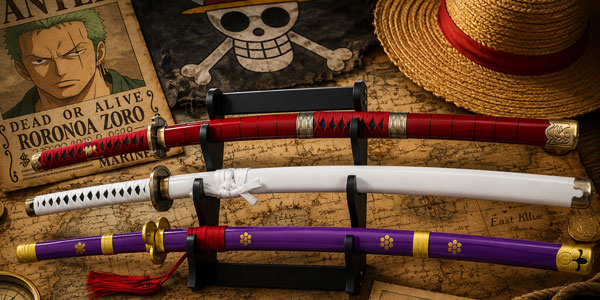
Visit Zoro's katanas are among the most iconic weapons in *One Piece*. Some of these swords have been with him since the beginning, while others have been lost, destroyed, or returned.
But above all, behind every sword lies a story. A promise made in childhood, a wager involving a cursed blade, a memorable duel, or even the legacy of a legendary samurai. All of these events help us understand Roronoa Zoro’s growth throughout his adventure.
Which lightsabers does he have now? Which ones did he wield in the past? Here is their history, the order in which they appear, and the details that make them recognizable.
Quick Answer: What are Zoro's katanas?
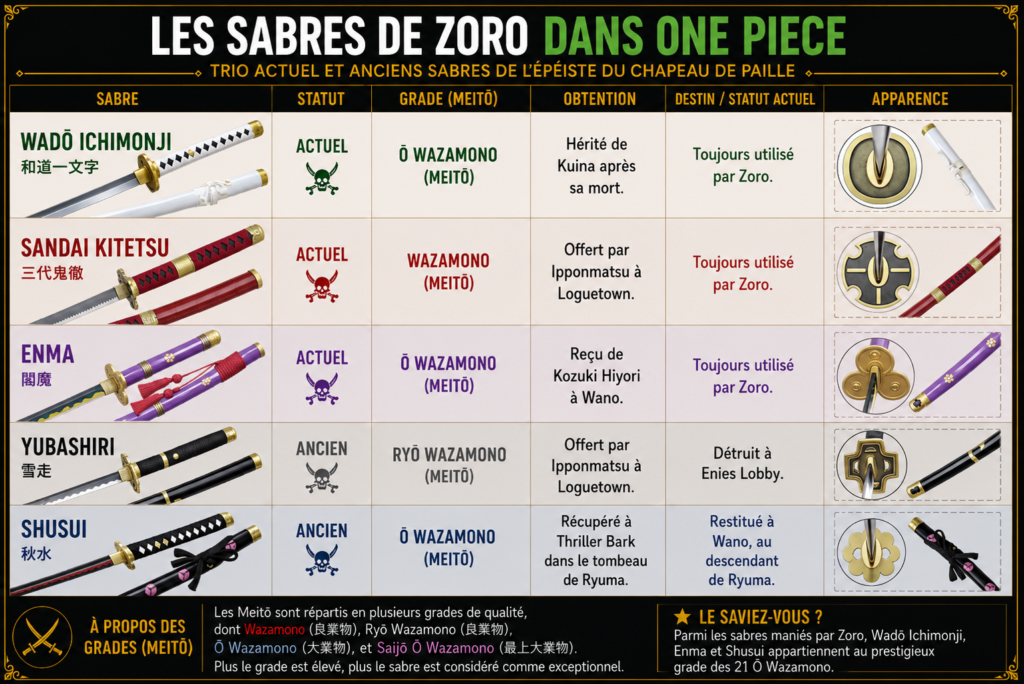
The three Zoro's katanas Those currently in use are Wadō Ichimonji, Sandai Kitetsu and Enma. However, his arsenal has evolved several times since the beginning of One Piece. Yubashiri and Shusui, in particular, played an important role in his career.
Here is a simplified timeline of these five blades:
| Katana | Status | A Place in History | Evolution | Visual cue |
|---|---|---|---|---|
| Wadō Ichimonji | Current | Before setting sail | Zoro keeps it | A white sheath with a very understated design |
| Sandai Kitetsu | Current | Loguetown | Given to him by Ipponmatsu, Zoro keeps it | Red scabbard and distinctive tsuba |
| Enma | Current | Wano | Replaces Shusui in Zoro's arsenal | Purple sheath and distinctive decorations |
| Yubashiri | Former | Loguetown | Given by Ipponmatsu, then destroyed at Enies Lobby | Black sheath and understated design |
| Shusui | Former | Thriller Bark | Returned to Wano when Zoro received Enma | Black blade and sheath decorated with pink patterns |
At Réplique Manga Ciné, our One Piece replicas are primarily intended for collection and exhibition. They allow fans to get their hands on the iconic weapons of their favorite characters. Also check out our collection of One Piece katanas, dedicated to the various blades inspired by the universe created by Eiichiro Oda.
Zoro's three current katanas and what makes them iconic
Zoro’s current trio consists of the Wadō Ichimonji, the Sandai Kitetsu, and the Enma. Yet these three swords are no accident. Each represents a significant milestone in the famous swordsman’s evolution. The Wadō Ichimonji embodies the promise he made to Kuina. Sandai Kitetsu serves as a reminder of his daring in the face of a blade reputed to be cursed. Finally, Enma symbolizes his growth in the Land of Wano and his increasing mastery of Haki. Together, these three katanas thus tell a part of Zoro’s story.
Wadō Ichimonji Sword: Zoro's Promise
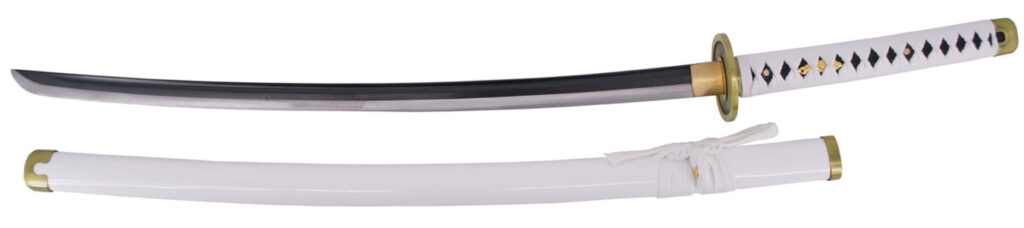
Visit Wadō Ichimonji Katana holds a unique place in Zoro's history. This blade once belonged to Kuina, his childhood friend and greatest rival. After her disappearance, Zoro received the Wadō Ichimonji from his father, Kōshirō. He thus carries with him the promise he made to Kuina: to become the world’s greatest swordsman.
Unlike the other swords in his arsenal, Zoro has never replaced the Wadō Ichimonji. The sword has therefore been with him throughout his journey since the very beginning. It also belongs to the 21 Ō Wazamono, one of the prestigious ranks among the Meitō. Finally, its white scabbard and minimalist design make it instantly recognizable. More than just a weapon, the Wadō Ichimonji thus represents the promise that has been with Zoro since childhood.
Kitetsu's Sandai Sword: Zoro's Cursed Blade
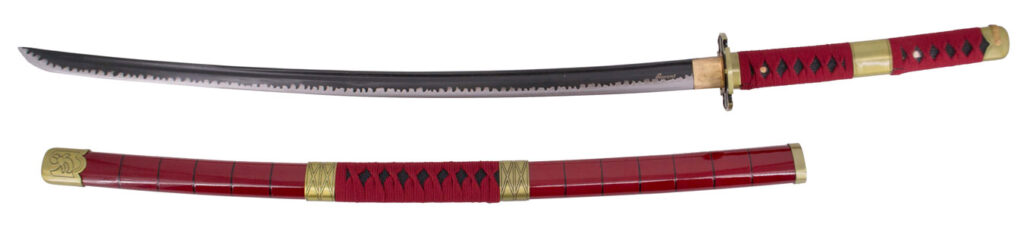
Visit Katana Sandai Kitetsu (Zoro's cursed sword) belongs to the famous lineage of the Kitetsu, said to be cursed in *One Piece*. In Loguetown, Zoro discovers the blade in Ipponmatsu’s shop. Although he is aware of its sinister reputation, he decides to test his luck against the curse.
He then threw the sword into the air and held out his arm along its path. The blade missed him, which deeply impressed Ipponmatsu. The merchant finally decided to give him Sandai Kitetsu, as well as Yubashiri. Since then, this sword has accompanied Zoro throughout much of his adventure. Visually, the Sandai Kitetsu stands out in particular for its distinctive tsuba and reddish finish.
Its history, reputation, and Zoro's temperament make it one of his most iconic swords.
Enma Sword: The Legacy of Kozuki Oden
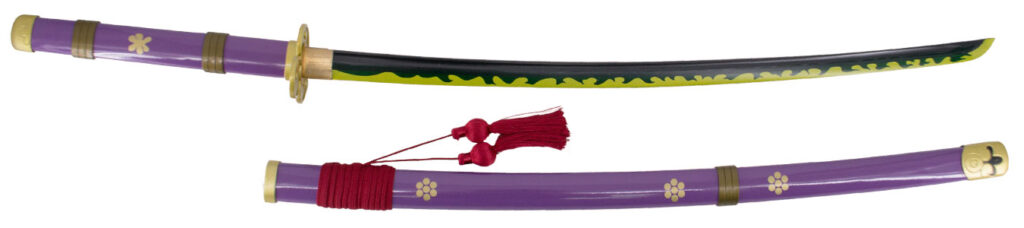
Visit Zoro's Katana Enma joins his arsenal at the Land of Wano. This blade previously belonged to Kozuki Oden, who also wielded Ame no Habakiri. After Shusui was returned to Wano, Kozuki Hiyori entrusts Enma to Zoro.
However, Enma is no ordinary blade. It releases an excessive amount of Armament Haki depending on the user and can unleash attacks far more powerful than expected. Zoro must therefore learn to control this trait rather than simply endure the blade. Mastering it becomes another important step in his evolution as a swordsman.
Like Wadō Ichimonji, Enma was forged by Kōzaburō Shimotsuki and belongs to the 21 Ō Wazamono. Its purple scabbard and distinctive decorations also make it easy to identify among Zoro's katanas.
What are Zoro's old swords, and what happened to them?
Before wielding his current trio of swords, Zoro owned several others. Among them, Yubashiri and Shusui hold a special place in his history. However, these two swords left his arsenal for very different reasons. One was destroyed in battle, while the other eventually returned to its homeland.
Yubashiri Sword: The Blade Lost at Enies Lobby
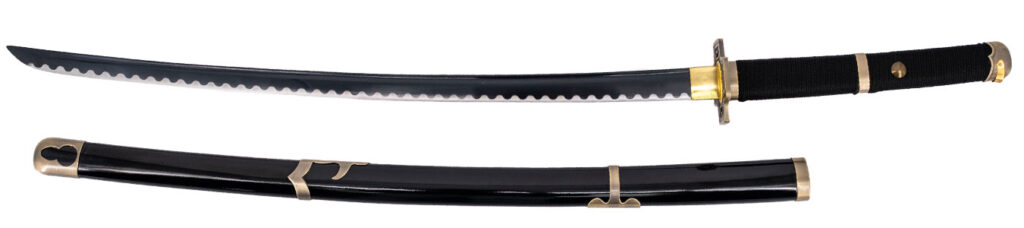
Yubashiri joined Zoro's arsenal in Loguetown. Impressed by his courage in the face of Sandai Kitetsu, Ipponmatsu decided to give him this blade. At the time, Yubashiri was a precious family heirloom belonging to the merchant.
Ranked among the Ryō Wazamono, Yubashiri then accompanies Zoro throughout several story arcs. However, his story comes to an abrupt end at Enies Lobby. The Marine captain Shu He then uses the power of the Sabi Sabi no Mi against the blade. The blade is corroded by rust and becomes unusable.
Later, Zoro pays one last tribute to Yubashiri by placing what remains of him on Thriller Bark. This disappearance explains why the saber is no longer part of his current arsenal.
Shusui Sword: Ryuma's Black Blade
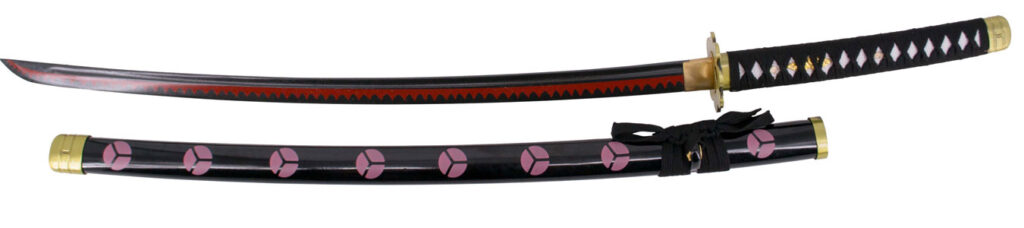
Shusui has a very different history. This famous black blade once belonged to the legendary samurai Shimotsuki Ryuma, a hero of the Land of Wano. After his death, his body and sword were stolen and later ended up on Thriller Bark.
Zoro then faces Ryuma's zombie in a memorable duel. After his defeat, Ryuma acknowledges his opponent's skill and entrusts Shusui to him. The sword thus joins Zoro's arsenal, replacing Yubashiri.
Ranked among the 21 Ō Wazamono, Shusui is also a black blade. Its dark appearance and distinctive red pattern make it instantly recognizable.
However, Shusui remains a true national treasure for the Land of Wano. Zoro finally agrees to return it. In exchange, Kozuki Hiyori entrusts Enma to him, one of the two ancient blades that belonged to his father, Kozuki Oden.
In what order does Zoro get his katanas according to the arcs?
Zoro's katanas evolve throughout his adventure. Some have been with him since the beginning, while others disappear or are added to his arsenal later on. This timeline makes it easy to track the major changes.
- The Beginning of the Adventure: Wadō Ichimonji and Two Ordinary Swords
Zoro begins his journey with the Wadō Ichimonji, which he inherited after Kuina's death. He also uses two ordinary swords, the names of which are unknown. These two blades are later broken by Mihawk during their duel at Baratie. - Loguetown: Sandai Kitetsu and Yubashiri
Zoro then needs to expand his arsenal. In Loguetown, he discovers the Sandai Kitetsu in Ipponmatsu’s shop. Impressed by his courage, the merchant ultimately gives him both the Sandai Kitetsu and the Yubashiri. - Enies Lobby: The Destruction of Yubashiri
During the battle at Enies Lobby, Yubashiri was destroyed by Shu using the power of the Sabi Sabi no Mi. Zoro, however, kept the remains of the blade for a while. - Thriller Bark: Shusui Joins Zoro's Swords
After his battle against Ryuma's zombie, Zoro receives Shusui. This famous black sword then replaces Yubashiri in his arsenal. - Wano: Shusui Hands the Reins to Enma
In the Land of Wano, Zoro agrees to return Shusui, which is considered a national treasure. Kozuki Hiyori then entrusts him with Enma, one of Kozuki Oden’s former swords.
To remember : Zoro's current trio consists of Wadō Ichimonji, Sandai Kitetsu and Enma.
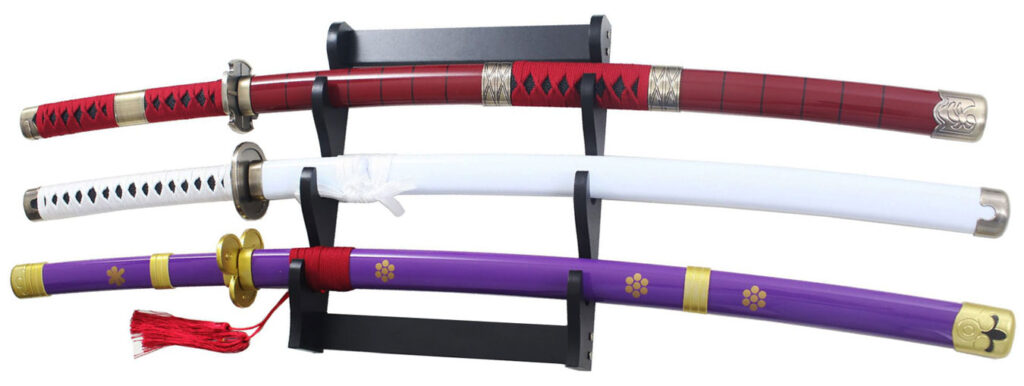
How can you tell Zoro's katanas apart from replicas?
Recognizing Zoro’s katanas becomes fairly easy once you know their main distinguishing features. The color of the scabbard is a first clue. However, the guard, the decorations, and the blade often help confirm the identification.
- Wadō Ichimonji It is instantly recognizable by its very minimalist white design. Its light-colored scabbard and hilt contrast with Zoro's other swords. Its guard is also simple and easily identifiable.
- Sandai Kitetsu has a much darker and more high-contrast appearance. Its red scabbard, gold accents, and distinctive tsuba serve as valuable identifying features.
- Enma It immediately catches the eye with its purple scabbard. Its gold embellishments and ornate guard reinforce its visual identity. This makes it easily distinguishable from the other blades in the current trio.
- Yubashiri It has a much more understated look. Its black scabbard and subtle finishes complement the overall elegance of this historic blade belonging to Zoro.
- Shusui It is certainly one of the easiest to identify. Its black blade is already a major clue. In addition, its dark sheath is decorated with distinctive pink patterns.
Would you like to put together an ensemble that stays true to the Zoro swords ? Start by choosing the time period you want to represent. Today, his trio consists of Wadō Ichimonji, Sandai Kitetsu and Enma.
On the other hand, Shusui belongs to an earlier period of his journey. As for Yubashiri, its destruction occurs even earlier in the story. It is, of course, still possible to mix these different blades in a collection. However, this choice would not reflect Zoro’s arsenal during a specific period.
Finally, be careful not to Ame no Habakiri. Despite its connection to Kozuki Oden and Wano, this sword does not belong to Zoro. It was passed down to Kozuki Momonosuke. So, to recreate Zoro's current trio, it is indeed Enma that you have to choose.
Much more than just swords
Throughout his journey, Zoro’s arsenal evolves alongside him. Each change marks an encounter, a trial, or a new milestone in his journey. Yet one thing never changes: his determination to improve and to keep the promise he made as a child.
This is undoubtedly why his weapons fascinate *One Piece* fans so much. Behind their designs lie memories, battles, and sometimes legacies steeped in history. For a collector, they therefore represent much more than just beautiful pieces to display. In their own way, they tell the story of Roronoa Zoro’s incredible journey toward his dream of becoming the world’s greatest swordsman. To continue exploring the universe created by Eiichiro Oda, check out the latest news and updates published on the One Piece official website