





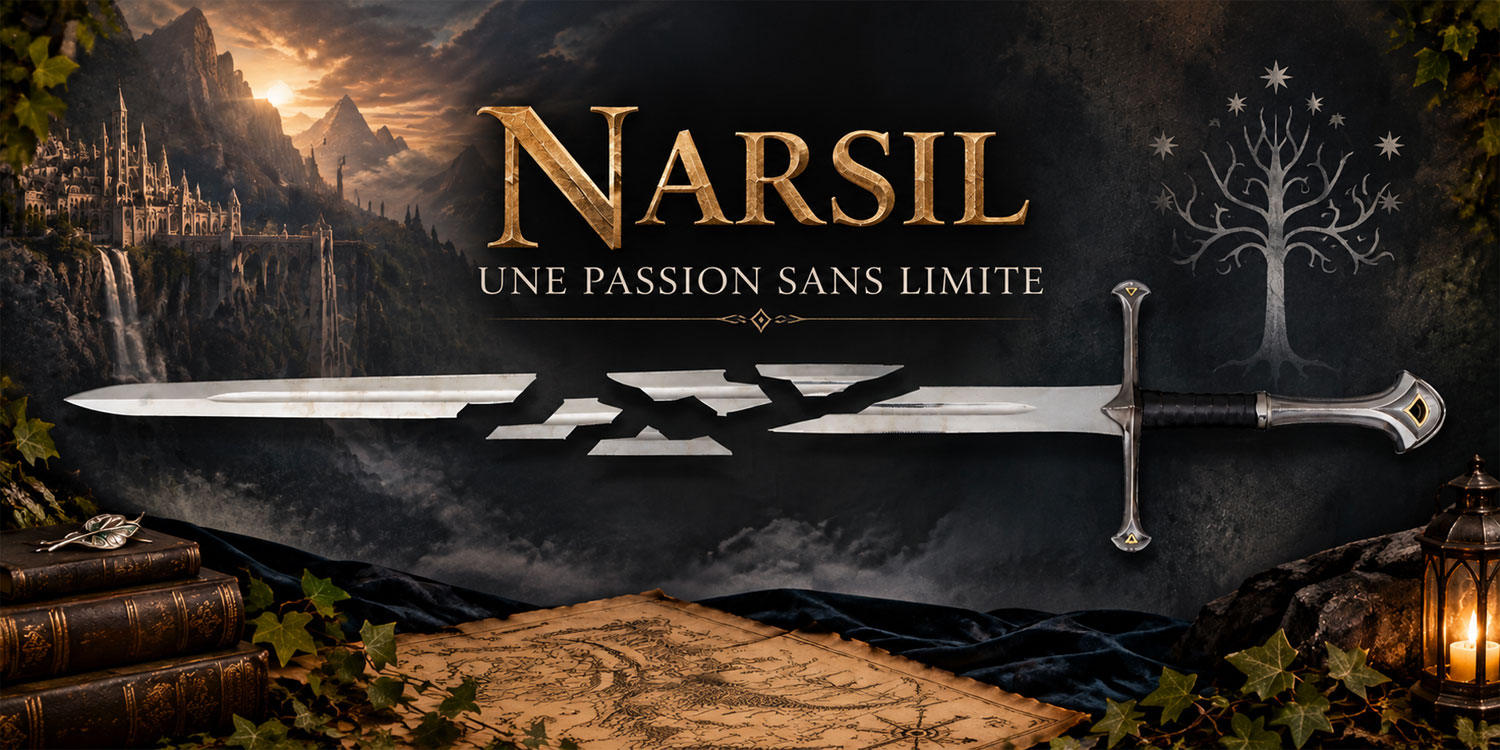
Narsil is one of the most iconic swords in *The Lord of the Rings*. Yet its history begins long before Aragorn and the War of the Ring. Forged in the First Age, it endured through the centuries before becoming Elendil’s sword. Its fate then took a turn during the Last Alliance of Elves and Men.
Although Narsil was shattered during the battle against Sauron, it did not disappear along with its owner. Its fragments became a precious heirloom, preserved and passed down through the generations. Thus, this broken blade gradually came to symbolize much more than just a lost weapon.
However, Narsil and Andúril do not refer to exactly the same sword. Andúril is the name given to Narsil after it was reforged for Aragorn. Before that happened, several thousand years of history separated its creation from its rebirth.
Who forged Narsil? How was it broken? What became of its fragments? And why does it play such an important role in the legend of Aragorn? Let’s trace the history of this sword from its origins.
Who forged Narsil? The origins of Elendil's sword
The history of this sword dates back to the ancient times of Middle-earth, likely to the First Age, several millennia before Aragorn’s birth. Telchar of Nogrod, one of the most famous Dwarf smiths, forged this blade in ancient times. Its origins thus place Narsil among the weapons inherited from a particularly ancient past.
Nogrod was one of the great Dwarf cities established in the Blue Mountains. Telchar earned an exceptional reputation there thanks to his skill as a blacksmith. Tolkien also credits him with creating other major artifacts in his legend. Among them are Angrist, the famous knife used by Beren, and the Dragon Helmet of Dor-lómin.
However, Tolkien does not specify exactly how Narsil passed from Telchar’s hands to those of Elendil. That part of its history therefore remains unknown. When the blade reappears several centuries later, it belongs to the Númenorean lord and has since been passed down through his line.
This ancient origin already gives Narsil a special significance. Even before it became a symbol for the heirs of Isildur, it had lived through several ages of Middle-earth. To learn more about the history of Narsil and its references in Tolkien’s writings, you can consult the entry dedicated to Narsil at Tolkien Gateway.
Narsil and Elendil during the Last Alliance
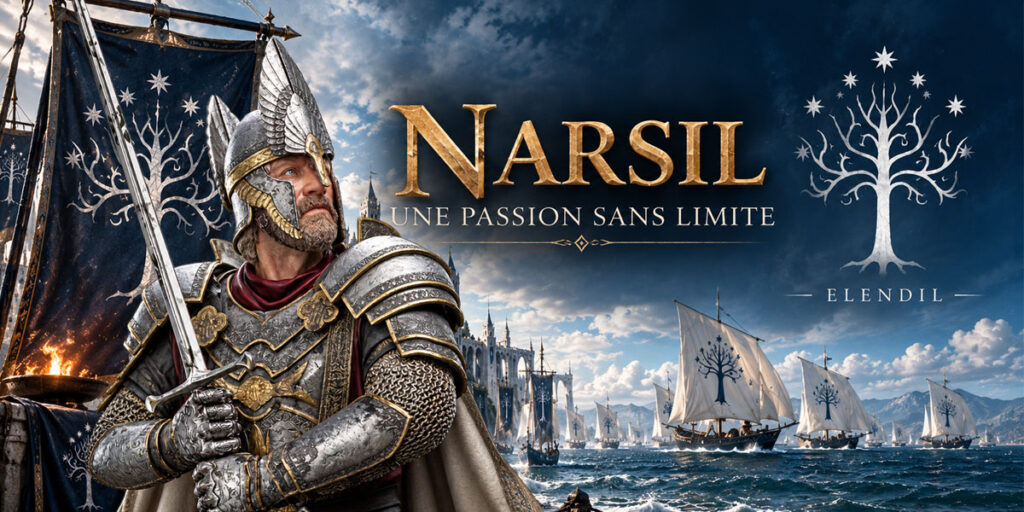
At the end of the Second Age, Narsil belonged to Elendil, founder of the kingdom of Arnor and father of Isildur. Faced with Sauron’s growing power, Elendil allied himself with Gil-galad, High King of the Noldor. Together, they formed the Last Alliance of Elves and Men.
Narsil then accompanied Elendil into battle. He carried it, in particular, during the Battle of Dagorlad, and later during the long siege of Barad-dûr. This siege lasted seven years before Sauron finally left his fortress in 3441 of the Second Age. The decisive confrontation could then begin.
Elendil and Gil-galad confront Sauron and manage to defeat him. However, both of them also die in the battle. When Elendil falls, Narsil shatters beneath his body. All that remains of the king’s famous sword are several fragments.
Yet its story does not end with Elendil’s death. Isildur, who was present during the final battle, will use what remains of the blade. This act will change the fate of Middle-earth.
💡 Did you know? Narsil doesn't break the same way in the book
The prologue to The Fellowship of the Ring made famous a scene that is absent from Tolkien’s writings. In the film, Sauron shatters Narsil with his mace after knocking Elendil to the ground. Isildur then seizes the broken blade and cuts off Sauron’s fingers. In Tolkien’s account, the story differs. Elendil and Gil-galad confront Sauron directly and manage to defeat him, but die in the battle. Narsil then shatters beneath Elendil as he falls. Peter Jackson thus transformed this episode into a much more visual and immediate scene for the big screen.
Isildur and the Broken Blade
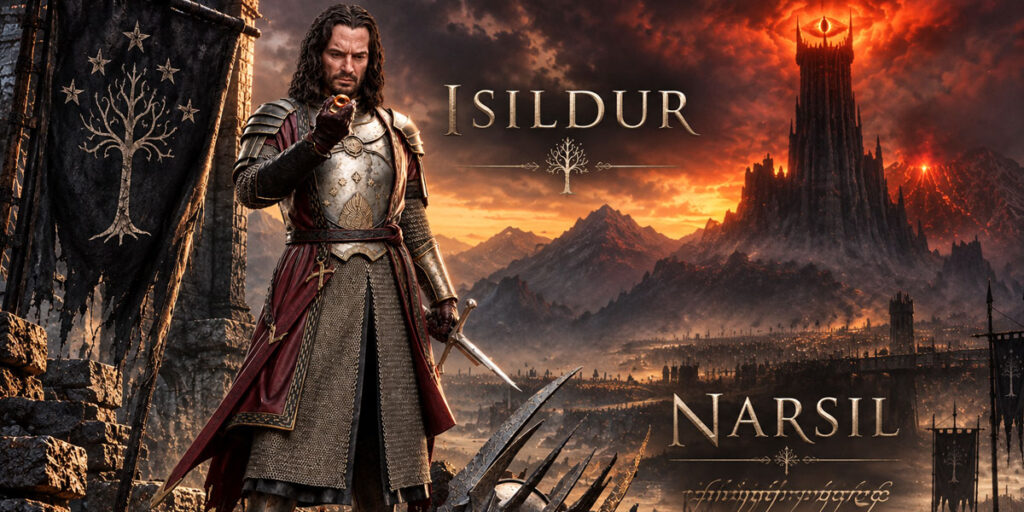
After the fall of Elendil and Gil-galad, Isildur discovered his father dead and Narsil broken. Sauron was also defeated during the battle. Isildur then seized the fragment of his father’s blade and used it to cut the One Ring from Sauron’s hand.
This act left a profound mark on the history of Middle-earth. Deprived of the Ring, Sauron lost his physical form, and his power was temporarily broken. However, Isildur decides to keep the Ring as compensation for the deaths of his father and his brother Anárion. He therefore refuses to destroy it when Elrond and Círdan advise him to get rid of it.
The blade thus takes on new significance. It is no longer merely the sword wielded by Elendil during the Last Alliance. Its broken blade is now associated with the downfall of Sauron and the fate of Isildur.
However, the sword’s story would span several more millennia. Its fragments would outlive Isildur and become one of the most precious legacies of his lineage.
What happened to the fragments after Isildur?
After the war, Isildur kept the shards of Narsil as a memento of his father. However, his own fate took a dramatic turn just a few years later. In the year 2 of the Third Age, he was ambushed by Orcs near the Fields of Irises. Isildur was killed, but the shards of Narsil escaped the disaster.
His squire, Ohtar, had been tasked with recovering the fragments of the sword. He thus managed to reach Rivendell, where he handed them over to Valandil, Isildur’s youngest son. Narsil then became part of his descendants’ legacy.
Over the centuries, this legacy has endured despite the fall of the Kingdom of Arnor and the trials endured by the line of Isildur. The fragments eventually found their way to Rivendell, where they remained under Elrond’s protection. Thus, they became a tangible testament to a vanished kingdom and a history still yet to be completed.
Much later, they would be passed on to Aragorn, Isildur’s direct heir. Narsil then found a new bearer, but remained a broken sword. Its rebirth belongs to another chapter in its history.
Why is Elendil's sword such an important symbol?
This sword holds a value that far exceeds that of a mere weapon. Broken upon Elendil’s death, it first became a symbol of a vanished kingdom. Its fragments also serve as a reminder not only of Sauron’s downfall, but also of Isildur’s failure in the face of the power of the One Ring.
For centuries, the blade remained incomplete. Yet no one simply sought to replace this sword, which had become unusable. Its fragments were preserved and passed down as a legacy. Thus, Narsil symbolizes the continuity between Elendil, Isildur, and their descendants, despite the upheavals in Middle-earth.
This aspect takes on even greater significance with Aragorn. He belongs to a lineage whose greatness now seems to be a thing of the past. However, the broken sword still bears witness to his origins and the legacy he carries.
Narsil thus embodies several ideas at once: memory, loss, transmission, and the hope of restoration. Its breaking does not, in the end, mark the end of its story. On the contrary, it signals that an ancient legacy still awaits fulfillment.
Narsil and Andúril: What's the difference?
Andúril and Narsil are closely related, but these two names refer to two different stages in the history of the same sword. Narsil refers to the blade carried by Elendil, and later to the fragments of it that were preserved after his death. Andúril is the name given to this blade after it was reforged for Aragorn.
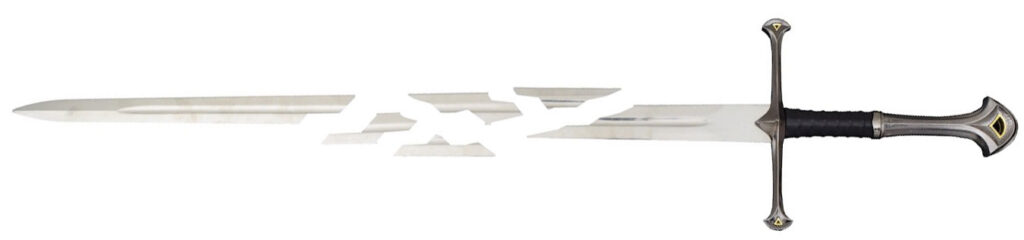
This distinction helps us better understand reproductions inspired by *The Lord of the Rings*. A broken Narsil generally represents the fragments of Elendil’s sword. A reproduction of Andúril, on the other hand, represents the restored blade intended for Aragorn.
| Narsil | Andúril | |
|---|---|---|
| Identity | Sword of Elendil | Narsil, Reforged |
| Decisive Period | End of the Second Age | End of the Third Age |
| Iconic Vehicles | Elendil and Isildur | Aragorn |
| Symbolic status | A Shattered Legacy | Restored Heritage |
| Main Meaning | Memory and Transmission | Fulfillment and Restored Kingship |
So these are not two completely different swords. The reforging transforms Narsil and opens a new chapter in its history. It is precisely this chapter that belongs to Andúril, the Flame of the West.
When does Narsil become Andúril?
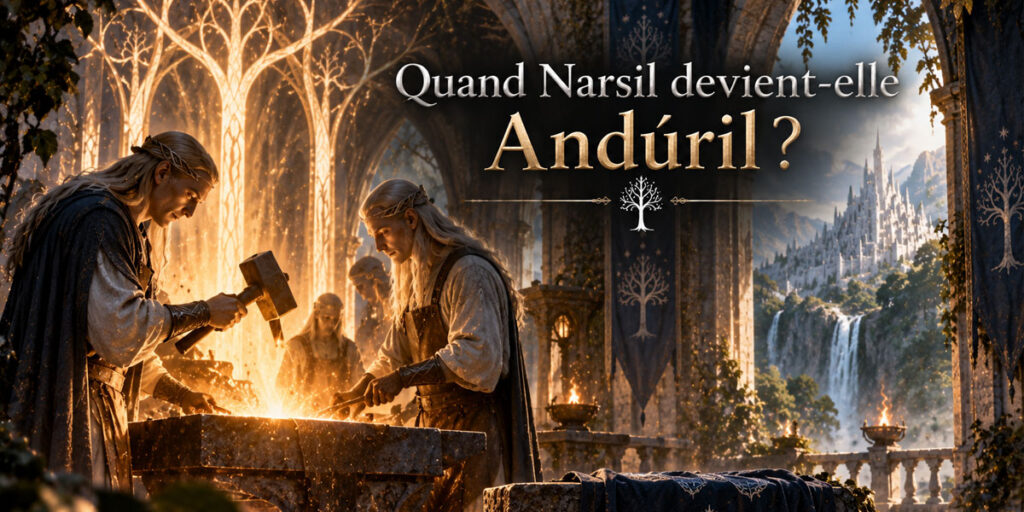
Narsil remained broken for more than three millennia. Its fate finally changed at the end of the Third Age, when the War of the Ring began. In Rivendell, the fragments that had been preserved since the time of Isildur were then reforged by the Elven smiths.
The restored blade is given a new name: Andúril, the Flame of the West. It now becomes Aragorn’s sword and marks a new chapter in the history of Elendil’s legacy.
However, Tolkien and Peter Jackson’s films do not place this reforging at the same time. In the book, Andúril is reforged before the Fellowship of the Ring sets out. In the films, Narsil remains broken for much longer, and its transformation does not take place until *The Return of the King*.
From that moment on, the story is no longer really about Narsil. It becomes the story of Andúril, its new bearer, and Aragorn’s destiny.
Why collect a replica of a broken Narsil?
Choosing a replica of a broken Narsil carries a different meaning than displaying a complete sword. Here, it’s not just a weapon from *The Lord of the Rings* that one wishes to own. It’s a specific moment in its history and everything it represents.
These fragments immediately bring to mind Elendil, Isildur, and the downfall of Sauron. They also evoke the scenes in Rivendell, where the broken sword still bears witness to a legacy dating back several millennia. As a result, a replica of Narsil has a visual identity that is very different from the other weapons in the saga.
For a collector, this unique feature also makes it possible to create a display centered on the evolution of the sword. In particular, Narsil can be displayed alongside Andúril to represent two periods of the same story: the broken legacy and the restored legacy.
At Réplique Manga Ciné, you can explore our broken replica of Narsil and recover the fragments of this iconic blade from Middle-earth.
⭐ Réplique Manga Ciné's Tip
The broken Narsil deserves to be displayed differently from a conventional sword. Rather than viewing its fragments separately, display them as the different parts of a single blade. This will immediately evoke the image of Elendil’s sword, preserved in Rivendell. If you also own Andúril, placing the two reproductions side by side can create a particularly compelling display. One represents the broken legacy, while the other symbolizes its rebirth. Two pieces, one story: for a Lord of the Rings collector, it’s hard to imagine anything more symbolic. Some enthusiasts even take the display a step further, as shown by this creation shared by one of our customers.
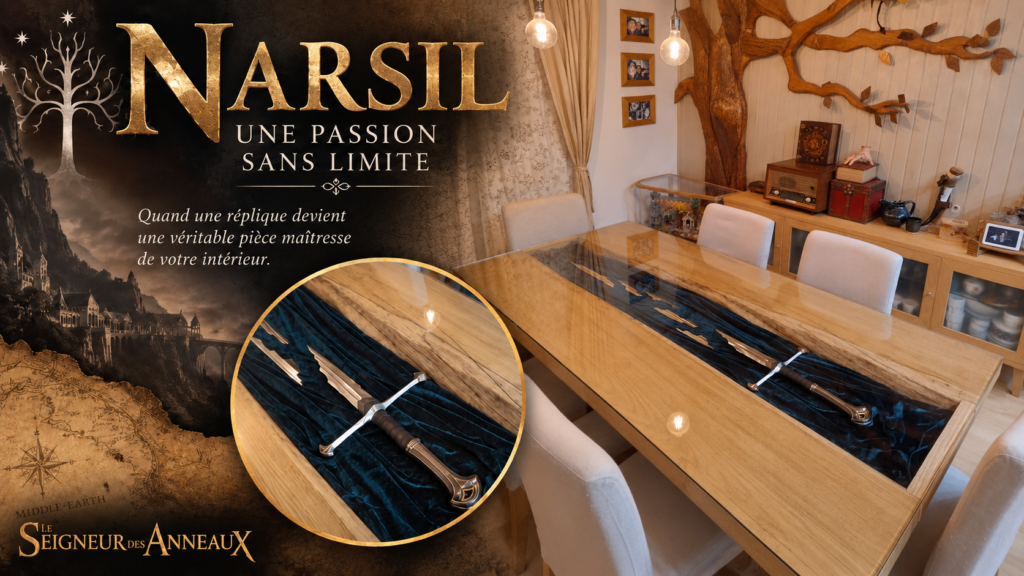
A collector's idea: One of our customers designed this display table to showcase his broken replica of Narsil. The fragments thus become a true centerpiece of the decor.
FAQ About Narsil
Is Narsil Aragorn's sword?
Narsil was originally Elendil's sword. Its fragments were then passed down through Isildur's line to Aragorn. Once reforged, the blade was named Andúril and became Aragorn's iconic sword.
Why were the fragments of Narsil preserved?
The fragments represent Elendil’s legacy and the continuity of his lineage. They have therefore been preserved for millennia, despite the disappearance of the kingdoms associated with them. They also bear witness to a history that remains unfinished.
Where are the fragments of Narsil kept?
After being saved from the disaster at the Fields of Irises, the fragments made their way to Rivendell. They were kept there for centuries, until their fate became intertwined with Aragorn’s.
Are Narsil and Andúril the same sword?
Yes. Andúril is the reforged Narsil. However, the two names refer to two different periods in its history. Narsil represents Elendil’s broken legacy, while Andúril embodies its restoration.
Who broke Narsil?
In Tolkien’s work, no one deliberately breaks Narsil. The blade shatters in Elendil’s hand when he falls during his battle with Sauron. In Peter Jackson’s film, however, Sauron strikes Narsil directly with his mace and breaks the sword.
Who forged Narsil?
Telchar of Nogrod, a famous Dwarf smith of ancient times, forged Narsil. Tolkien does not, however, specify how the sword subsequently came into Elendil’s possession.
Narsil, a broken sword that became legendary
Few weapons in Middle-earth have a history comparable to that of Narsil. Its uniqueness lies precisely in what should have marked its end: its shattering. Preserved for millennia, its fragments stand as witnesses to a legacy that time has never completely erased.
That is also what makes Narsil so fascinating today. Before it was a sword reforged and wielded by a king, it represented a story cut short, a memory preserved, and a promise yet to be fulfilled.
When its fragments are finally returned to the forge's fire, Narsil ceases to exist under its former name. Andúril can then become the stuff of legend.