How to Choose Your Sword
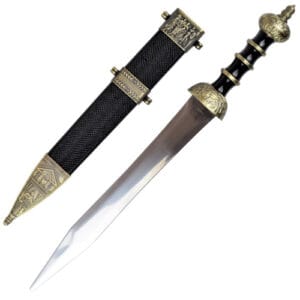
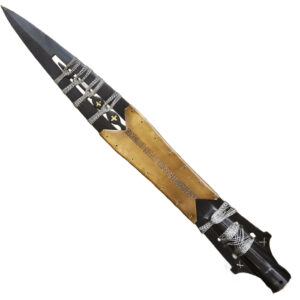
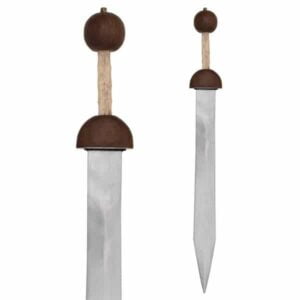
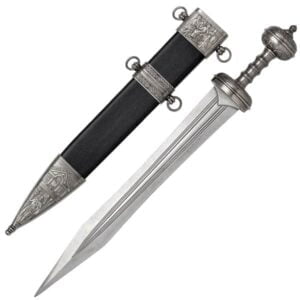
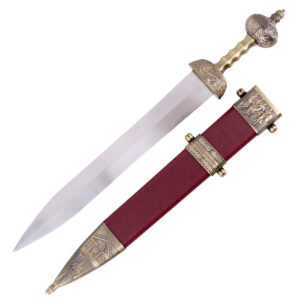
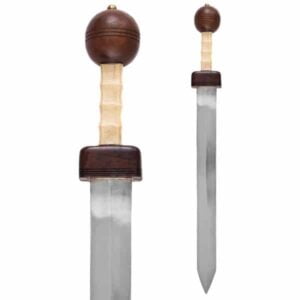
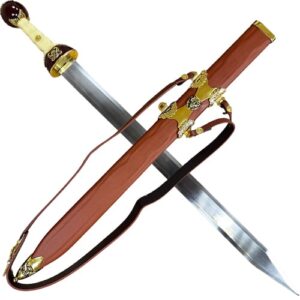
Start with the historical model. The glaive—gladius in Latin—is the short sword of Roman legionaries, and many reproductions follow a specific design. The Pompeii-style Roman sword It has a 49-cm blade, a guard and pommel made of solid wood, and a sheath lined with red leather and featuring engraved brass plates. The Roman Sword of Fulham, a Mainz-style variant, features a 54.5-cm blade and a genuine leather sheath with embossed plates. For a longer blade, the Roman cavalry spatha measures 104 cm in total length.
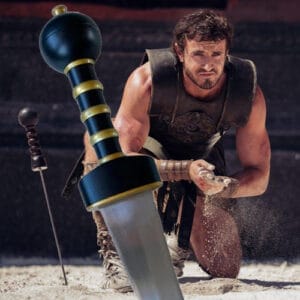
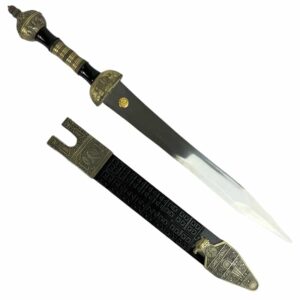
Next, check the weight and finish. The Pompeii and Fulham swords, made of carbon steel by Deepeeka, weigh between 910 g and 1.4 kg; the Roman swords with imitation Damascus blades and black or red faux-leather sheaths weigh 1.68 kg. For a compact size, the Roman gladiator dagger-sword It measures 46 cm with its sheath.
💡 Did you know?
Historians name types of gladius swords after the location where their reference specimen was found. The Pompeii type owes its name to the four gladius swords discovered in the Roman city; it is recognizable by its parallel edges and triangular tip, and is by far the most common. The Mainz type, which is older, appeared along the Empire’s frontiers in its early days.
The Must-Haves of the Collection
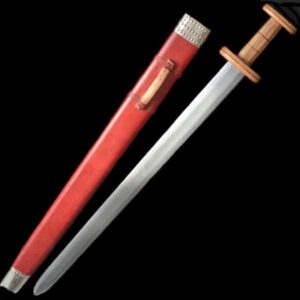
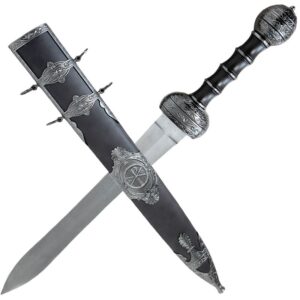
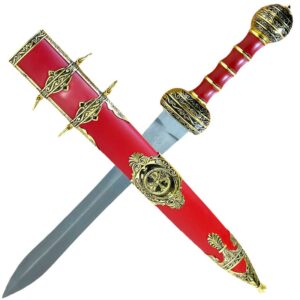
Julius Caesar's Sword, signed "Denix," is the most ornate piece in the collection: a fluted blade made of aged steel, an engraved handle, and decorative plates depicting a Roman scene and Caesar himself. It is available with a black or red sheath. Feltwell's Sword is a replica of a sword from the first half of the 5th century, with a 76-cm blade and a leather-sheathed scabbard.
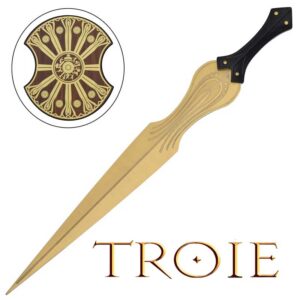
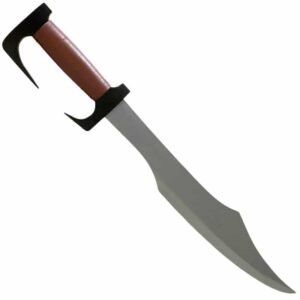
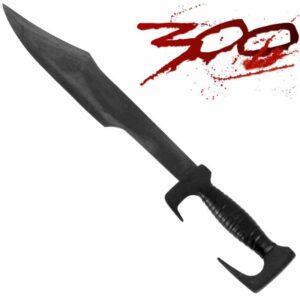
For a Greek sword, the collection is featured in a movie: Leonidas's sword from the movie 300, made of a single piece of black-bladed steel, and Achilles' sword from the movie Troy, comes with a wall mount. For a Roman shade, add one of our replicas of Roman and Greek helmets, or browse the entire collection Antique Weapons.
📜 A Moment in History
At the end of the 3rd century BCE, Rome adopted a sword inspired by that of the Celtiberians of Hispania: the gladius hispaniensis, which was in use from around 216 to 20 BCE. It was succeeded by the Mainz, Fulham, and then Pompeii types. By the end of the 2nd century and throughout the 3rd century CE, the longer spatha gradually took its place in the legions. The Feltwell sword, discovered beneath the floor of a Roman bathhouse in Norfolk, dates from the first half of the 5th century.
Displaying and Caring for Your Sword
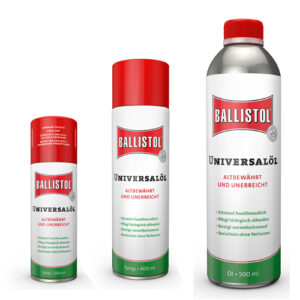
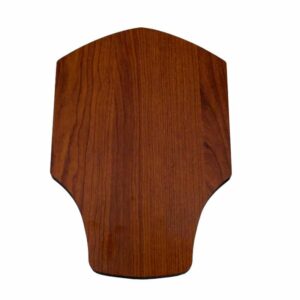
The wooden wall plaque, which comes with its own hardware, fits all sword models. Store your sword away from moisture and direct sunlight, which can damage the leather of the scabbards. Fingerprints can leave marks on steel: wipe them off with a lightly oiled cloth, such as one treated with Ballistol all-purpose oil, which is also suitable for wood and leather.
⭐ Réplique Manga Ciné's Tip
For your first piece, choose a gladius that is a faithful reproduction of a specific original, such as the Pompeii type or the Fulham gladius: this is the piece that best complements a display case dedicated to Rome. Next, add one of our antique helmets. And be sure to check the weight before choosing the mounting: it ranges from 440 g for a dagger to over 2.5 kg for Julius Caesar’s gladius.
Frequently Asked Questions
Are these Roman swords authentic?
These are contemporary reproductions, not period pieces. Some are faithful reproductions of archaeological originals, such as the Fulham sword—the original of which is housed at the British Museum—or the Pompeii-style sword. Others, such as the swords of Leonidas and Achilles, are based on models seen in movies.
What is the difference between a glaive and a spatha?
The glaive is a short sword: the blades of the Roman glaives in the collection measure between 46.5 and 54.5 cm, with a total length of 66 to 80 cm. The spatha, a cavalry sword, has a blade measuring 76 cm—like the Feltwell sword—with a total length of 90 to 104 cm.
Do the swords come with a scabbard?
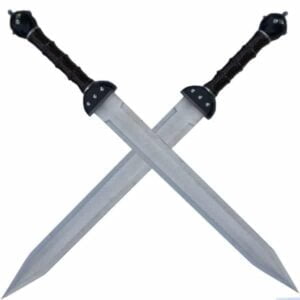
Most of them, yes: a leather-covered wooden scabbard for the Pompeii type, the spatha and the Feltwell sword, made of genuine leather for the Fulham gladius, made of faux leather for the gladiuses of Julius Caesar and Leonidas, and made of Cordura for the set of two gladiuses inspired by Spartacus.
Can you buy and carry a metal sword?
Metal replicas are restricted to adults. When transporting your sword, always keep it in its box or a carrying case; never display it in public. At trade shows and conventions, metal is usually prohibited, and sometimes even wood: replicas are generally allowed only for cosplayers during parades.
For more on the origins of the gladius and the evolution of its designs, read our article Everything You Need to Know About the Roman Sword.