



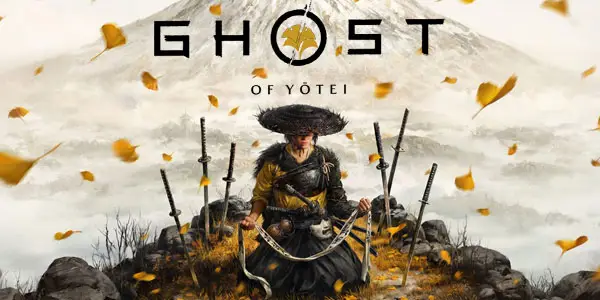
Visit Weapons of Ghost of Yōtei play a central role in Atsu’s adventure. From the very first minutes, they reflect the heroine’s personality while telling a story deeply inspired by feudal Japan. As a result, every katana, every nodachi, and every Sword Kit has its own visual identity, shaped by the wild landscapes of Ezo, Japanese beliefs, and the traditions of the ancient samurai.
Unlike many action games, Ghost of Yōtei doesn't just offer simple aesthetic changes. In fact, each weapon evokes an emotion, a natural element, or a Japanese legend. That's why the Sword Kits fascinate players and replica collectors alike.
In this guide, discover the main weapons in Ghost of Yōtei, their cultural inspirations, and the decorative replicas that let you extend the experience long after you’ve left the wilds of Ezo.
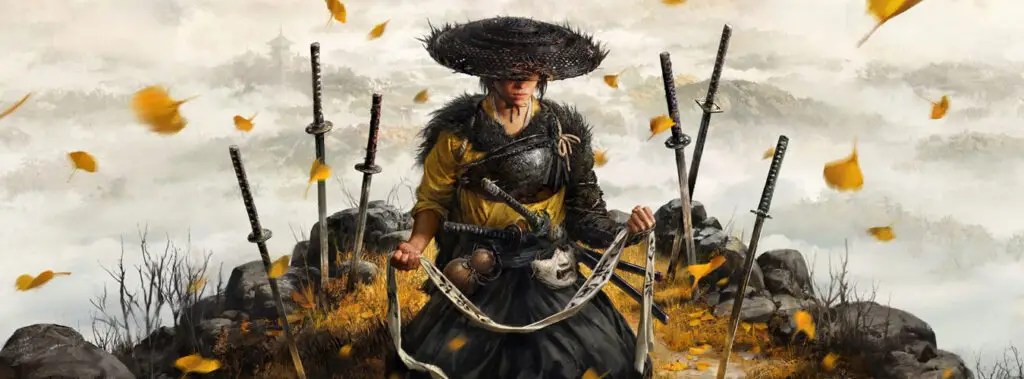
Ghost of Yōtei Weapons: A New Legacy in Samurai Games
Ghost of Yōtei builds on the legacy of Ghost of Tsushima while offering an entirely new adventure. This time, players take on the role of Atsu, a warrior exploring the vast landscapes of Ezo, the ancient island that would later become Hokkaidō.
Throughout his journey, Atsu travels through snow-capped mountains, dense forests, wave-battered coastlines, and isolated villages. As a result, these environments directly influence the design of weapons and Sword Kits.
In addition, each region has its own unique atmosphere. The developers drew inspiration from Japanese nature to create weapons that seem as though they have always been part of this world.
📜 A Moment in History
Before it became Hokkaidō, the island was known as Ezo. This region was primarily inhabited by the Ainu people, whose culture had a very strong connection to animals, mountains, and nature spirits. This influence is reflected in several elements of *Ghost of Yōtei*, particularly through the wolf, the vast open spaces, and the respect for the wild world.
Atsu: A Warrior Guided by Her Weapons
Atsu is much more than just another heroine armed with a katana. In *Ghost of Yōtei*, her arsenal is directly tied to her story and her growth. Each new weapon, therefore, marks a milestone in her journey through Ezo.
Her journey remains deeply intertwined with her family. In fact, the Wolf Blade was forged by her father, Master Kengo. As such, it represents much more than just a starting weapon; it is a family heirloom that Atsu carries with her.
In fact, the game develops this symbolism as the story unfolds. At the beginning, the Wolf Blade is equipped with the Lone Wolf Sword Kit. The lone wolf is thus a perfect fit for Atsu, who is isolated and haunted by her past.
How does Atsu's arsenal evolve in *Ghost of Yōtei*?
However, his arsenal isn't set in stone. During his journey, Atsu learns new techniques and discovers several weapons.
In particular, she has mastered the Dual Katana technique thanks to Hanbei’s instruction. This master once knew her father. Thus, even learning to fight with two swords reconnects her with her family heritage.
Atsu can also wield other types of weapons depending on the enemies he faces. This versatility profoundly changes the approach to combat. Whereas *Ghost of Tsushima* relied heavily on Jin Sakai’s stances, *Ghost of Yōtei* places greater emphasis on weapon switching.
But Atsu's evolution is also reflected in the appearance of his swords. Sword Kits allow him to transform their visual identity without altering their performance. Some are discovered during exploration. Others are directly tied to events in the story.
Ultimately, Atsu’s weapons serve almost as a travel journal. They chronicle her encounters, her lessons learned, her losses, and the bonds she is gradually rebuilding.
And that is precisely why we must distinguish between the weapon itself and the Sword Kit that equips it.
What is a Sword Kit in Ghost of Yōtei?
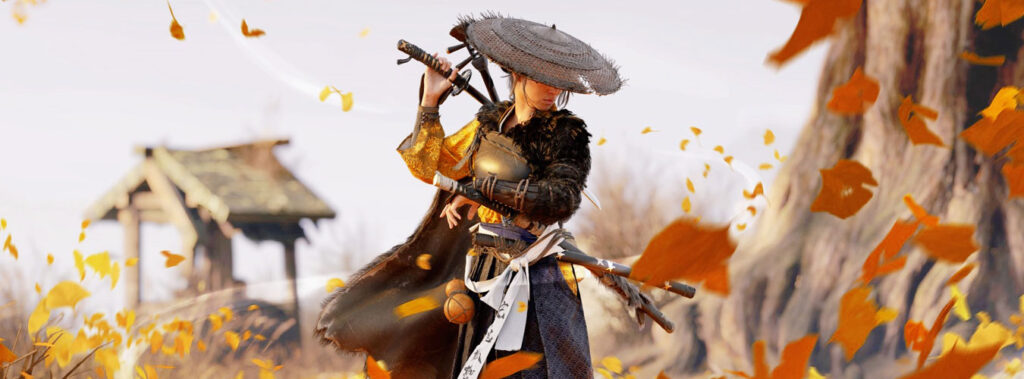
Visit Sword Kits allow you to change the appearance of Atsu's weapons. However, this is neither a new weapon nor a power boost. The purpose is primarily cosmetic.
Therefore, equipping a Sword Kit does not change your katana's damage. Nor does it increase Atsu's stats. However, it radically transforms the visual appearance of his gear.
Depending on the kit chosen, several elements may change. The scabbard features new designs, while the guard may take on a completely different shape. The handle and ornamentation also change. As a result, two configurations of the same weapon can have very different visual styles.
How do you get Sword Kits in Ghost of Yōtei?
Not all Sword Kits are unlocked the same way. That's exactly what makes collecting them so interesting.
Some rewards are earned by exploring the lands of Ezo. To do so, the player must venture off the main paths and search for specific locations. Several kits are associated with the Pillars of the Fallen, which are scattered throughout various regions.
Other skins are unlocked as the story progresses. “Twin Wolves,” for example, plays a narrative role directly tied to Atsu’s journey. “Omens of the Aurora,” on the other hand, is related to the odachi and accompanies the player’s learning process with this weapon.
As a result, searching for the various Weapon Kits encourages both exploration and progress through the adventure.
Do Sword Kits improve Atsu's weapons?
No. And this distinction deserves to be made perfectly clear.
A Sword Kit does not make a weapon more powerful. It does not change its damage or its effectiveness against certain enemies. Its purpose is to customize its appearance.
The choice therefore depends primarily on the player's preferences. You can choose the cherry blossoms in *Sakura in Moonlight*, the waves in *Aranami’s Claw*, or the wolves in *Twin Wolves*.
However, their appeal sometimes goes beyond mere decoration. Many kits also have a name, a story, or a special symbolism. They thus become small narrative fragments scattered throughout Ezo.
It is precisely this blend of customization, exploration, and storytelling that makes the Sword Kits so appealing.
The Main Weapons of Ghost of Yōtei
| Weapon | Type | Inspiration |
|---|---|---|
| Wolf Blade | Katana | Atsu's Main Weapon |
| Atsu's Dual Katana | Katana | Two-Sword Combat |
| Sakura in Moonlight | Sword Kit | Cherry Blossoms |
| Aranami's Claw | Sword Kit | Japanese Waves |
| Omens of the Aurora | Nodachi Kit | Northern Lights |
| Twin Wolves | Sword Kit | Protective Wolves |
| Gilded Dawn | Sword Kit | Imperfect Dawn, White and Gold |
| Gilded Night | Sword Kit | An Imperfect Night, Black and Gold |
The Japanese influences behind each weapon
Ghost of Yōtei doesn't choose its designs at random. On the contrary, the game's world draws heavily on Japan's landscapes, animals, and traditions. As a result, each of Atsu's weapons and Sword Kits has its own unique identity.
Cherry blossoms, in particular, evoke fleeting beauty. Waves, for their part, remind us of nature’s uncontrollable power. Wolves, meanwhile, refer to beliefs associated with the guardians of the mountains. Finally, some motifs draw their inspiration directly from the wild landscapes of Ezo.
However, these references aren't just there to make the weapons look better. Some Sword Kits also have their own backstory and their own way of being obtained. Sometimes you have to explore a specific region, discover a Pillar of the Fallen, or deliberately stray from the main quest.
That's exactly what makes their quest so exciting. Behind every appearance, there's sometimes a piece of history waiting to be discovered by the player.
Let's take a closer look at each weapon and Sword Kit, what they mean, and—most importantly—how to obtain them in Ghost of Yōtei.
Sakura in Moonlight: The Elegance of the Cherry Blossom Under the Moon
Among the many Sword Kits in *Ghost of Yōtei*, *Sakura in Moonlight* stands out for its delicate aesthetic. Yet behind its cherry blossoms lies a much less peaceful story.
This Sword Kit is associated with Lord Itakura. The accompanying text explains that he served his clan while passing on his knowledge to his men. However, his final lesson was neither about swordsmanship nor a combat technique. It was about loyalty.
This short story adds another dimension to the kit. Indeed, *Sakura in Moonlight* isn’t just about the beauty of cherry blossoms. It also evokes honor, tradition, and loyalty to those we have chosen to serve.
Its name is an integral part of this atmosphere. In Japan, cherry blossoms are particularly associated with the fleeting nature of life. Their spectacular bloom lasts only a few days. Thus, their beauty also serves as a reminder that everything eventually fades away.
Combined with the moonlight, they give *Sakura in Moonlight* an almost melancholic feel. The Sword Kit thus becomes much more than just a cosmetic change for Atsu’s katana.
How do you get Sakura in Moonlight in Ghost of Yōtei?
To obtain Sakura in Moonlight, the player must explore the Oshima Coast region and discover the Pillar of the Fallen associated with the Sword Kit.
So it isn't automatically obtained during the main story. Instead, it rewards players who explore the open world and take the time to search for the various Pillars of the Fallen.
Once unlocked, Sakura in Moonlight can be equipped as a Sword Kit. It changes the appearance of Atsu’s weapon but does not improve its damage or stats. It is primarily a cosmetic customization.
This distinction is worth clarifying. In fact, a player searching for «how to get Sakura in Moonlight» might easily think they’re discovering a new weapon. In reality, the Sword Kit customizes the existing weapon without changing its performance.
What does the text on the "Sakura in Moonlight" Sword Kit say?
The section on Lord Itakura is intentionally very short. However, it conveys a great deal in just a few lines.
His role as a teacher initially suggests a man tasked with passing on his experience. However, his «final lesson» focuses on loyalty. This phrasing therefore leaves considerable room for interpretation.
It can refer to loyalty to a lord, a clan, or one’s companions. But it also reflects one of the major themes of *Ghost of Yōtei*: what each person is willing to sacrifice for their beliefs and for the people they care about.
It’s precisely this kind of detail that makes the Weapon Kits so interesting. Not all of them tell a grand story, but some serve as small fragments of the past scattered throughout Ezo.
Why do cherry blossoms go so well with this Sword Kit?
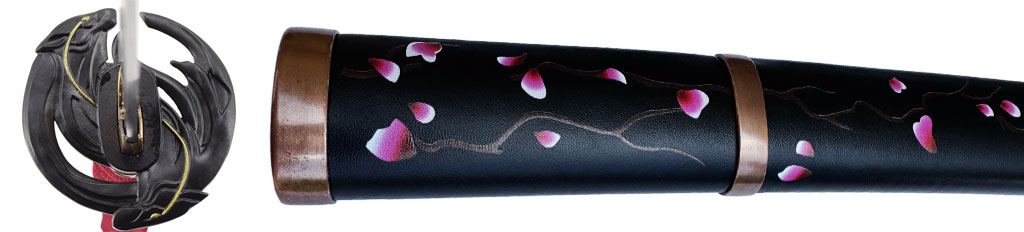
The choice of the sakura is probably not coincidental. In Japanese culture, the cherry blossom symbolizes, among other things, fleeting beauty and the passage of time.
This symbolism fits particularly well with the world of *Ghost of Yōtei*. The characters live in a world marked by violence, loss, and memories. Yet the landscapes are often breathtaking.
"Sakura in Moonlight" plays precisely on this contrast: the beauty of a fragile flower applied to a weapon designed for combat.
That's also what makes this Sword Kit so recognizable among the many customization options available in the game.
The "Sakura in Moonlight" replica is available at Réplique Manga Ciné
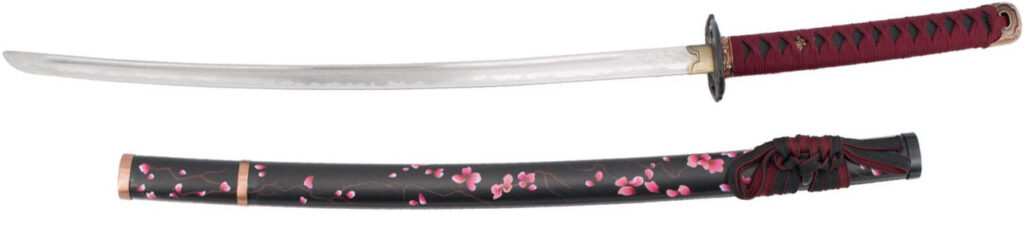
Did you discover "Sakura in Moonlight" while exploring Ezo? You can also experience this aesthetic outside the game with our replica of the "Sakura in Moonlight" katana.
It incorporates the Sword Kit’s key visual elements to make it a true collector’s item. It thus allows you to extend the world of Ghost of Yōtei into a gaming room, a display case, or a collection dedicated to Japanese weapons.
Check out our replica Katana Sakura in Moonlight.
Aranami’s Claw: The Power of Japanese Waves
After the delicate atmosphere of *Sakura in Moonlight*, *Aranami’s Claw* takes a radical turn. Here, *Ghost of Yōtei* evokes a much wilder natural setting. Its name immediately sets the tone: *aranami* (荒波) refers to rough or raging waves.
Thus, this Sword Kit evokes the power of the sea surrounding Ezo. It also evokes a force that cannot be contained. Unlike cherry blossoms, its aesthetic therefore suggests neither fragility nor contemplation. Rather, it conveys the movement, resilience, and violence of the elements.
This inspiration fits perfectly with the world of Ghost of Yōtei. Indeed, Atsu travels through landscapes where nature plays a role almost as important as the characters. The mountains, snow, wind, and ocean are constant elements of the game’s visual identity.
Aranami’s Claw transforms Atsu’s katana without altering its abilities. Like the other Sword Kits, it is primarily a cosmetic customization of the weapon. However, its appearance allows the player to give their sword a much more aggressive look.
How do you get Aranami’s Claw in Ghost of Yōtei?
Aranami’s Claw is one of the Weapon Kits to discover in Ghost of Yōtei. So don’t confuse it with a new weapon or an upgrade to the katana. Once obtained, the kit lets you change the appearance of the corresponding weapon while retaining its combat stats. GameTrek actually classifies it directly among the game’s Weapon Kits.
Who is Master Kujii, the character associated with Aranami’s Claw?
Master Kujii is directly linked to the story of Aranami’s Claw. The short text accompanying this Weapon Kit paints a portrait of a man whose character is as strong as his fighting style.
In particular, he is described as a master whose words knew no bounds and whose technique was particularly tenacious. However, the mention of Lord Saito lends a much more serious tone to his story. Neither his outspokenness nor his talent seemed to waver in the face of Lord Saito.
The final part of the text becomes even more evocative. It suggests that Master Kujii now rests where the water continues to flow. This reference naturally creates a connection to the name “Aranami’s Claw” and its aquatic world.
Thus, the waves featured in this Sword Kit may not be purely decorative. They can also be seen as an echo of Kujii’s fate: a tenacious force, facing a formidable opponent, only to be ultimately swept away as the water continues on its path.
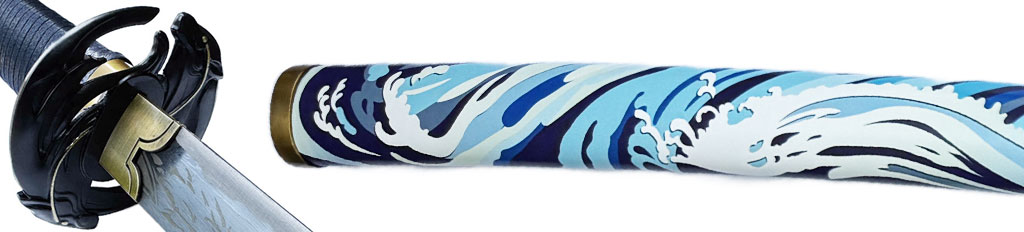
Why do waves play such an important role in Japanese art?
The wave is one of the most recognizable motifs in Japanese art. Yet it does not merely represent the sea. It can also evoke power, movement, and a force of nature that humans can never fully control.
The most famous example is, of course, Katsushika Hokusai’s *The Great Wave off Kanagawa*. However, depictions of waves existed long before this work. They appear, in particular, in Japanese decorative arts in various stylized forms.
In *Ghost of Yōtei*, this symbolism works particularly well. Atsu is making her way through a harsh and unpredictable landscape. She must therefore adapt, persevere, and keep going despite the obstacles.
Ultimately, Aranami’s Claw is more than just a pretty wave design on a katana. Its name and aesthetic evoke a force in motion. That is precisely what gives it a personality so different from Sakura in Moonlight.
The Aranami’s Claw replica is available at Réplique Manga Ciné
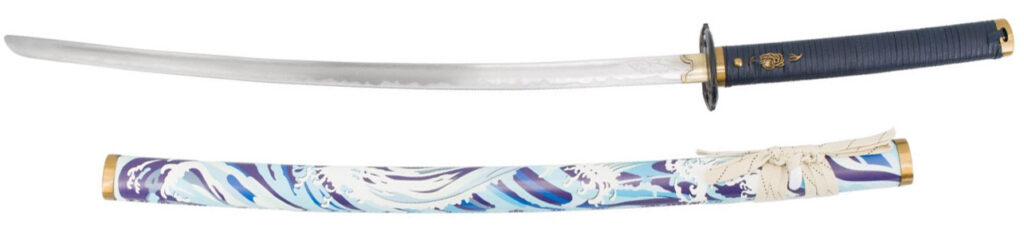
Did you discover Aranami’s Claw while exploring Ezo? Now experience the full character of this Sword Kit with our replica of the Aranami’s Claw katana.
Its design incorporates the visual elements that make this weapon instantly recognizable. As a result, this replica extends the *Ghost of Yōtei* experience far beyond the screen. It will naturally find its place in a gaming room or as the centerpiece of a collection dedicated to Japanese swords and video game weapons.
Furthermore, after learning about Master Kujii’s story and the symbolism of the waves, the details of the replica take on a whole new meaning. It is no longer just a katana with a spectacular design. It also evokes the power, movement, and tenacity associated with Aranami’s Claw in the game’s universe.
Discover our Katana Aranami's Claw.
Omens of the Aurora: When the Skies of Ezo Meet the Odachi
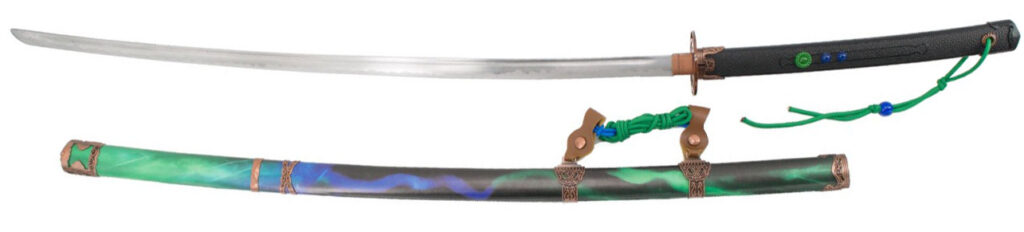
With *Omens of the Aurora*, *Ghost of Yōtei* leaves behind the delicate flowers of *Sakura in Moonlight* and the turbulent waves of *Aranami’s Claw*. This time, the focus turns to the sky and the luminous phenomena that light up the northern lands.
Most importantly, Omens of the Aurora has one key feature: it’s not a Sword Kit designed for Atsu’s katana. It’s an Odachi Kit. This means it lets you customize the appearance of this imposing Japanese weapon without altering its performance or stats.
His in-game text is extremely short: it refers to a celestial battle and a blessed path. Just a few words, but it paints a particularly powerful picture.
The name *Omens of the Aurora* reinforces this almost mystical aspect. The lights in the sky thus become signs to be interpreted, while the odachi seems to guide Atsu down a new path.
As such, this kit doesn't tell the specific story of a former owner. Instead, it serves more as an evocation of fate, the sky, and the journey. This distinction gives it a very unique character among the game's Weapon Kits.
How do you get "Omens of the Aurora" in Ghost of Yōtei?
Unlike many of the Sword Kits hidden throughout the world of Ezo, *Omens of the Aurora* cannot be obtained from a Pillar of the Fallen.
Earning it is directly tied to Atsu's progress.
During the main quest "The Saito Brothers," the player must complete "The Way of the Odachi." Upon doing so, the player obtains "Omens of the Aurora.".
This approach is particularly consistent. In fact, the kit is specifically designed for the odachi. The game thus combines the discovery of a new combat style with a new visual identity for the weapon.
For a player who is only looking for the answer:
➡️ You can obtain "Omens of the Aurora" by completing "The Way of the Odachi" during the main quest "The Saito Brothers.".
What is the difference between an odachi and a katana?
The katana is designed to have a relatively maneuverable blade suitable for a variety of situations. The odachi, on the other hand, is historically distinguished by its much larger size.
Its long blade calls for a different fighting style. The reach is greater, while the movements require a wider range of motion. Visually, the weapon also has a much more imposing presence.
In *Ghost of Yōtei*, this difference primarily allows for a variety of combat styles available to Atsu. *Omens of the Aurora* specifically equips this odachi, not his main katana.
This distinction is also important for collectors. A replica odachi naturally has a much more spectacular silhouette than a traditional Japanese sword. It therefore requires more space when on display.
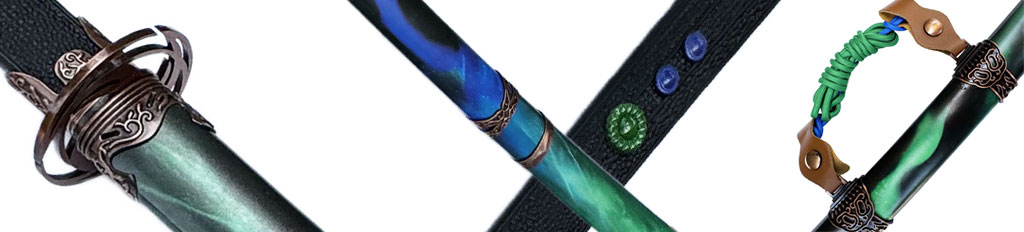
What does «A celestial battle. A blessed path.» mean?
The text associated with *Omens of the Aurora* remains deliberately mysterious. It simply links two ideas: a clash in the heavens and a path marked by a favorable sign.
We can therefore see this as a contrast between chaos and hope. On one side is the battle. On the other, a path forward emerges.
The word «Omens» reinforces this interpretation. A phenomenon observed in the sky can become a sign foretelling future events. The aurora is thus no longer merely a natural spectacle: it symbolically accompanies Atsu’s journey.
This interpretation is deliberately cautious. However, it fits perfectly with the visual poetry of *Ghost of Yōtei*, in which the landscapes constantly contribute to the story’s atmosphere.
Why does the dawn fit so well with the landscapes of *Ghost of Yōtei*?
The world of *Ghost of Yōtei* draws inspiration from the landscapes of northern Japan and the ancient region of Ezo. The vast open spaces, mountains, snow, and spectacular skies play a major role in shaping its identity.
With *Omens of the Aurora*, the sky becomes the very theme of the weapon.
The "Omens of the Aurora" replica is available at Réplique Manga Ciné
Did you acquire this Odachi Kit during your adventure with Atsu? You can also find *Omens of the Aurora* as an impressive decorative replica.
Its size, in particular, highlights what immediately sets the odachi apart from the katana: a spectacular presence and a particularly long blade. It is thus a prime choice for extending the world of Ghost of Yōtei beyond the game.
Discover our Nodachi: Omens of the Aurora.
Twin Wolves: Two Wolves, a Family Story
Among the Sword Kits in *Ghost of Yōtei*, Twin Wolves holds a particularly personal significance. Its story isn't just about its appearance; it's directly tied to Atsu, his brother, and their father.
The text included with the kit explains that this blade was forged by Atsu’s father to protect his family. This gives the two wolves their full meaning. They represent a brother and sister finally reunited, transforming the animal motif into a true family symbol.
This symbolism becomes even more powerful when compared to Lone Wolf, the Sword Kit associated with Atsu at the beginning of his adventure. The transition from the lone wolf to the two wolves thus marks a significant development in his story.
Twin Wolves is therefore not only one of the most visually striking Sword Kits; it also embodies the family ties that play a central role in Atsu’s journey.
How do you get Twin Wolves in Ghost of Yōtei?
Unlike *Sakura in Moonlight* or *Aranami’s Claw*, *Twin Wolves* isn’t revealed through a Pillar of the Fallen.
The Sword Kit is directly tied to the story's progression. Players unlock it during the main quest, "The Oni.".
Obtaining it therefore has a special narrative dimension. Here, no further exploration is needed to discover a hidden location. The game gives Twin Wolves back to the player just as its story truly comes into its own.
Once obtained, the kit allows you to change the appearance of the Wolf Blade. Like the other Sword Kits, it is purely cosmetic and does not alter the weapon's stats.
What's the difference between Lone Wolf and Twin Wolves?
To understand *Twin Wolves*, you need to go back to *Lone Wolf*, which is available from the very beginning of the adventure.
Lone Wolf's blade was forged by Atsu's father. However, its original saya was lost during the Night of the Burning Tree. The scabbard used afterward was therefore a replacement made after that event.
The name «Lone Wolf» fits Atsu perfectly at the start of her journey. She moves forward alone, haunted by her past and driven by her quest.
With *Twin Wolves*, this image is changing.
The lone wolf gives way to two wolves. The text in the kit then describes a brother and sister reunited. This transformation gives the change in appearance real narrative significance.
Thus, *Lone Wolf* and *Twin Wolves* can be viewed as two stages of the same story. The first depicts Atsu’s isolation. The second places the family back at the center of the narrative.
Why does the wolf hold such strong symbolic significance in Japan?
The Japanese wolf, or ōkami, holds a special place in certain Japanese traditions. Far from being viewed solely as a predator, it has also been seen as a protector.
In certain belief systems, wolves were associated in particular with mountains and forests. They were believed to protect travelers and crops from certain wild animals.
This protective theme takes on special significance in *Twin Wolves*. Atsu’s father forges his blade to protect his family. Furthermore, the two wolves come to symbolize the renewed bond between a brother and a sister.
The choice of the wolf, then, has multiple layers of meaning. It evokes strength and independence, but also protection and the bonds that unite a family.
In *Ghost of Yōtei*, this symbolism ultimately turns the animal into the central thread of Atsu's story.
The Twin Wolves replica is available at Réplique Manga Ciné
Did you unlock Twin Wolves during your adventure? Our replica lets you experience this particularly symbolic weapon outside the game.
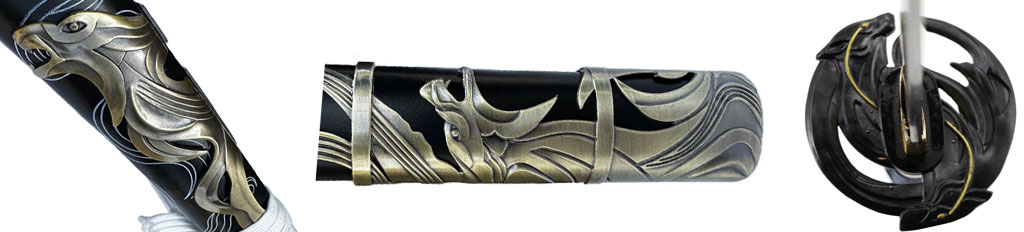
Its design naturally puts wolves front and center. The guard itself is shaped like a wolf, while the scabbard features two imposing metal pieces depicting the animal. The steel blade also reflects this theme through its engraving.
These details take on added significance when you know the history of the Sword Kit. The two wolves are no longer merely a decorative choice. They serve as a direct reminder of the brother, the sister, and the legacy left by their father.
With its imposing presence and numerous metal elements, this reproduction is a particularly interesting piece for a collection dedicated to Ghost of Yōtei.
Discover our Katana Twin Wolves.
Wolf Blade: Atsu's Father's Legacy
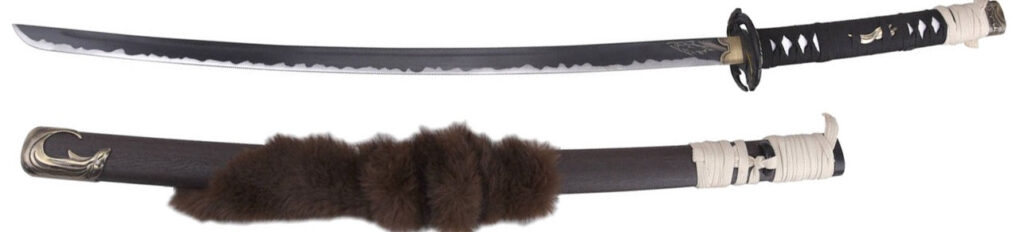
Before the Twin Wolves comes the Wolf Blade. This weapon holds a special place in *Ghost of Yōtei*, as it has been with Atsu since the very beginning of his adventure. It is therefore not merely a sword chosen for battle; it is one of his last tangible connections to his family and his past.
The blade was forged by Atsu's father. Its primary purpose was clear: to protect his family. This family heritage immediately sets the Wolf Blade apart from the weapons discovered later on the journey.
At the start of the game, she appears with the Lone Wolf Sword Kit. Her name, «Lone Wolf,» perfectly captures Atsu’s situation. Haunted by the events of her childhood, she travels through Ezo alone, pursuing those who destroyed her family.
As such, the Wolf Blade is about much more than just battle. It carries with it a legacy, memories, and the very reason that drives Atsu forward.
How do you get the Wolf Blade in Ghost of Yōtei?
Good news for players who want to use this weapon: you don't have to go looking for it in Ezo.
The Wolf Blade is available to Atsu from the very beginning of his adventure. This means the player has access to this weapon without having to discover a Pillar of the Fallen or complete a specific side quest.
Next, its appearance can be customized using the various Sword Kits available in the game.
At the start, the Wolf Blade comes equipped with the Lone Wolf kit. Later on, the player can unlock Twin Wolves as the story progresses.
This distinction is important. "Wolf Blade" refers to the weapon, while "Lone Wolf" and "Twin Wolves" are skins that depict different moments in Atsu's story.
What is the story behind Lone Wolf?
Lone Wolf's story is closely tied to that of the Wolf Blade.
While the blade itself is indeed the work of Atsu’s father, not all of its accompanying parts survived the events intact. Its original saya—that is, its scabbard—was lost during the Night of the Burning Tree.
So the one Atsu uses next is a replacement that was put together after that tragic night.
This detail may seem minor. Yet it reveals a great deal about the weapon. The Wolf Blade isn’t preserved as a family heirloom that has remained intact for years. It physically bears the marks of what happened to Atsu.
The blade remains. The sheath, however, is gone.
The name "Lone Wolf" takes on even greater meaning. Like her weapon, Atsu presses on despite what she has lost.
Why is the transition from Lone Wolf to Twin Wolves so important?
Both "Lone Wolf" and "Twin Wolves" use the wolf as a symbol. However, their meanings are profoundly different.
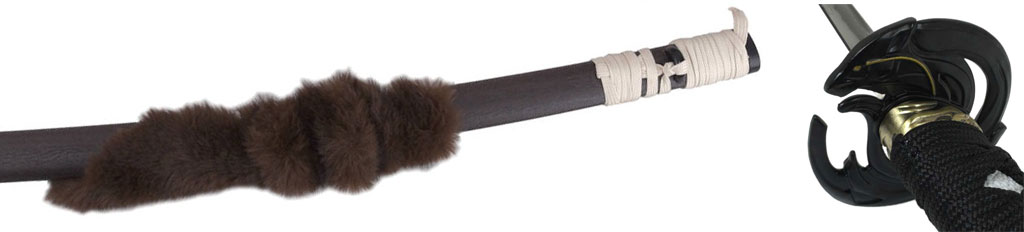
Lone Wolf is Atsu all by herself. At the start of her journey, she carries a blade she inherited from her father, but she moves forward burdened by the loss of her family.
"Twin Wolves" depicts another stage. The two wolves represent a brother and sister reunited. The image of the solitary animal thus gradually gives way to that of a bond restored.
That’s what makes the evolution of the Wolf Blade particularly interesting. The game doesn’t just tell Atsu’s story through dialogue or cutscenes. The appearance of his weapon also plays a part in this narrative.
Players can thus view *Lone Wolf* and *Twin Wolves* as two chapters of the same story: first, loneliness; then, the restoration of family bonds.
The Wolf Blade replica is available at Réplique Manga Ciné
The Wolf Blade will particularly appeal to players who are drawn to Atsu’s personal story. Unlike the Sword Kits found during exploration, this weapon has been with the heroine since the very beginning of her journey.
Our reproduction captures the aesthetic of this iconic blade, allowing collectors to extend the world of *Ghost of Yōtei* beyond the screen.
It takes on even greater meaning when displayed alongside *Twin Wolves*. Together, the two pieces represent two different moments in Atsu’s journey: the lone wolf at the start of the adventure and the two wolves symbolizing the rediscovered family bond.
Discover our Katana Wolf Blade.
Dual Katana: When Atsu Learns to Fight with Two Swords
The Dual Katana marks an important milestone in Atsu's evolution. For the first time, the warrior no longer fights with a single blade. She learns to wield two katanas simultaneously, which transforms her fighting style and opens up new possibilities when facing certain opponents.
However, this technique isn’t mastered right from the start of *Ghost of Yōtei*. Atsu must set out to meet Hanbei, the master of the Dual Katana who lives on the slopes of Mount Yōtei. Hanbei, in fact, knows Atsu’s family history personally.
Hanbei was a friend of Master Kengo, Atsu’s father. Master Kengo was a talented blacksmith who had forged Hanbei’s second katana. Thus, Atsu’s training is not merely about acquiring a new weapon; it also forges a new connection to the legacy left by his father.
After several days of training, Atsu gradually learns to coordinate his two blades. This skill then becomes an integral part of his arsenal.
How do you get the Dual Katana in Ghost of Yōtei?
The Dual Katana is obtained by completing the quest “The Way of Dual Katana,” which becomes available after the prologue. The player must meet Hanbei on the slopes of Mount Yōtei to receive his training.
Learning isn't just about retrieving two swords. Hanbei puts Atsu through rigorous training so she can learn to use this new technique properly.
Upon completing the quest, the Dual Katana is permanently unlocked in Atsu’s arsenal. The player also gains Tempest Strike, a move consisting of a series of rapid attacks that culminates in a particularly powerful, unblockable strike.
To obtain the Dual Katana, complete "The Way of Dual Katana" with Hanbei on Mount Yōtei.
What is the Dual Katana used for in Ghost of Yōtei?
In Ghost of Yōtei, the various weapons aren't just there to add variety to the animations. The combat system encourages players to adapt their equipment to the type of opponent they're facing.
The Dual Katana is particularly effective against enemies wielding polearms, especially the yari and the naginata. The speed of the two blades allows Atsu to put more pressure on these fighters.
This mechanic clearly sets *Ghost of Yōtei* apart from *Ghost of Tsushima*. Whereas Jin Sakai mainly adjusted his stances, Atsu has several specialized weapons she can use depending on the situation.
The Dual Katana is therefore as much an aesthetic choice as it is a genuine tactical tool. When mastered, it above all enables a much faster and more spectacular fighting style.
Who is Hanbei, the master of the Dual Katana?
Hanbei is the person from whom Atsu learns how to wield two swords. However, their relationship doesn't start out simply as that of a master and student.
Hanbei has a history with Master Kengo, Atsu’s father. The two men were friends, and Kengo had forged the second katana used by Hanbei. This connection explains, in particular, why the master ultimately agrees to pass on his technique to the young warrior.
His story is also connected to Lord Saito. Hanbei once faced this opponent and lost an arm during their battle. Despite this, his expertise is still extensive enough to allow Atsu to learn his technique.
Later, when she, in turn, faces Lord Saito, he even recognizes Hanbei’s teachings in her fighting style.
Thus, the Dual Katana connects several generations: Hanbei, Master Kengo, and finally Atsu.
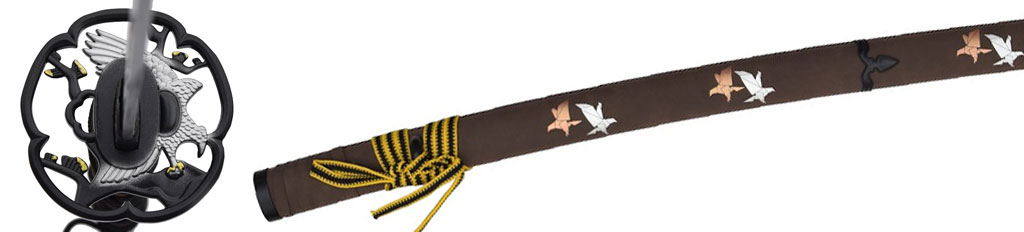
Two katanas: a technique inspired by authentic Japanese schools?
Sword fighting with two swords also has a particularly interesting historical background.
In Japan, the most famous name associated with the simultaneous use of two weapons remains that of Miyamoto Musashi. The renowned warrior is associated with the Niten Ichi-ryū, a school in which the combined use of a long sword and a shorter sword plays an important role.
However, it is important to distinguish this historical practice from the spectacular “Dual Katana” style depicted in *Ghost of Yōtei*. Atsu uses two long blades, and his movements are designed primarily to create a dynamic combat system suited to video games.
However, this reference to Japanese martial traditions adds an extra layer of depth to the weapon. As a result, the player isn’t simply encountering «two katanas,» but rather a video game reinterpretation of a martial tradition deeply rooted in Japanese history.
Atsu's Dual Katana replica is available at Réplique Manga Ciné
Have you taken up dual-sword combat after Hanbei's training? Our Atsu Dual Katana lets you recreate this iconic setup outside the game.
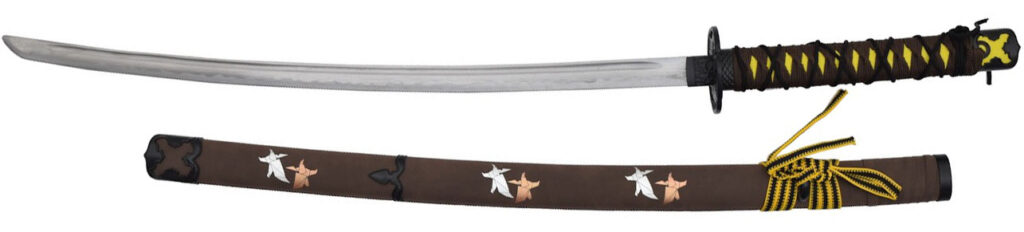
The reproduction brings the two swords together to immediately convey the essence of the fighting style Atsu learned. Displayed side by side, they also offer a very different presentation from a traditional katana on its own.
After learning about Hanbei’s role and his connection to Master Kengo, these two blades also take on greater meaning. They serve as a reminder of one of the many moments when Atsu expands his arsenal while reconnecting with his father’s legacy.
Discover our Atsu's Dual Katana.
Gilded Dawn and Gilded Night: Takezo the Undefeated’s Two Blades
Among the many Sword Kits in *Ghost of Yōtei*, *Gilded Dawn* and *Gilded Night* form a true duo. They both belong to Takezo the Undefeated. However, each represents a different facet of his world.
"Gilded Night" is her first Sword Kit. The game pairs it with the power of an imperfect night sky. "Gilded Dawn" is her second kit. This time, its description evokes the beauty of an imperfect dawn.
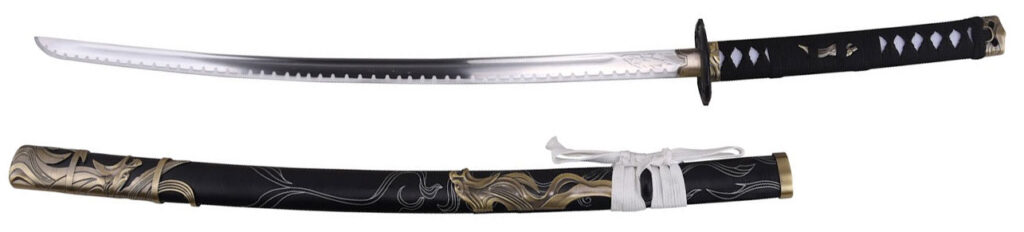
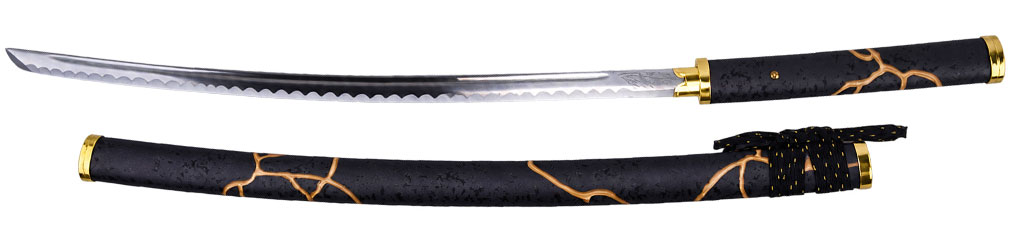
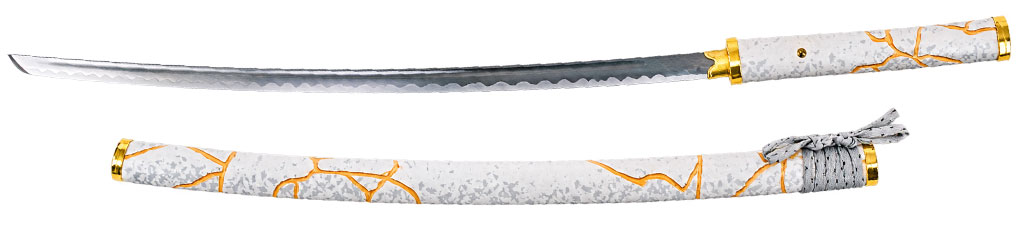
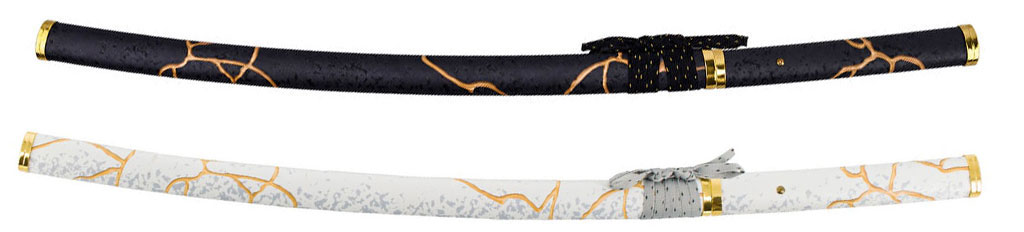
This contrast is immediately evident in their colors. Gilded Night combines black and gold, while Gilded Dawn combines white and gold. Yet both models share the same deliberately bold and irregular aesthetic.
The golden lines that run through their frames are particularly reminiscent of Japanese kintsugi. This technique highlights repaired fractures rather than seeking to conceal them. Here, the connection works particularly well with the words used in the game: both night and dawn are described as imperfect.
Most importantly, these two Sword Kits were designed to work together. Gilded Night adorns the main katana, while Gilded Dawn complements the Dual Katana. Atsu can therefore wear these two contrasting skins at the same time.
How do you get Gilded Dawn and Gilded Night in Ghost of Yōtei?
To unlock Gilded Dawn and Gilded Night, you’ll need to go far beyond simply exploring Ezo. These two Sword Kits are rewards for completing the story of Takezo the Undefeated.
First, you must complete the mythical story about Takezo. Completing this story will allow you to obtain his five charms. Next, equip all five charms at the same time and head to the summit of Mount Yōtei. You will then be able to continue the quest “The Five Teachings.”.
After waiting by the fire at the summit, Atsu reunites with Takezo for a final showdown. The duel is anything but a formality. Takezo fights with two katanas and is a particularly formidable opponent.
Once Takezo is defeated, the player receives Gilded Night and Gilded Dawn, as well as the Unbeaten’s Straw Hat. Both Sword Kits are therefore rewards for the same final battle.
Why are *Gilded Dawn* and *Gilded Night* so special?
These two kits offer more than just two new colors. Their appeal lies primarily in how well they complement each other visually.
Gilded Dawn brings light. Its white, accented with gold, evokes a dawning brightness—yet one that is deliberately imperfect. In contrast, Gilded Night features a black surface interspersed with the same golden accents. One thus seems to be a natural extension of the other.
Furthermore, their design immediately sets them apart from traditional scabbards. There is no tsuba to visually separate the hilt from the blade. Their sleek lines are thus reminiscent of a shirasaya, even though we are, of course, talking about Sword Kits in the game.
This aesthetic choice takes on even greater meaning when both weapons are used simultaneously. The player then wields a dark katana and its light counterpart. Night and dawn come together in Atsu’s two hands.
That’s also what makes this pair particularly appealing to collectors. It’s no longer just a matter of choosing between a black or white model. Bringing the two together allows you to physically recreate the combination envisioned for Takezo.
We now offer a replica of the Gilded Dawn Katana, featuring a white hilt adorned with gold patterns. Its counterpart, the Gilded Night Katana, features a black-and-gold color scheme. Both replicas also feature a wolf’s head engraved on the blade, near the hilt.
💡 Did you know?
The developers of Ghost of Yōtei drew inspiration from many elements of Japanese culture, including the landscapes of Hokkaidō, traditional swords, guardian animals, and classical art. As a result, many Sword Kits contain hidden cultural references that players gradually discover as they explore.
The Artistic Inspirations Behind *Ghost of Yōtei*
| Game element | Japanese Inspiration |
|---|---|
| Sakura in Moonlight | Hanami and Cherry Blossoms |
| Aranami's Claw | The Big Waves and the Prints |
| Omens of the Aurora | Landscapes of Northern Hokkaido |
| Twin Wolves | Ōkami and the Guardian Wolves |
| Dual Katana | Japanese Crane and Niten Ichi-ryū |
| Wolf Blade | Bushidō and the Traditional Katana |
Why are the weapons in *Ghost of Yōtei* so fascinating?
The weapons in *Ghost of Yōtei* aren’t just appealing for their aesthetics. They accompany Atsu on his journey and gradually become witnesses to his story. Some remind him of his family, while others symbolize an encounter, a lesson learned, or an important milestone in his adventure.
This narrative aspect profoundly changes the way we view them. After several hours of gameplay, a katana is no longer just a weapon selected from a menu. It sometimes brings to mind a place you’ve discovered, a quest you’ve completed, or a character you’ve met. That’s why certain Sword Kits become particularly memorable for players.
The Ghost of Yōtei weapons, which also depict the landscapes of Ezo
Another strength of *Ghost of Yōtei* lies in the way it integrates weapons into the environment. Indeed, the motifs encountered throughout the Sword Kits sometimes seem to extend the landscapes Atsu travels through.
The flowers in *Sakura in Moonlight* evoke a delicate and fleeting sense of nature. In contrast, *Aranami’s Claw* recalls the power of the waves. *Omens of the Aurora* turns our gaze toward the sky, while the wolves become a central theme in the story of Atsu and his family.
As a result, customizing your weapon also lets you choose the atmosphere that will accompany your journey. Some players will prefer an elegant look. Others will seek a wilder, darker, or more symbolic style.
From Video Games to Collectibles
It is precisely this connection to the weapon that explains the appeal of physical replicas. A collector doesn’t necessarily choose a model just because it’s spectacular. Often, they choose the one that reminds them of a particular moment in their adventure.
One player might prefer Sakura in Moonlight for its elegance. Another might be more drawn to the Wolf Blade because of its connection to Atsu’s past. Finally, Twin Wolves might resonate with someone who understands the full significance of the two wolves.
A replica allows you to preserve a small part of that experience outside the game. Whether displayed in a gaming room, on a stand, or as part of a collection, it becomes instantly recognizable to anyone familiar with its history.
Ultimately, that may be where the true power of the weapons in *Ghost of Yōtei* lies: they don’t just accompany Atsu into battle. They also end up accompanying the player’s memories.
Ultimately, that may be where the true power of the weapons in *Ghost of Yōtei* lies: they don’t just accompany Atsu into battle. They also end up accompanying the player’s memories.
⭐ Réplique Manga Ciné's Tip
If you want to build a collection that stays true to the world of Ghost of Yōtei, don’t choose your replicas based solely on their appearance. Instead, let their history and symbolism guide you. First, start with the Wolf Blade, Atsu’s signature weapon, and then add Atsu’s Dual Katana to represent his fighting style. Then, gradually expand your collection with the various Sword Kits. Sakura in Moonlight celebrates the beauty of cherry blossoms, Aranami’s Claw pays homage to the power of the waves, Omens of the Aurora evokes the mysterious landscapes of the north, and Twin Wolves showcases the protective wolves. Finally, by collecting these various replicas, you’ll not only be adding magnificent decorative weapons to your collection, but also the artistic and cultural richness that gives *Ghost of Yōtei* its charm.
FAQ – Everything You Need to Know About Weapons in Ghost of Yōtei
The weapons in Ghost of Yōtei raise many questions, both about their role in the game and their symbolism. This FAQ compiles the essential answers to help you better understand the Sword Kits, Atsu’s swords, and the Japanese influences that have shaped this universe.
What is Atsu's main weapon in Ghost of Yōtei?
Atsu's main weapon is the Wolf Blade, a katana that accompanies her throughout her adventure. A true symbol of the heroine, it embodies her determination, her courage, and her connection to the wild lands of Ezo.
What are Sword Kits used for in Ghost of Yōtei?
Sword Kits let you customize the appearance of Atsu's katana. They change the scabbard, the guard, the hilt, and certain decorative elements. However, they do not provide any power or stat bonuses.
What is the difference between the Wolf Blade and the Sword Kits?
The Wolf Blade is Atsu's signature weapon. Sword Kits, on the other hand, are decorative sets that let you customize its appearance. Each Sword Kit has a unique style inspired by nature, Japanese traditions, or the game's legends.
Are the weapons in *Ghost of Yōtei* inspired by real Japanese swords?
Yes. The developers drew heavily on traditional Japanese weapons for inspiration. Katanas, nodachi, carved guards, floral motifs, and animal symbols all incorporate numerous elements from Japanese history and culture.
Why are wolves so prominent in *Ghost of Yōtei*?
The wolf is a powerful symbol in Japanese culture. Once considered the guardian of the mountains and the protector of travelers, it also represents courage, freedom, and the instinct for survival. That is why several weapons in the game feature this iconic figure.
What is the difference between a katana and a nodachi?
The katana is a Japanese sword designed to offer an excellent balance between speed and maneuverability. The nodachi, on the other hand, has a longer blade, giving it greater reach and a particularly impressive presence. In *Ghost of Yōtei*, *Omens of the Aurora* perfectly illustrates this type of weapon.
Is *Ghost of Yōtei* the sequel to *Ghost of Tsushima*?
Yes. Ghost of Yōtei is the spiritual successor to Ghost of Tsushima, developed by Sucker Punch Productions. Although both games share the same universe and philosophy, Ghost of Yōtei tells a new story featuring a brand-new heroine, Atsu, and takes place several centuries after the events of Ghost of Tsushima. It offers a standalone adventure, enriched with new gameplay mechanics and a world inspired by the wild landscapes of Ezo.
Are the "Ghost of Yōtei" replicas intended for cosplay or as decorations?
The replicas available on Réplique Manga Ciné are primarily designed for collecting and display. Thanks to their meticulous craftsmanship, they also make magnificent display pieces for fans of video games and Japanese culture.
Which line is the most faithful to the game?
Each model features the main elements seen in *Ghost of Yōtei*. The Wolf Blade is Atsu’s primary weapon, while the other models faithfully reproduce the various Sword Kits discovered throughout the adventure.
Where can I buy a Ghost of Yōtei replica?
You can find our entire collection of Ghost of Yōtei replicas on Réplique Manga Ciné. There, you'll discover the Wolf Blade, Atsu's Dual Katana, and various Sword Kits inspired by the game.