

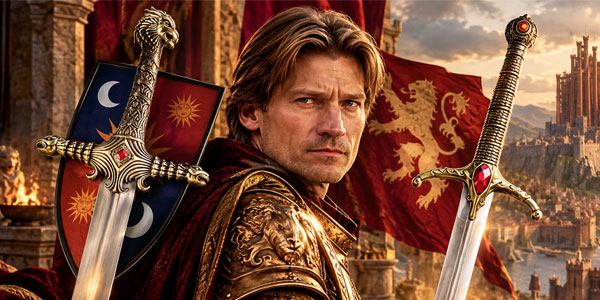
L'Jaime Lannister's sword has a more complex history than it seems. Over the course of Game of Thrones, the Regicide wields several weapons, including a sword that is recognizable from the very first seasons.
But two Valyrian steel blades would go on to play a special role in his journey: Féale and Pleurs-de-Veuve. Both have a common origin, directly linked to House Stark and one of Westeros' most iconic weapons.
Why does Jaime give up his first sword? Where do "Féale" and "Pleurs-de-Veuve" come from, and how do these two blades end up in the hands of different characters?
To understand this, we must follow Jaime’s journey and go back to a decision made by Tywin Lannister that forever changed the legacy of two great houses of Westeros.
What is Jaime Lannister's sword?
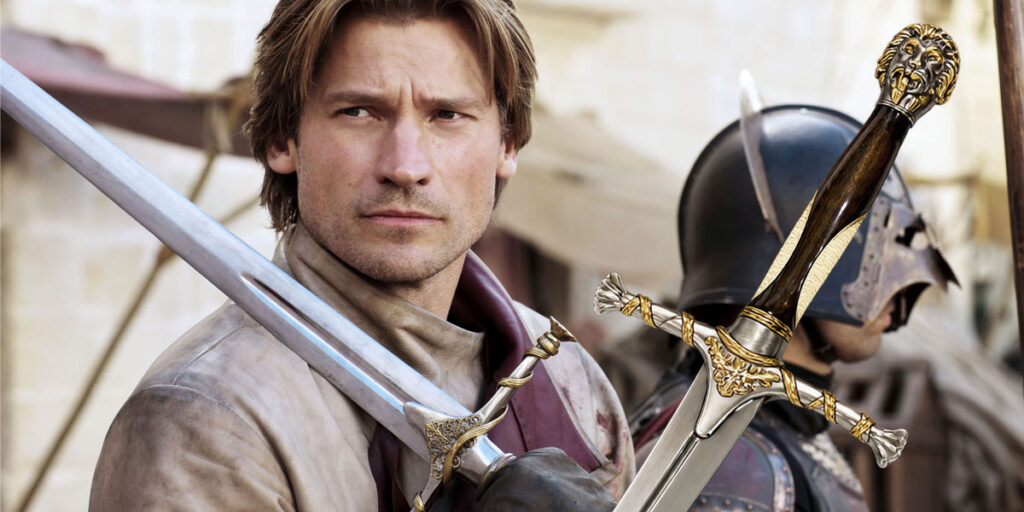
During Game of Thrones, Jaime Lannister is associated with several swords, which can easily lead to confusion. Before Féale and Pleurs-de-Veuve, the Regicide already had his own weapon—the one he carried, in particular, during the first few seasons of the series.
This first sword accompanies Jaime before an event that profoundly changes his life: the loss of his right hand. His approach to combat changes completely, as does his personal journey.
Later, Tywin Lannister presented him with a new Valyrian steel sword, forged from Ice, Ned Stark’s ancestral weapon. This sword was intended for Jaime, but he ultimately chose to entrust it to Brienne of Tarth so that she could find and protect Sansa Stark. Brienne named it “Féale,” which translates to “Oathkeeper” in the original version.
The second blade from Glace is Widow's Tearsor Widow’s Wail. Originally given to Joffrey Baratheon, it was eventually worn by Jaime in the final seasons of the series.
The history of Jaime's swords thus follows three major stages: his first knight's sword, "Féale," which he received and then entrusted to Brienne, and "Widow's Tears," which he wielded later. Each one corresponds to a different period in his career.
Why is Féale—or Oathkeeper—so important?
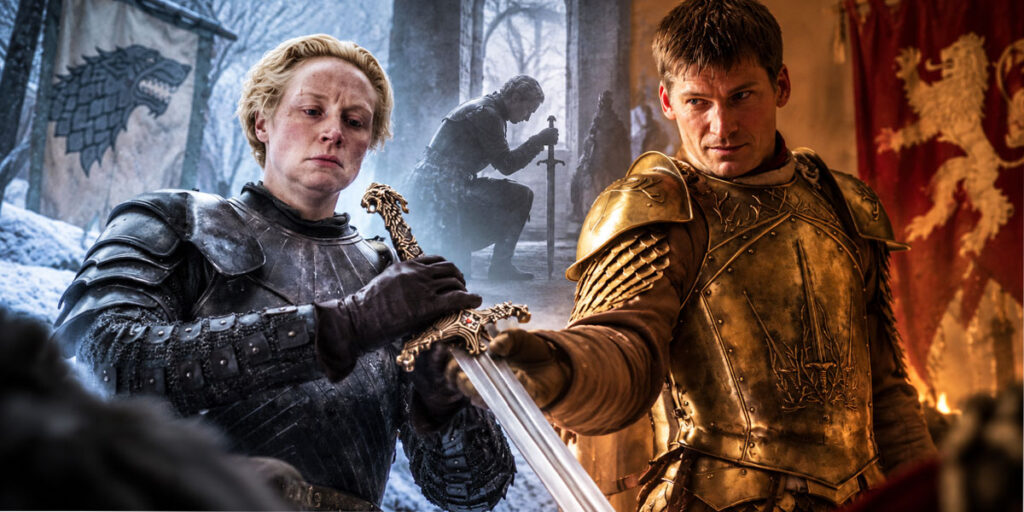
Loyal holds a special place in Jaime Lannister’s history. Yet he keeps it for only a very short time. The significance of this sword, therefore, does not lie in the battles he fights with it, but in the choice he makes when he decides to entrust it to Brienne of Tarth.
Jaime then asks him to find Sansa Stark and protect her. In doing so, he is trying to honor the promise he made to Catelyn Stark, even though she died during the Red Wedding.
The gesture takes on even greater significance when one considers the blade’s origin. Féale was forged from Glace, Ned Stark’s sword. A part of his family’s ancestral weapon thus symbolically returns to serve the Starks.
Brienne names the sword «Féale,» or “Oathkeeper” in the original version, a name that can be linked to the idea of a “guardian of the oath.” This name directly echoes the mission she agrees to undertake.
But it also refers to Jaime himself. Long derisively nicknamed “the Kingslayer” for killing King Aerys II, whom he had sworn to protect, Jaime now entrusts a sword to Brienne so that another oath may be honored.
Féale thus becomes much more than just a Valyrian steel weapon. It accompanies one of the character’s most significant transformations: that of a man associated with a broken oath who, through Brienne, attempts to ensure that another oath is upheld.
Why is "Pleurs-de-Veuve," or "Widow’s Wail," connected to Jaime?
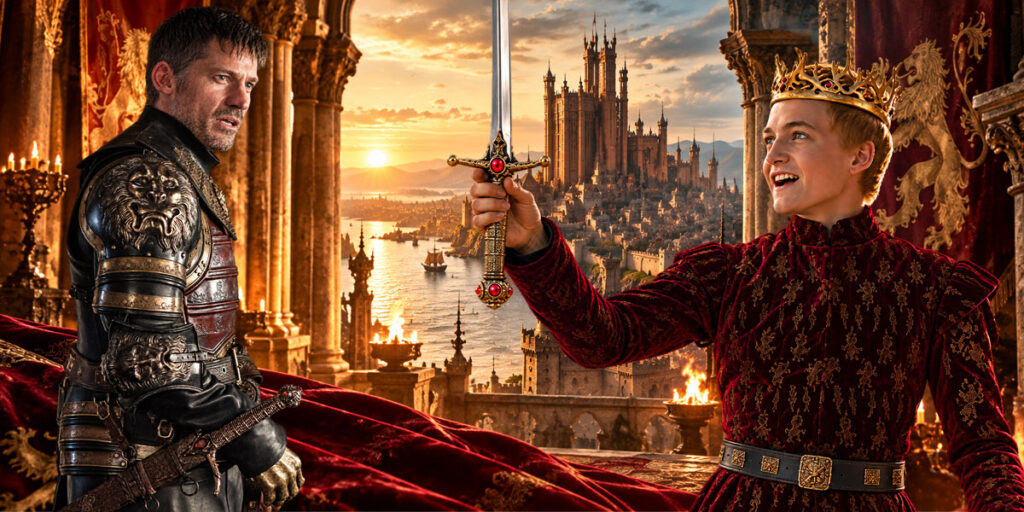
Widow's Tears, known as Widow’s Wail In the original version, it is the second sword forged from ice. Unlike Féale, however, it was not intended for Jaime when it was created.
Tywin Lannister gives it to Joffrey Baratheon before his marriage to Margaery Tyrell. The young king chose his own name from among the suggestions offered by those present. It was a particularly cruel name, perfectly suited to Joffrey's character.
After Joffrey's death during his wedding to Margaery Tyrell, the fate of Widow's Lament differs between the books and the series. In the books, the sword goes to his younger brother Tommen Baratheon. In the TV adaptation, however, she ends up in Jaime Lannister's hands.
Jaime has been wearing "Widow's Tears" in recent seasons. This development creates a particularly symbolic situation: although he entrusted "Féale" to Brienne, he now fights alongside the other half of Ned Stark's old sword.
The two blades forged from Ice are thus associated with the two characters. Faithful accompanies Brienne, while Widow’s Weeps becomes Jaime’s sword.
This story takes on even greater significance when their paths cross as they face the army of the dead. Two fragments of the Stark legacy then fight side by side—a far cry from Tywin Lannister’s original intention when he had Ice reforged.
Why are "Féale" and "Pleurs-de-Veuve" made of Valyrian steel?
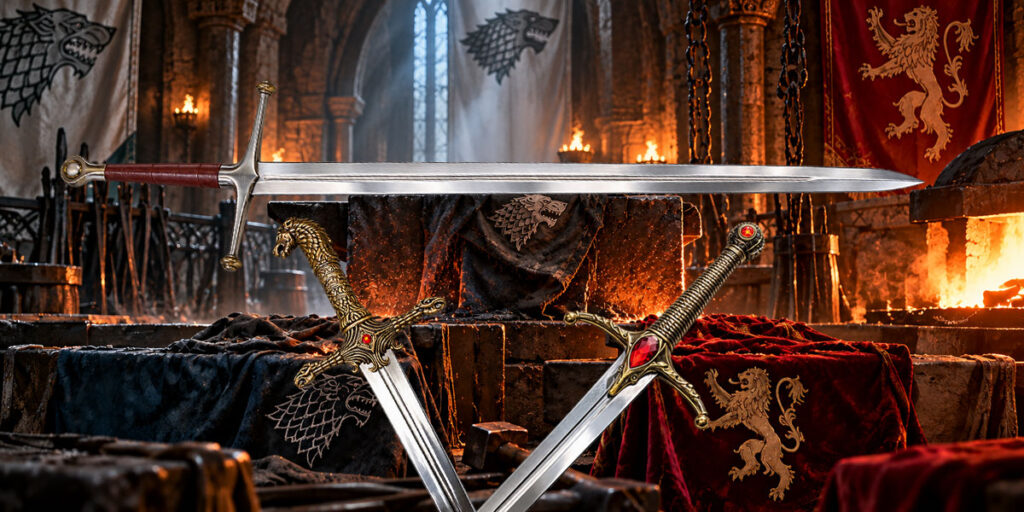
Féale and Pleurs-de-Veuve share one essential characteristic: both are forged from Valyrian steel, one of the rarest and most prestigious materials in Westeros.
However, Tywin Lannister does not simply possess Valyrian steel that he decides to forge into two swords. The steel comes from Ice, the immense ancestral blade of House Stark, which was recovered after Ned Stark’s execution.
Tywin then entrusts Ice to a master craftsman capable of reworking this exceptional metal. In the novels, this is Tobho Mott, a swordsmith from King's Landing originally from Qohor. The greatsword was melted down and then reforged to create two new blades: "Féale" and "Widow's Tears.".
George R. R. Martin even includes a particularly symbolic detail in the books. The armorer attempts to give the new swords the Lannister red. However, the steel does not react as expected and retains ripples that blend shades of dark red and nearly black gray.
In the series, Valyrian steel also has a distinctive appearance. Tommy Dunne, the fight choreographer for *Game of Thrones*, explains that the team used, among other things, the pattern welding, which is often compared to Damascus steel, to visually recreate that distinctive look on screen.
Féale and Pleurs-de-Veuve are therefore not merely two prestigious weapons. They still bear, in their very essence, the’The Legacy of Ice and the House of Stark.
In George R. R. Martin’s novels, Tywin Lannister wants the two swords reforged from Ice to bear his house’s colors. However, despite the armorer’s attempts, the Valyrian steel refuses to take on the desired uniform red hue. The new blades ultimately feature dark red ripples intermingled with an almost black gray. It is as if, symbolically, the Stark steel itself refuses to become fully Lannister.
"Féale" or "Pleurs-de-Veuve": Which name should you choose for a collection?
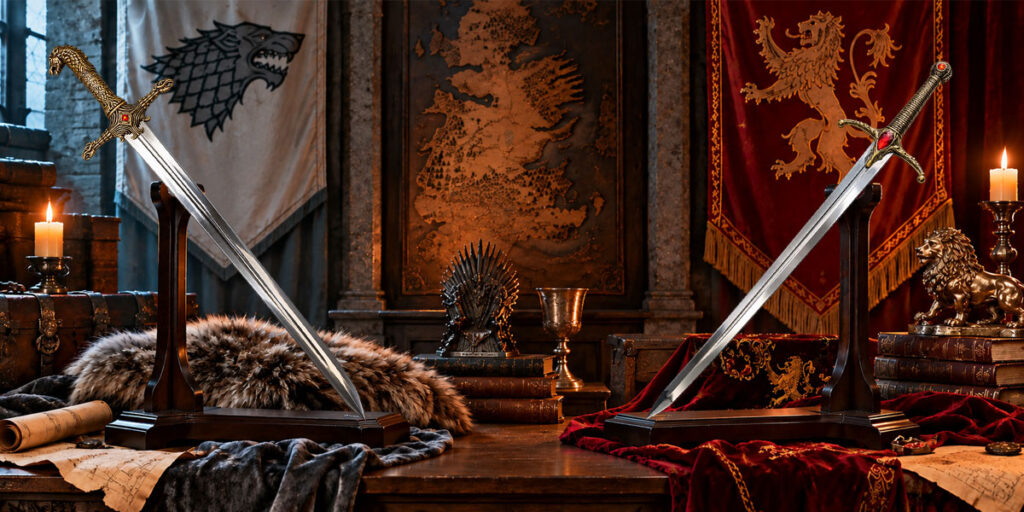
Choose between Féale and Pleurs-de-Veuve depends above all on the character and the story you want to portray in your collection. Although they share the same origin, the two swords evoke very different moments from *Game of Thrones*.
Féale remains deeply connected to Brienne of Tarth and the promise Jaime asks her to keep. For a collection focused on their relationship, oaths, or the Stark legacy, it therefore takes on a particularly powerful significance.
"Pleurs-de-Veuve" first brings to mind Joffrey Baratheon, who receives Tywin Lannister's sword. However, in the series, it later becomes the weapon wielded by Jaime. It is therefore better suited for a collection dedicated to the Lannisters or to the King's Slayer's journey in the final seasons.
For a decorative replica, the overall proportions, the craftsmanship of the guard, the handle, and the appearance of the blade naturally contribute to the overall look. But the choice can be based primarily on the story behind each sword.
When brought together in a single collection, *Féale* and *Pleurs-de-Veuve* take on even greater meaning. They allow us to symbolically reconstruct the two parts of Ice, the ancient ancestral sword of House Stark.
If you’re torn between “Féale” and “Pleurs-de-Veuve,” start by deciding which story you want to represent. “Féale” evokes Brienne, the oaths, and the connection to the Starks, while “Pleurs-de-Veuve” is associated with Joffrey and later Jaime in the series. Taken together, the two lines take on even greater meaning: they allow us to symbolically recreate the two blades forged from Ice.
Why do *Féale* and *Pleurs-de-Veuve* also tell the story of Jaime Lannister?
Ultimately, the story of Jaime Lannister’s sword cannot be reduced to a single weapon. “Fidelity” and “Widow’s Tears” are two different blades, but their fate remains inextricably linked to that of “Ice,” the ancient ancestral sword of House Stark.
Tywin Lannister intended to turn a symbol of his enemies into a legacy for his own family. Yet the journey of the two swords takes a very different turn.
Féale quickly leaves Jaime’s care to accompany Brienne of Tarth on her mission to the Starks. Widow’s Tears, originally given to Joffrey, ends up being worn by Jaime in the series.
Thus, the two shards of Ice navigate the rivalries between the Starks and the Lannisters while chronicling the journeys of their new owners.
Perhaps that is where the true power of their story lies: Glace may have disappeared as a sword, but its legacy has never truly left Westeros.