*From 2 to 14/02/2026. Excluding items already on sale. Offer applied directly to basket, and valid on all additional, lower-priced items.
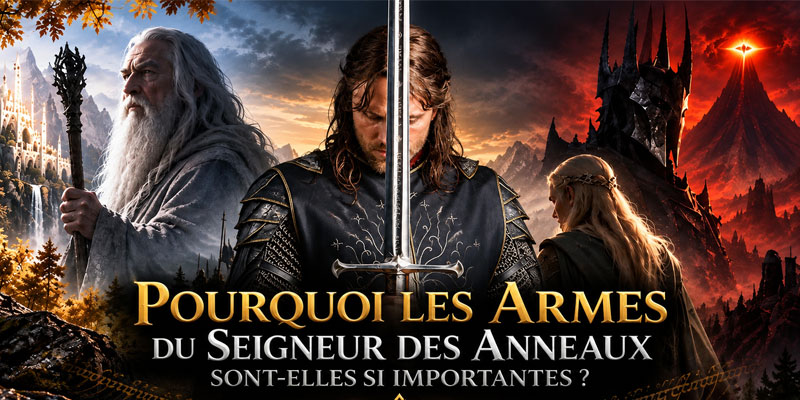
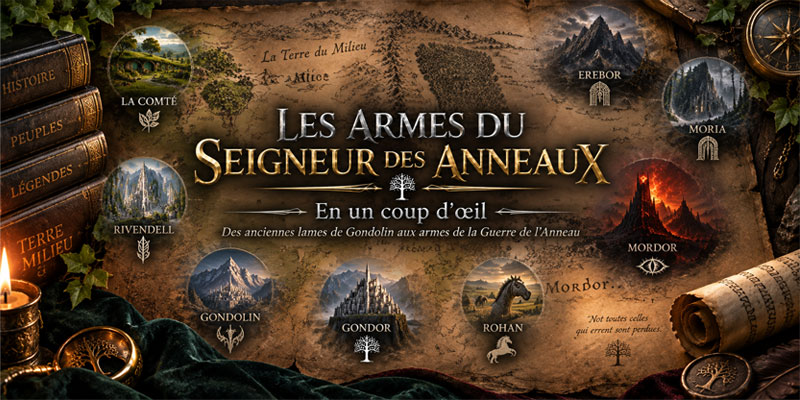
More than seventy years after its publication, *The Lord of the Rings* continues to capture the imagination of several generations. From the characters to the peoples of Middle-earth, The Weapons of The Lord of the Rings also contribute to this fascination. Yet behind Aragorn, Gandalf, Frodo, and Sauron lies a universe far vaster than the one depicted on screen.
J.R.R. Tolkien didn’t simply imagine an adventure centered on a ring. He created peoples, languages, kingdoms, and a history spanning several Ages. As a result, each character is rooted in a past that sometimes stretches back thousands of years.
The weapons of *The Lord of the Rings* also tell this story. Narsil passes through generations before becoming Andúril. Glamdring comes from a world long since vanished. As for Dard, it accompanied Bilbo before passing into Frodo’s hands.
But how is all of this connected? Who was Tolkien, really? What do the different Ages of Middle-earth represent? And why have some weapons become as famous as their owners?
From the books to Peter Jackson’s films, let’s set out on a journey through Middle-earth. You don’t have to have read the entire “Tolkien Bible” to join us!
Before the Hobbits, the Rings of Power, or the great battles, there was first and foremost J.R.R. Tolkien and his passion for languages. Born in 1892, the British writer was also a professor, linguist, and scholar of ancient texts.
From a very young age, Tolkien was interested in languages and even began inventing them. Later, he studied Old English, Middle English, and Old Norse, among other languages. He also discovered the Icelandic sagas and the Finnish Kalevala. Gradually, languages, myths, and stories began to form a much vaster universe.
And that’s where the story gets fascinating. Tolkien didn’t just create a few Elvish words to make his novels more realistic. His languages played a role in the very creation of his imaginary world. They needed peoples to speak them, as well as a history and legends.
Quenya and Sindarin thus become two of the major Elvish languages in his universe. Behind the names of characters, places, and objects often lie centuries of imagined history.
Middle-earth did not come into being with Frodo.
Tolkien worked on his «Legendarium» for much of his life. As early as World War I, he wrote the first drafts of stories that would much later form the basis of *The Silmarillion*. Some of these stories already recounted very ancient events in his universe, notably the fall of Gondolin.
Then came *The Hobbit*, published in 1937. Bilbo, Gandalf, Gollum, and Smaug introduced readers to a part of this world. However, behind this adventure lie elements that stem from a much older story.
This is particularly true of Gondolin, Glamdring, and Orcrist. These names, therefore, were not invented after the fact for *The Lord of the Rings*. They belong to a universe that Tolkien had been building and shaping for years.
With *The Lord of the Rings*, published in three volumes in 1954 and 1955, this mythology took on an extraordinary scope. Yet Tolkien would continue to work on his universe for the rest of his life.
That is why Middle-earth gives this special impression: behind every kingdom, every people, and sometimes every sword lies a history far older than the characters who discover it.
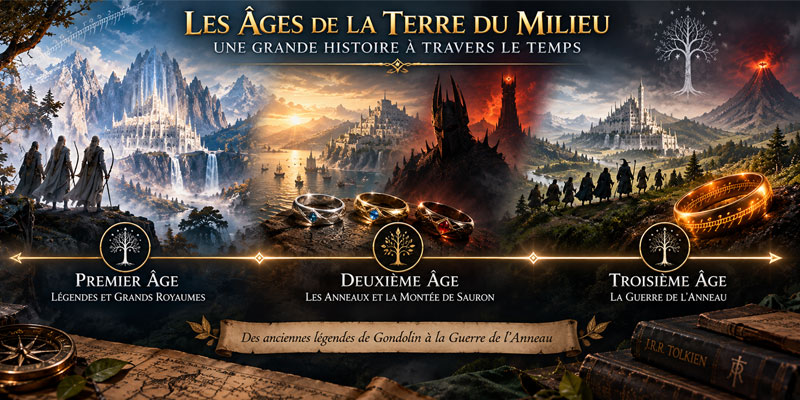
First Age, Second Age, Third Age… When you first discover Tolkien, the timeline can quickly become overwhelming. However, a few key points are all you need to understand where the main stories take place.
Middle-earth has a history that spans thousands of years. Thus, Aragorn, Frodo, and Gandalf arrive very late in this vast history.
Visit Early Age It belongs to the earliest periods of Tolkien's world. In particular, it is the era of the great wars against Morgoth, the first Dark Lord.
It is also during this period that several of the stories told in *The Silmarillion* take place. Beren and Lúthien, the Silmarils, and the Elven city of Gondolin all belong to this distant past.
This detail will be important later on. In fact, Glamdring, Orcrist, and Dard are associated with Gondolin. When Bilbo and Gandalf discover these blades in *The Hobbit*, they are thus uncovering the remnants of a world that has been gone for millennia.
At the end of the First Age, much of Beleriand was submerged beneath the waters during the upheavals that followed Morgoth's defeat. The Second Age could then begin.
Visit Second Age lasts for about three and a half millennia. Sauron then becomes the greatest threat to Middle-earth.
It is during this Age that they are forged The Rings of Power. Sauron forged the One Ring around the year 1600 in order to establish his dominion.
This era also saw the rise and subsequent fall of Númenor, a major kingdom of Men. Later, Elendil and Isildur played a crucial role in the struggle against Sauron.
The Second Age came to an end with the War of the Last Alliance of Elves and Men. It was during this conflict that Narsil, Elendil's sword, is broken.
So here we can already see the origins of a weapon that would become essential thousands of years later.
Visit Senior Citizens is the one that movie audiences are most familiar with.
Bilbo meets Gollum and finds the Ring in 2941. Several decades later, the Fellowship of the Ring is formed in Rivendell in 3018.
The War of the Ring thus takes place over a surprisingly short period of time. The One Ring is finally destroyed in 3019.
It was during this time that Frodo, Sam, Aragorn, Legolas, Gimli, Boromir, and Gandalf crossed paths. Yet many of the items they carry date back to far more ancient times.
In 3021, Frodo, Bilbo, Gandalf, and Elrond leave Middle-earth. This event marks the end of the Third Age.
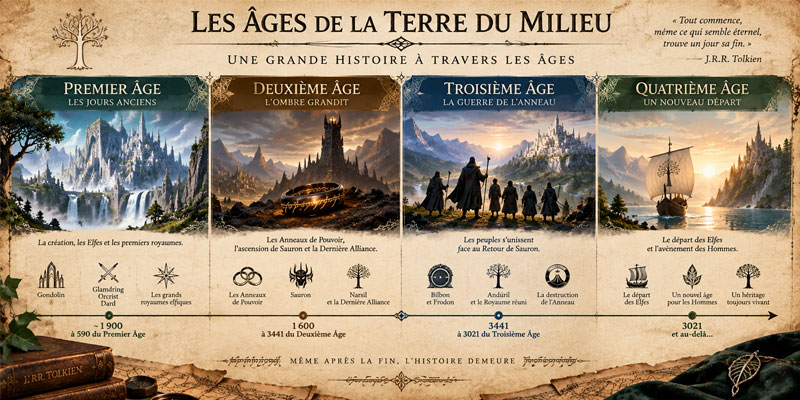
That, after all, is the most important thing to remember.
Early Age : Morgoth, the Silmarils, and the ancient Elvish legends.
Second Age : Sauron, the Rings of Power, Númenor, and the Last Alliance.
Senior Citizens : The Hobbit, Bilbo, Frodo, and the War of the Ring.
Thus, when an ancient weapon reappears in *The Lord of the Rings*, it often spans several thousand years of history.
That is precisely what makes Tolkien's world so fascinating: The past has never completely disappeared.
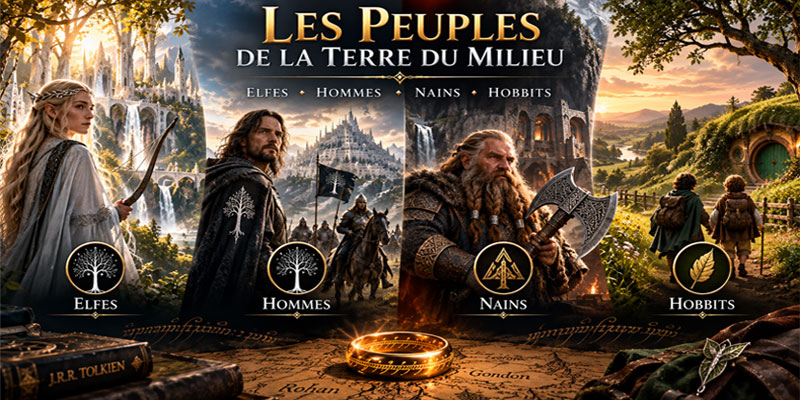
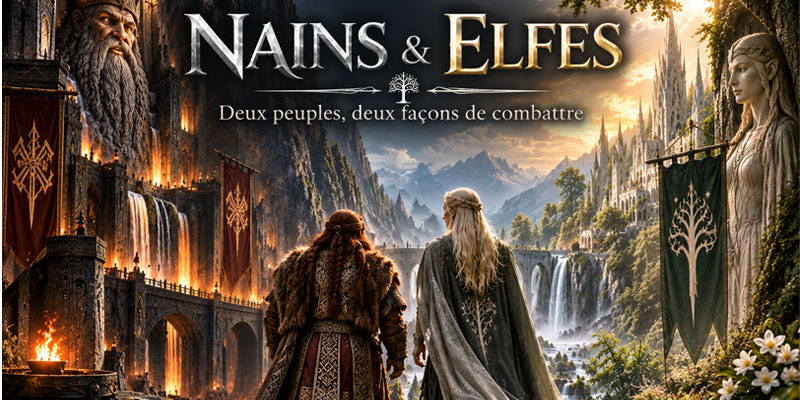
Middle-earth would be nothing without the peoples who inhabit it. Each has its own history, traditions, and worldview. Some have lived side by side for millennia, while others choose to live far from major conflicts.
Understanding their differences also helps us better understand their alliances, rivalries, and weapons.
Visit Elves They are among the oldest peoples in Tolkien's universe. Immune to natural aging, they can live for centuries and preserve the memory of events long forgotten by Men.
However, not all Elves belong to a single, homogeneous people. Their history is complex, with several lineages and kingdoms.
In *The Lord of the Rings*, the reader encounters, among others, Elrond in Rivendell, Galadriel in Lothlórien, and Legolas, prince of the Sylvestre Kingdom.
Elves also have a special connection to craftsmanship. Some of their creations have endured for millennia. Weapons forged in long-vanished kingdoms may thus reappear long after they were first created.
Glamdring, Orcrist, and Dard are magnificent examples of this.
Visit Men play a central role in the history of Middle-earth. Unlike the Elves, their lives are short. Yet their kingdoms, their alliances, and their choices profoundly influence the fate of the world.
Two kingdoms in particular dominate *The Lord of the Rings*: Gondor and Rohan.
Gondor carries on the legacy of Númenor. Elendil, Isildur, and—several generations later—Aragorn are also part of that history.
Rohan has a distinct identity. Its horsemen, the Rohirrim, live in a culture deeply intertwined with horses. Théoden, Éomer, and Éowyn, in particular, embody this people in the story.
These differences will also be evident in their equipment and weapons.
Visit Dwarves have a history very different from that of the Elves and Men. Originally created by Aulë, one of the Valar, they are renowned for their endurance and their extraordinary craftsmanship.
They excel in particular at working with stone and metals. Their vast underground cities are a testament to this mastery.
Visit Moria, formerly known as Khazad-dûm, is certainly the most famous among the general public.
In the Fellowship of the Ring, Gimli represents this people. Proud of his heritage and a formidable fighter, he also helps bring together two peoples who have long been suspicious of one another through his friendship with Legolas.
And it's hard to imagine Gimli without his favorite weapon: the axe.
Visit Hobbits seem almost insignificant compared to the powerful kingdoms of Men or the ancient history of the Elves.
They generally prefer the tranquility of the Shire, hearty meals, and a life far removed from war. Yet Tolkien places these very humble characters at the heart of his two most famous adventures.
Bilbo leaves the Shire in *The Hobbit*. Later, Frodo embarks on a far more dangerous journey with the One Ring.
Sam, Merry, and Pippin also show that courage depends neither on size nor on strength.
This idea is fundamental to Tolkien's universe: Those whom no one notices can sometimes achieve the impossible.
Opposing these peoples are, in particular, the Orcs, which have been around since the ancient times of Tolkien's legend.
In the Third Age, they serve the Powers of the Shadow and make up a large part of Sauron's armies.
In *The Lord of the Rings*, the Uruk-hai also play an important role. Peter Jackson's films, in particular, made them famous as part of the forces sent by Saruman.
Their equipment stands in stark contrast to that of the Elves or Gondor. The designs are more rugged, and the weapons seem designed primarily for war.
This visual contrast will become particularly striking in the film adaptations.
This is perhaps one of the most exciting aspects of *The Lord of the Rings*.
Elves, Men, Dwarves, and Hobbits have profoundly different histories and cultures. Some of these peoples have even harbored centuries of mistrust toward one another.
Yet, as Sauron returns, their paths eventually cross.
The Fellowship of the Ring and becomes its symbol: a Wizard, an Elf, a Dwarf, two Men, and four Hobbits set out together from Rivendell.
And their differences can even be found in the Weapons from *The Lord of the Rings* The weapons they carry—swords, bows, axes, and small blades—already reveal something about each of their bearers.
In Middle-earth, a weapon can be much more than just a tool of combat. Some have names, origins, and histories that date back centuries. They can also pass from one character to another and become symbols of a legacy.
This significance is rooted in a world shaped by the languages, legends, and ancient traditions that Tolkien studied. In the heroic tales with which he was familiar, named weapons already hold a special place. In particular, they serve to connect a hero to his past.
In Tolkien's work, this idea takes on an impressive dimension.
When a character receives or rediscovers an ancient blade, they don't just acquire a weapon.
Narsil This is an excellent example. The sword belonged to Elendil during the Last Alliance. Broken in battle, it was passed down through the generations before its fragments eventually found their way to Aragorn.
For his part, Glamdring has an even longer history. Forged in Gondolin during the First Age, it reappeared millennia later in Gandalf's hands.
As for Sting, it passes from Bilbo to Frodo.
In each of these cases, the new bearer thus inherits an object steeped in a past that is beyond their understanding.
Obviously, not all weapons in Middle-earth have names. However, some of the most important ones do.
And these names aren't chosen at random.
Andúril means «Flame of the West.» Glamdring is known as the «Hammer of Enemies,» while Orcrist is associated with the «Goblin-Splitter.».
The languages invented by Tolkien take on their full significance here. A name can reveal information about a weapon’s origin, reputation, or history.
Thus, learning the name of a blade is sometimes like opening a small window into Middle-earth’s past.
Weapons also allow Tolkien to give tangible form to the passing down of traditions from one generation to the next.
This is particularly evident with Narsil and Andúril. The broken sword symbolizes Elendil’s downfall and the unfinished victory over Sauron. Its rebirth then marks Aragorn’s return to his royal heritage.
"The Sting" depicts a much more intimate act of passing on. Bilbo entrusts his little sword to Frodo before they leave Rivendell.
The object changes hands, but its story continues.
Perhaps that is one of the reasons why these weapons continue to hold such a fascination. They do not merely represent the person who carries them; they also carry the memory of those who came before them.
Film adaptations will further strengthen this relationship.
Today, it’s hard to imagine Aragorn without Andúril, Gandalf without Glamdring, or Gimli without his axes. Yet their appearance, which has become so well-known to the general public, is also the result of the work done for the movies.
We'll come back to that later.
Before that, it’s time to trace the history of a few of these weapons. And to start off, it’s hard to find a better example than a broken sword that became the symbol of a king: Narsil, and later Andúril.
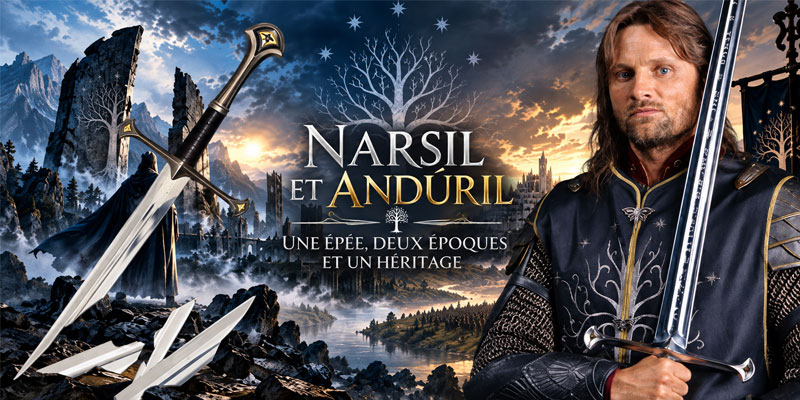
Of all the weapons Tolkien imagined, Narsil and Andúril certainly tell one of the most beautiful stories of passing down a legacy.
At the end of the Second Age, Narsil belonged to Elendil, who fought Sauron during the Last Alliance of Elves and Men. Elendil fell in battle, and his sword was shattered.
Isildur then used a fragment of Narsil to cut the One Ring from Sauron's hand. The pieces of the sword were preserved and passed down through Isildur's descendants.
Thousands of years later, this legacy has reached Aragorn.
During the War of the Ring, Narsil is reforged and given a new name: Andúril, the Flame of the West. The ancient, broken sword then becomes one of the symbols of the return of Isildur’s heir.
A single blade thus connects Elendil, Isildur, and Aragorn, but also the Second and Third Ages.
That is precisely what makes its story so exceptional: Andúril does not replace Narsil. It gives it a new life.
To learn more, check out The Complete Story of Narsil as well as our feature on Andúril and its symbols.
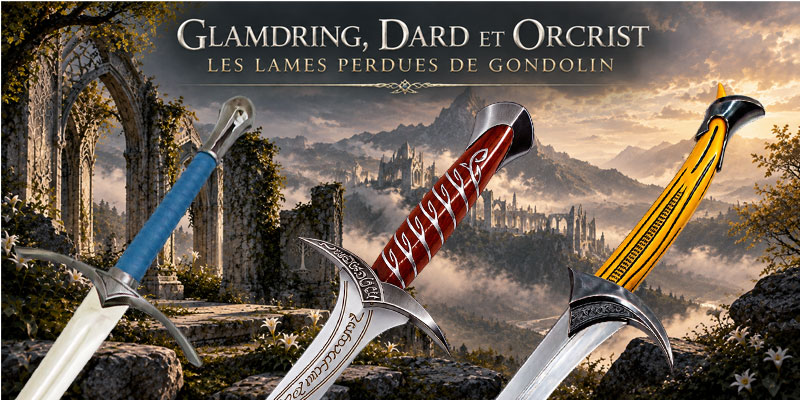
When Bilbo accompanies Thorin and his company in *The Hobbit*, an extraordinary discovery awaits them. Three ancient blades reappear after having been lost for millennia: Glamdring, Orcrist, and Dard.
All of them are associated with Gondolin, the great hidden elven city of the First Age. Its fall, therefore, dates back to an extremely ancient period in the history of Middle-earth.
That's why these weapons are so fascinating. When Gandalf, Thorin, and Bilbo discover them, they don't just find fine blades. They come across relics of a world that has vanished.
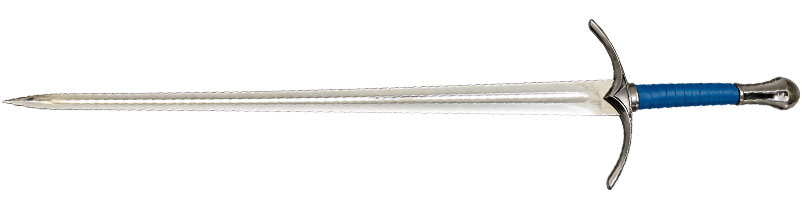
Glamdring becomes Gandalf's weapon after he discovers it in the trolls' lair.
In Rivendell, Elrond examines the inscriptions on the blades. He then identifies Glamdring and Orcrist as two famous swords from Gondolin.
Glamdring even has a prestigious history: it once belonged to Turgon, King of Gondolin. Thousands of years, then, separate its first known owner from the Wizard who carries it in *The Hobbit* and then *The Lord of the Rings*.
Its Sindarin name is generally translated as « Enemy Hammer ». The Orcs, who know and fear the ancient blades of Gondolin, also give it another name: Beater, often translated as «Cogneuse.».
However, its full story deserves much more than just a few lines. So we’ve told it in our special feature on Glamdring, Gandalf's sword, from its origins to its various representations.
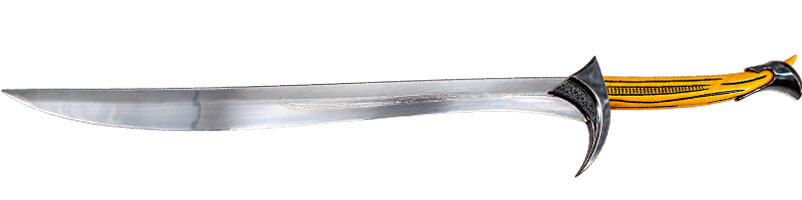
Next to Glamdring is Orcrist, which Thorin Oakenshield carries as his weapon during his expedition to the Lonely Mountain.
Its name means « Gobelins Bread Knife ». The Goblins, in fact, know her by the name Biter, «The Biter.» Like Glamdring, her reputation thus dates back to a very ancient past.
Orcrist accompanies Thorin for much of his adventure. However, when he is captured by the Elves of the Woodland Realm, the sword is taken from him.
But that's not the end of the story.
After Thorin's death following the Battle of the Five Armies, Thranduil places Orcrist on his grave. Tolkien explains that it then glows in the dark when enemies approach.
The Dwarf King's weapon thus also becomes the symbolic guardian of his tomb.
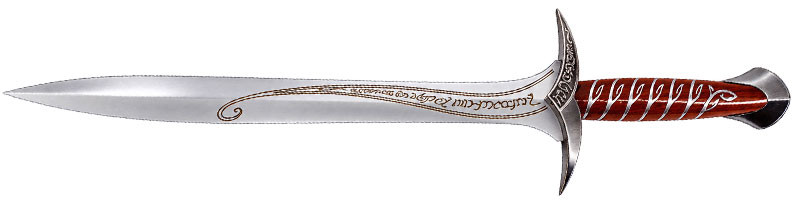
Next to Glamdring and Orcrist, the third blade seems almost modest.
It is so small that a Man or an Elf would consider it more of a knife. For a Hobbit, however, its size makes it a true little sword.
Bilbo takes him along and later names him Sting, or Sting in English.
The blade has a distinctive feature that has become famous: It glows when Orcs or Goblins are nearby. This trait will prove particularly useful during Bilbo's adventures.
But Dard has another distinctive feature: its story directly links *The Hobbit* to *The Lord of the Rings*.
Many years later, in Rivendell, Bilbo gives Dard to Frodo. He also gives him his mithril coat of mail.
The small blade then accompanies Frodo on his own quest. It even briefly passes into Sam’s hands, particularly during the events surrounding Shelob’s lair and the tower of Cirith Ungol.
Thus, a weapon discovered almost by chance in *The Hobbit* plays a role, several decades later, in the journey that will determine the fate of the One Ring.
Glamdring, Orcrist, and Dard, above all, help us understand the depth of Tolkien’s universe.
Their new owners are seniors. Yet their origins date back to The First Age and Gondolin.
They thus create an extraordinary bridge between stories separated by several thousand years.
Gandalf inherits a royal blade. Thorin takes a weapon feared by the goblins. Bilbo transforms a small elven blade into a Dard before passing it on to Frodo.
Three weapons, three different fates, but the same origin.
And beyond the ancient elven blades, other peoples of Middle-earth have their own warrior traditions. Now let’s turn to Gondor and Rohan, two kingdoms of Men with very different identities.
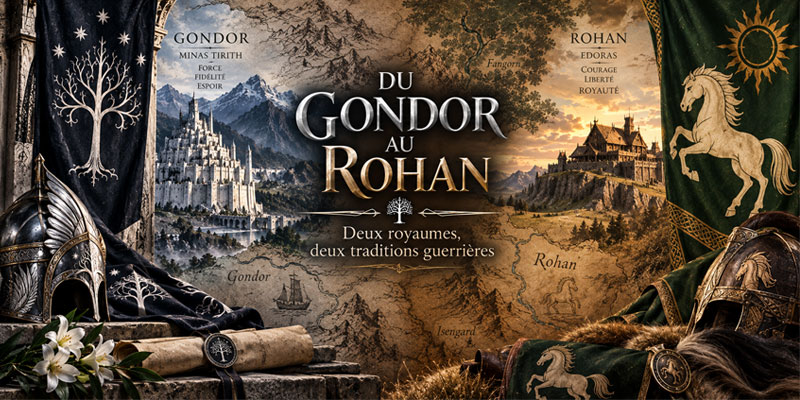
After the ancient Elven blades, let’s return to the Third Age. Two great kingdoms of Men played a pivotal role at that time: the Gondor and Rohan.
They become allies against Sauron, but their cultures remain very different. This identity is reflected in their fortresses, their clothing, their horses, and, of course, their weapons.
Gondor carries on part of the legacy of the Númenóreans. After the fall of Númenor, Isildur and Anárion, the sons of Elendil, established Gondor in the south of Middle-earth, while their father reigned as High King of the Dúnedain from the kingdom of Arnor in the north.
During the War of the Ring, however, Gondor no longer had a king. It was ruled by the Stewards, and Denethor II holds this position as Sauron prepares for his return.
His two sons, Boromir and Faramir, embody two different facets of Gondor.
Boromir joins the Fellowship of the Ring and fights with a sword, a shield, and his famous horn. Faramir, meanwhile, commands the Rangers of Ithilien and defends the eastern lands of the kingdom.
Their weapons do not have the millennia-old history of Narsil or Glamdring. Yet they tell a different story: of Men defending a kingdom that has long been threatened by the’Shadow of Mordor.
To the west of Gondor lies the Rohan, Land of the Rohirrim.
Here, the horse plays a fundamental role. The Rohirrim are, above all, remarkable horsemen, capable of rapidly moving their forces over great distances.
This equestrian culture naturally influences the way they fight. Swords, spears, and shields accompany the horsemen when they go to war.
Visit King Théoden embodies this tradition. During the War of the Ring, he ultimately led the Rohirrim to the Pelennor Fields to come to the aid of besieged Gondor.
Among those at his side are Éomer and Éowyn. She would, in fact, go on to achieve one of the battle’s most famous feats against the Witch-King of Angmar.
The Rohan thus possesses an instantly recognizable warrior identity: that of a people who fight just as effectively on horseback as they do in hand-to-hand combat.
The history of Rohan is also the history of the royal house.
Theodred, Théoden's son and heir, dies during the battle against Saruman's forces. Éowyn, the king's niece, refuses to remain a mere spectator while her people go into battle.
Their weapons, therefore, also serve to tell stories of individual lives.
At Théoden's, the royal sword Herugrim accompanies her reclaiming of authority. For Éowyn, the blade becomes the instrument of her courage when she confronts the Witch-King.
The film adaptations have reinforced this visual identity by giving the arms of Rohan designs and an aesthetic that are immediately associated with that kingdom.
We'll come back to this important difference between what Tolkien describes in his writings and what the movies have created visually.
Gondor and Rohan, therefore, share neither the same history nor the same warrior culture.
The first carries on the legacy of a Númenorean past and is on the front lines against Mordor. The second relies heavily on the strength and mobility of its cavalry.
Yet when Minas Tirith is under threat, their stories converge.
This alliance is one of the highlights of *The Lord of the Rings*. It also echoes a theme that runs throughout the story: No people can defeat Sauron entirely on their own.
And while men prepare for war, two other traditions fight side by side: those of the Dwarves and Elves, embodied by the unlikely friendship between Gimli and Legolas.
Gimli and Legolas have become two iconic characters in *The Lord of the Rings*. Yet at first glance, everything seems to set them apart.
One is a sturdy Dwarf, accustomed to close-quarters combat. The other is an agile Elf, particularly formidable at a distance. Their weapons reflect these differences and play a major role in defining their identities.
But above all, their story tells of the reconciliation of two peoples who had long been divided by mistrust.
Gimli, son of Glóin, represents the Dwarves in the Fellowship of the Ring.
In Tolkien's work, it is primarily associated with the axe, a weapon particularly suited to his strength and close combat. In Peter Jackson’s adaptation, Gimli even attempts to destroy the One Ring with his axe during the Council of Elrond. His weapon shatters on impact, while the Ring remains intact. This scene does not appear in Tolkien’s novel; it was created for the film to immediately show the audience that an ordinary weapon cannot destroy the Ring.
As the journey unfolds, the Dwarf proves himself above all to be a brave warrior who is extremely loyal to his companions.
His equipment is also an integral part of the image of the dwarf warrior: armor, helmet and the axe now form an instantly recognizable silhouette.
However, part of this image—which has become famous among the general public—owes a great deal to film adaptations.
Standing across from Gimli, Legolas represents the Elves of the Woodland Realm.
His most distinctive weapon is his bow. Thanks to his exceptional eyesight and skill, he can strike enemies from a great distance.
In Tolkien's writings, he also carries a long knife. The movies will expand on this aspect considerably by giving him the two famous elven blades that viewers now associate with the character.
This difference is interesting. It shows how an adaptation can take certain elements from a book and give them a much stronger visual identity.
We'll come back to this question when we compare Tolkien's works to the choices made for the films.
Ultimately, the most interesting thing about these two warriors isn't which one has the better weapon.
At the beginning of their adventure, Gimli and Legolas are caught up in the long-standing tensions between Dwarves and Elves. Their exchanges are sometimes wary, sometimes sharp.
Yet the struggles they face together gradually transform their relationship.
Helm's Deep perfectly illustrates this bond. The two companions keep track of the enemies they've defeated and almost turn the battle into a competition.
Behind this friendly rivalry lies, above all, an exceptional relationship between a Dwarf and an Elf.
Tolkien thus uses two very different warriors to show that a legacy of mistrust does not prevent the formation of new bonds.
And standing opposite them are adversaries whose weapons tell a much darker story: Sauron, the Nazgûl, and the Witch-King of Angmar.
Not all weapons in Middle-earth tell stories of heritage or heroism. On the side of Mordor, they also become instruments of fear and domination.
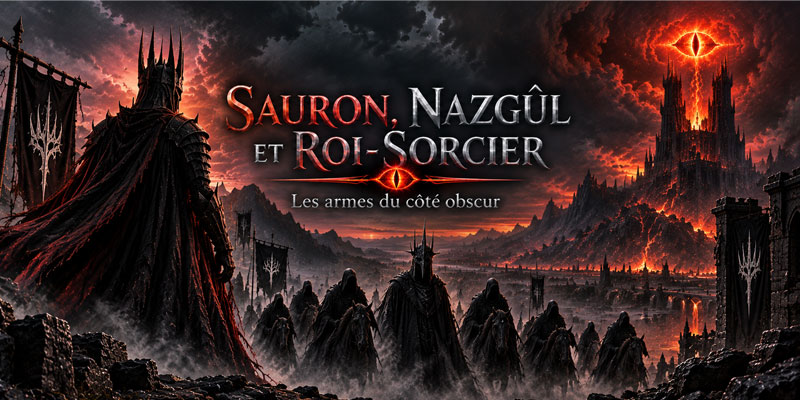
Sauron, the Nazgûl, and their terrible Witch-King embody this other facet of the universe. However, in Tolkien’s writings and Peter Jackson’s films, their equipment is not always depicted in the same way.
That's exactly what makes their story so fascinating.
Sauron is not a Man who has become extremely powerful. He belongs to the Maiar, spiritual beings from Tolkien's world. Gandalf, in fact, also belongs to this order, although their paths are radically different.
Originally, Sauron was associated with Aulë, before becoming the servant of Morgoth, the first Dark Lord. After the latter's defeat, Sauron gradually became the principal evil force in Middle-earth.
In the Second Age, Sauron took on the guise of Annatar, the «Lord of Gifts,» and won the trust of the Elven smiths of Eregion. He imparted some of his knowledge to them and thus played a decisive role in the creation of the Rings of Power. He then secretly forged the One Ring in the flames of Orodruin in order to dominate the other Rings.
His most famous weapon among the general public, however, is something else entirely.
In the opening scene of Peter Jackson's *The Fellowship of the Ring*, Sauron appears on the battlefield clad in imposing black armor.
In his hands is a gigantic arsenal. Each strike knocks several opponents to the ground and immediately reinforces the character's impression of power.
This weapon has become one of the most recognizable objects associated with Sauron.
However, we must distinguish Tolkien's work from its film adaptation. The books do not describe Sauron fighting during the Last Alliance with that immense mass as it appears in the film.
His appearance and weapon are therefore largely the result of the design work done for Peter Jackson's trilogy.
This is an excellent example of how cinema has created images that are now almost inseparable from Middle-earth.
Visit Nazgûl, also known as the Ringwraiths, were once nine Men who were given Rings of Power.
Little by little, they fell under Sauron's rule.
In the Third Age, they become his most feared servants. Their presence instills an almost supernatural fear, while their primary mission is to find the One Ring.
Their appearance as black figures on horseback has become iconic. Yet their true danger does not lie solely in their swords.
On Amon Sûl, the Witch-King, leader of the Nazgûl, attacks Frodo with a Morgul blade. A shard remains lodged in his wound and is gradually threatening to pull him into the world of the Spectres.
Here, then, the weapon is not used solely to inflict injury: It becomes a means of corruption.
At the head of the nine Specters is the Wizard-King of Angmar.
His history extends far beyond the events of the War of the Ring. Centuries earlier, he ruled the kingdom of Angmar and played a part in the destruction of the kingdom of Arnor.
During the Battle of the Pelennor Fields, he emerged as one of the principal commanders of Sauron's forces.
That is when one of the story's most famous moments takes place.
The Wizard King then faces Éowyn, with Merry's help. Merry strikes him behind the knee with an ancient blade forged in the kingdom of Arnor to fight the forces of Angmar. His intervention allows Éowyn to deliver the decisive blow.
And so the ancient prophecy of Glorfindel, according to which the Witch-King would not fall at the hand of a man. Here, Tolkien masterfully plays with words and the reader’s expectations: one of the most terrifying beings in Middle-earth is ultimately defeated thanks to the combined efforts of a woman and a Hobbit, two characters whom many might have underestimated.
The weapons of Mordor and its minions therefore serve a different purpose than Narsil or Glamdring.
They do not primarily represent a heroic lineage. They are part of the fear, domination, and corruption who accompany Sauron's forces.
The movies further emphasized this aspect through instantly recognizable figures: black armor, menacing blades, and Sauron’s gigantic form.
This aesthetic has become so famous that it is sometimes difficult to distinguish between what Tolkien actually described and what the movies added.
And this boundary between books and movies will in fact be essential to understanding why the weapons in *The Lord of the Rings* look the way we know them today.
After several thousand years of history, a few points of reference wouldn't hurt! Some weapons date back to the First Age, while others are associated primarily with the heroes of the Third Age.
This table allows you to quickly find the main weapons, who carries them, and their distinctive features.
| Weapon | Related character | Origin or period | Key Takeaways |
|---|---|---|---|
| Narsil | Elendil, then Isildur | Second Age | Shattered during the battle against Sauron, its fragments were preserved for generations. |
| Andúril | Aragorn | Senior Citizens | Narsil was reforged for Aragorn and renamed «Flame of the West.». |
| Glamdring | Turgon, then Gandalf | First Age, Gondolin | An ancient sword belonging to the King of Gondolin, rediscovered millennia later. |
| Orcrist | Thorin Oak-Shield | First Age, Gondolin | An ancient elven blade feared by the goblins, which was later placed on Thorin's grave. |
| Sting | Bilbo, then Frodo | First Age, associated with Gondolin | A small elven blade that glows when near orcs or goblins. |
| Herugrim | Théoden | Third Age, Rohan | The name of King Théoden's sword in Tolkien's writings. |
| Éowyn's Sword | Éowyn | Third Age, Rohan | His now-famous appearance is primarily associated with film adaptations. |
| Theodred's Sword | Theodred | Third Age, Rohan | A weapon associated with Théoden's son and heir in the visual universe of the films. |
| Boromir's Sword | Boromir | Third Age, Gondor | His sword and shield play a major role in shaping the character's warrior identity in the movies. |
| Gimli's axe | Gimli | Senior Citizens | In Tolkien's works, Gimli carries a broad-bladed axe; in Peter Jackson's films, he is shown wielding several different models. |
| Legolas' Bow | Legolas | Senior Citizens | The Elf's signature weapon, reflecting their extraordinary skill in long-range combat. |
| Morgul's blade | Wizard-King / Nazgûl | Senior Citizens | Used against Frodo at Amon Sûl, it left a shard in his wound. |
| Sauron's Army | Sauron | Film adaptation | A spectacular weapon made famous by Peter Jackson's movies. |
This table also reveals something essential: Not all of the weapons we associate with *The Lord of the Rings* today have the same status.
Narsil, Andúril, Glamdring, Orcrist, Dard, and Herugrim are mentioned in Tolkien's writings.
On the other hand, several weapons that have become instantly recognizable owe much of their visual identity to the film adaptations. This is particularly true of the swords associated with Éowyn, Théodred, and Boromir, as well as Sauron’s impressive mace.
This distinction in no way diminishes their appeal. On the contrary, it helps us understand how the universe Tolkien imagined became a visual world that is instantly recognizable.
And behind this transformation was, in particular, a director who would forever change the general public’s perception of Middle-earth: Peter Jackson.
For millions of viewers, their first encounter with Middle-earth did not take place in Tolkien’s books, but in a movie theater.
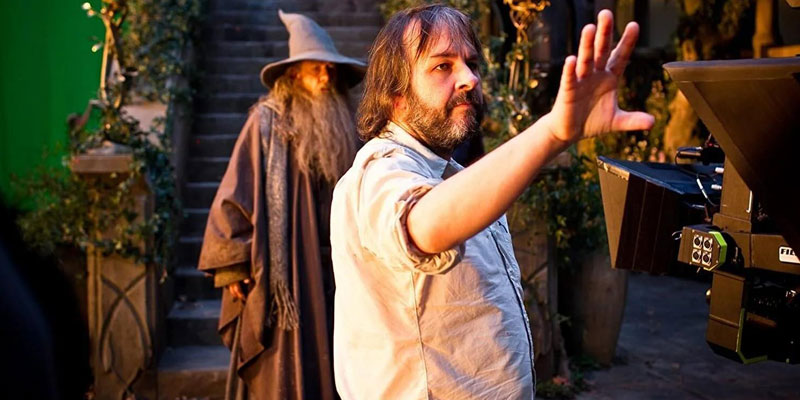
Between 2001 and 2003, Peter Jackson brings *The Fellowship of the Ring*, *The Two Towers*, and *The Return of the King* to the screen. Filmed in New Zealand, this trilogy gives a visual identity—as spectacular as it is—to a large part of the world imagined by Tolkien for the first time.
Minas Tirith, the Shire, Rohan, and Mordor suddenly seem to exist.
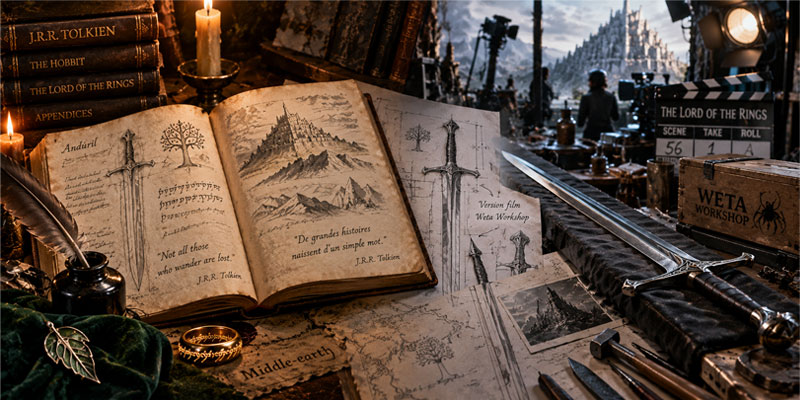
But this work obviously doesn't rest on Peter Jackson alone. Behind every suit of armor, every creature, and many Weapons from *The Lord of the Rings* There are artists and artisans whose job it is to transform Tolkien's descriptions into believable objects.
Based in New Zealand, Wētā Workshop plays a major role in this transformation.
In particular, his teams help create the armor, weapons, creatures, prosthetics, and numerous props used in the films.
The challenge is immense.
A sword from Gondor should not resemble a weapon from Rohan. Similarly, objects belonging to the Elves, the Dwarves, or Sauron’s forces should immediately evoke their distinct cultures.
The shapes, materials, patterns, and even the wear and tear on objects all help tell the story of the people who use them.
Middle-earth then becomes a world that we no longer merely imagine: We can now see it down to the smallest detail.
This work is particularly evident in the weapons from *The Lord of the Rings*.
Andúril must evoke the legacy of Elendil and the return of the king. Glamdring must appear ancient and noble enough to have endured through the centuries before coming into Gandalf’s possession. Dard, which is much smaller, must remain believable as a Hobbit’s sword.
Conversely, weapons associated with Mordor must immediately convey a sense of menace.
Sauron’s gigantic form is probably one of the best examples of this. It took only a few moments at the beginning of *The Fellowship of the Ring* for his silhouette to become etched in the collective imagination.
In this way, cinema gives weapons a second dimension: they no longer simply tell a story, They also make it possible to immediately recognize the person wearing them.
Among the designers who contributed to this visual identity, Peter Lyon holds a special place.
A weapons master and craftsman, he works on many of the swords used in productions set in Middle-earth. Behind the objects that appear on screen for just a few seconds often lie weeks of design, fabrication, and testing.
We must also take into account the constraints of filming.
A prop designed for a close-up does not necessarily have the same characteristics as one used in a fight scene. Therefore, several versions of the same prop can be made as needed: detailed models, lighter versions, or props adapted for stunts.
This fact also helps explain why a collector's replica should not be confused with the exact prop used during filming.
The trilogy's success quickly extended beyond the big screen.
New Zealand's landscapes have come to be associated with Middle-earth. The characters' silhouettes have become iconic in popular culture. As for weapons, jewelry, helmets, and other items, they have become sought after by collectors around the world.
For many fans, Andúril now looks like the Andúril from the movies, just as "Glamdring" immediately brings to mind the sword wielded by Gandalf.
This may be one of the trilogy’s greatest visual achievements: giving Middle-earth a presence strong enough that it continues to exist in the collective imagination more than twenty years after the films were released.
However, this visual fidelity does not mean that Peter Jackson reproduced every detail exactly as Tolkien had written it.
And when you compare the books to the movies, certain weapons actually hold a few surprises.
Adapting *The Lord of the Rings* for the big screen inevitably requires making choices.
Tolkien sometimes provides a great deal of information about the history or name of a weapon, without, however, describing every detail of its hilt, guard, or blade. The artists working on the films therefore had to transform words into objects that viewers could immediately recognize.
That is why some Weapons from *The Lord of the Rings* Today's famous figures owe just as much to Tolkien for their story than in the movies by Peter Jackson for their appearance.
In both versions, Andúril is forged from Narsil, Elendil's broken sword. However, the timing of its reforging differs significantly.
In the book, Narsil is reforged before the Fellowship of the Ring set out. So Aragorn already has Andúril when he leaves Rivendell.
In the movies, Peter Jackson deliberately delays this event. Narsil remains broken for much longer, and Elrond finally brings Andúril to Aragorn before his journey along the Paths of the Dead.
This change gives the reforging a very cinematic impact: the moment directly coincides with Aragorn's acceptance of his royal heritage.
In Tolkien's works, Dard already possesses an extraordinary characteristic: like Glamdring and Orcrist, the blade is linked to the ancient weapons of Gondolin and reacts to the presence of Orcs.
Film naturally transforms this property into a visual cue that is extremely easy to understand.
When Orcs or Goblins approach, Dard's blade turns blue. The viewer immediately realizes that danger is near, without needing any further explanation.
This is a perfect example of an element from books that the movies have made even more recognizable.
FROM BOOKS TO MOVIES
Narsil and Andúril
In the book: Narsil was reforged in Rivendell before the Fellowship set out. Aragorn therefore began the journey with Andúril.
In movies: The reforging is delayed. Elrond brings Andúril to Aragorn before the Paths of the Dead.
Sting
From Tolkien: The elven blade glows when it detects the presence of orcs or goblins.
On screen: This property creates a spectacular visual signal: the blade turns a vivid blue when danger approaches.
One story, two ways to tell it: Tolkien gives weapons their history and meaning; cinema transforms these elements into images that are immediately understandable.
Legolas is another interesting case.
Tolkien equips him, among other things, with a bow and a long white knife. Yet the image many viewers still have of the character today is that of a warrior fighting not only with his bow but also with two long elven blades.
The movies therefore place a strong emphasis on developing his gear to suit his fighting style and give him an instantly recognizable identity during battles.
Once again, the film does not start from scratch: it visually expands on elements present in the text.
The gigantic weapon used by Sauron during the Battle of the Last Alliance has become inextricably linked to the character for many fans.
However, Tolkien does not describe this scene with such an immense mass as it appears in the movie.
Here, the’A film adaptation truly creates a new image, powerful enough to go on to become a benchmark in video games, collectibles, and the imaginations of fans.
These differences do not necessarily mean, therefore, that the films «betray» the books.
A novel can tell the story of a sword’s origins, its name, its former owners, and what it represents. Film must also give it a form, proportions, and a visual identity.
That is why it is helpful to distinguish between what Tolkien actually wrote of what the adaptations have imagined or developed.
And this convergence of literature and film undoubtedly explains part of *The Lord of the Rings*’ incredible longevity. More than seventy years after the novels were published, New generations are still discovering Middle-earth.
Published in the mid-1950s, *The Lord of the Rings* could have been written in a different era. Yet Middle-earth continues to attract new readers and viewers.
The reason is quite simple: Every generation now has its own gateway into Tolkien's world.
Some people discover Frodo, Aragorn, or Gandalf through the books. Others start with Peter Jackson’s movies. Younger readers may be introduced to this world through TV shows, video games, or simply by spotting a sword in a collection.
And sooner or later, many people discover that there is a much broader story behind these characters.
One of Tolkien's greatest strengths is that he made it seem as though Middle-earth had existed long before the story told in *The Lord of the Rings*.
Ruins have a past. Every people has its own languages and traditions. The characters speak of kings who have been dead for centuries, while some weapons have already survived several Ages.
Readers can therefore start with Frodo's story and then gradually work their way back to Bilbo, Númenor, Gondolin, the Silmarils, or the ancient wars against Morgoth.
The more we explore this universe, the larger it seems to become.
💡 Did you know? An early work by Tolkien is coming to France in 2026
More than fifty years after J.R.R. Tolkien’s death, his works continue to be published and translated. On September 17, 2026, The Story of Kullervo is being published in French for the first time by Christian Bourgois.
Inspired by the Kalevala This tragic, unfinished Finnish tale dates back to Tolkien’s youth. The author considered it an important step in his quest to create his own legends. Kullervo would later influence, in particular, the story of Túrin Turambar, one of the great tragic figures in his *Légendaire*.
More than a century after his early work on this story, Tolkien continues to offer new discoveries to French readers.
For further reading: Le Figaro – Tolkien’s novel published in France decades after it was written
Peter Jackson's trilogy then brought Middle-earth exceptional global recognition.
For an entire generation, Gandalf has the face we saw on the big screen, the Shire resembles the green hills of New Zealand, and the arrival of the Rohirrim on the Pelennor Fields remains one of the most memorable scenes in the trilogy.
Then something interesting happened: Some viewers have become readers.
After discovering the movies, some people wanted to understand what had happened before the War of the Ring, find out how the movies differed from the novels, or simply learn more about the characters.
So the movies haven't replaced Tolkien. For many, they were the first step toward discovering his books. The Weapons from *The Lord of the Rings* They, too, play a part in this intergenerational transmission.
Middle-earth didn't end with the film trilogy.
The adaptations of *The Hobbit*, TV series set in other time periods, and numerous video games have introduced new audiences to this universe.
So everyone can discover Tolkien in a different way.
One player might first become interested in Mordor. A viewer might want to understand who Sauron was before the War of the Ring. Another might discover Númenor through a TV series before exploring its history in the books.
These adaptations do not always retell the events in exactly the same way. However, they keep alive a curiosity about a world imagined many generations ago.
But the enduring popularity of *The Lord of the Rings* is not based solely on its adaptations.
At the heart of the story are themes that are extremely easy to understand: friendship, courage, the temptation of power, loyalty, loss, and hope.
Frodo is no great warrior. Sam is neither a king nor a wizard. Yet the fate of Middle-earth depends on them as well.
Aragorn must accept a legacy that is beyond him. Gandalf guides rather than rules. Gimli and Legolas learn to put aside the old rivalries between their peoples.
Perhaps that is why this world continues to resonate across generations.
You might come for the battles, the Elves, the Hobbits, or the legendary swords. Then, little by little, you discover something much bigger.
And sometimes, that passion makes you want to keep things at home a little piece of Middle-earth.

After exploring thousands of years of history, it becomes easier to understand why items inspired by Middle-earth hold such a fascination for collectors.
A replica of Andúril is no longer just a sword hanging on a wall. It brings to mind Narsil, Elendil, Isildur, and ultimately Aragorn. Dard evokes both Bilbo and Frodo. A Rohan helmet evokes an entire people of horsemen, while the One Ring alone symbolizes a large part of the work.
Collecting these objects is, ultimately, a way of preserving a piece of a story we love.
Among the Weapons from *The Lord of the Rings*, swords naturally hold a special place in collections.
Andúril, Narsil, Glamdring, and Dard have become so famous that even people who have never read the novels sometimes recognize them. But a collection dedicated to Middle-earth can go much further with the collectors.
Helmets, the weapons of Rohan and Gondor, objects associated with Sauron, and pieces inspired by the various peoples allow us to explore other facets of this universe.
Some collectors choose a specific character. Others prefer to build a collection around a theme: Gondor, Rohan, the forces of Mordor, or ancient Elven weapons.
So there isn't just one way to collect items from Middle-earth.
Not all iconic objects are weapons.
The One Ring is obviously the best example of this. As the central focus of the story, it has become one of the most recognizable symbols in all of fantasy.
But jewelry Items inspired by this world also feature other characters and symbols: pendants, rings, brooches, and objects evoking the Elves and their kingdoms.
They offer a more discreet way to keep a reminder of Middle-earth—and sometimes even to wear it every day.
So, two enthusiasts can love exactly the same universe while building completely different collections.
When you start a collection, it's important to take a close look at what you're buying.
A decorative replica inspired by a movie weapon is not necessarily an officially licensed product. Similarly, a replica intended for display should not be confused with a weapon designed for practical use.
The materials, dimensions, weight, finishes, and whether or not the product has an official license are therefore important pieces of information.
This distinction is particularly useful in the world of *The Lord of the Rings*, where one can find both official items and decorative replicas inspired by the designs seen in the movies.
Ultimately, the best choice depends on what the collector is looking for: a character, a memory, a beautiful object to display, or a special artifact from Middle-earth.
You don't have to have all of Middle-earth in your living room—that would probably take up quite a bit of space! 😄
Sometimes just one piece is enough.
For some, it will be Andúril because Aragorn remains their favorite character. For others, it will be Glamdring, an elven jewel, Gimli’s helmet, or an object associated with Sauron.
Ultimately, the most important thing is to understand what the object you choose represents.
Because once you've discovered its origin, its owner, and its history, A replica is no longer just a reproduction: It becomes a tangible reminder of a world we want to bring into our homes.
⭐ Réplique Manga Ciné's Tip
When starting a collection dedicated to Middle-earth, don't necessarily try to accumulate a large number of items. Instead, start by the character, the people, or the story that moves you the most.
An Andúril will hold special meaning for an Aragorn enthusiast, while a fan of Rohan might prefer the sword or helmet of one of its heroes. Elf enthusiasts might opt for a piece of jewelry or an ancient blade, while collectors drawn to Mordor will naturally choose items associated with Sauron or the Nazgûl.
Be sure to also check dimensions and weight Before making a purchase—especially when it comes to large swords, helmets, and other imposing pieces—this will help you plan from the start where your new piece will be best displayed.
The world of *The Lord of the Rings* was created by the British writer and philologist J.R.R. Tolkien. He did not limit himself to the story of Frodo and the One Ring: he imagined peoples, languages, kingdoms, and a timeline spanning several thousand years. Much of this mythology is now grouped under the name “Tolkien’s Legendarium.”.
It’s not required, but starting with *The Hobbit* lets you get to know Bilbo, Gandalf, Gollum, the Ring, and Dard before the events of *The Lord of the Rings*. The novel is also a more accessible introduction to Tolkien’s work. Those who then wish to explore the much more ancient times of Middle-earth can continue with *The Silmarillion* and other texts.
It is, in fact, the same sword at two different points in its history. Narsil belonged to Elendil and was broken during the Last Alliance against Sauron. Its fragments were preserved, and then, in the Third Age, the blade was reforged for Aragorn. It was then given a new name: Andúril, the Flame of the West.
The sword carried by Frodo is called Dard (Sting in English). Bilbo discovered it long before Frodo did during his adventure recounted in *The Hobbit*. He then passed it on to Frodo. This ancient Elven blade is connected to Gondolin and has the unique ability to sense the presence of Orcs or Goblins.
Gandalf carries Glamdring, an ancient Elven sword from Gondolin. It once belonged to Turgon, King of Gondolin, long before the events of *The Hobbit* and *The Lord of the Rings*. Gandalf discovers it in a troll hoard while accompanying Bilbo and Thorin.
No. Sauron is a Maia—that is, a spiritual being from the world Tolkien imagined. Before becoming the Dark Lord, he served Morgoth, among others. Gandalf is also a Maia, although his role and life story are obviously very different from those of Sauron.
Not in the spectacular form made famous by the movies. The gigantic form of Sauron used during the Battle of the Last Alliance is primarily a visual creation from Peter Jackson’s adaptations. It has become so iconic that many viewers now naturally associate it with the character.
Not always. Tolkien sometimes provides the name, origin, and history of a weapon without describing every aesthetic detail. The film crews therefore had to imagine what the weapons would look like for the big screen. That is why it is important to distinguish between the history of the weapon as written by Tolkien and its design, which became famous in Peter Jackson’s adaptations.
More than seventy years after the publication of *The Lord of the Rings*, Middle-earth continues to thrive.
Tolkien's books are still being read and reprinted. Some of his works are still being published in new editions or translated, as we have just seen with *The Tale of Kullervo* in France in 2026.
Movies, TV shows, and video games also allow new generations to meet Gandalf, Aragorn, Sauron, and the Hobbits.
And this story is far from over.
One of the upcoming major events will be The Hunt for Gollum, a new film set in the cinematic universe created by Peter Jackson.
This time, the story will explore a period that viewers are much less familiar with: The search for Gollum before the main events of *The Lord of the Rings*.
In Tolkien's writings, Gandalf gradually comes to understand the true danger posed by the ring in Bilbo's possession. Aragorn then joins the search for Gollum, whose past may provide valuable information.
This part of the story is relatively understated in the film trilogy. Yet it provides a fascinating link between *The Hobbit* and *The Lord of the Rings*.
For those who would like to learn more about this project, its timeline, and what is currently known about the film, we have dedicated a complete file at The Hunt for Gollum, which we will continue to update until its release.
Perhaps that is ultimately what makes Middle-earth so special.
Tolkien began building his universe long before *The Hobbit* was published. Peter Jackson then gave it a cinematic identity that has become world-famous. Even today, new adaptations allow us to explore parts of this story that have remained in the shadows.
But behind the movies, TV shows, and collectibles, there are always the same foundations: stories, languages, peoples, and legends created by J.R.R. Tolkien.
Narsil can be reforged into Andúril. A sword from Gondolin can reappear thousands of years later in Gandalf’s hands. A simple Hobbit can bear the fate of Middle-earth.
And a reader who discovers this world today through a movie, a video game, or even a sword may, in turn, want to go back to the stories that started it all.
For in Middle-earth, every object has a story. And behind every story often lies another legend waiting to be discovered.