




*From 2 to 14/02/2026. Excluding items already on sale. Offer applied directly to basket, and valid on all additional, lower-priced items.
Forged from the shards of Narsil, Andúril accompanies Aragorn as Isildur’s heir prepares to fulfill his destiny. Named the «Flame of the West,» this sword becomes one of the great symbols of the king’s return.
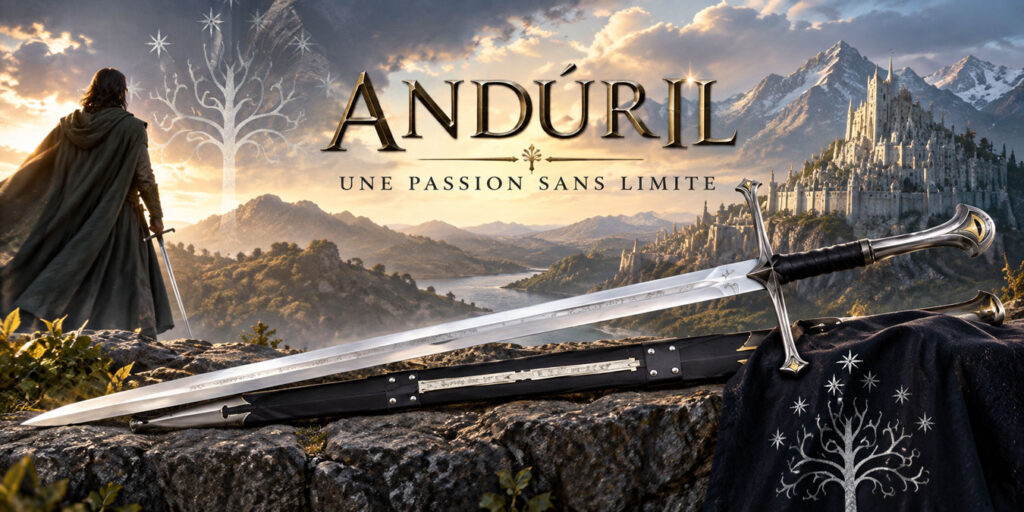
Andúril is the sword that accompanies Aragorn as he gradually ceases to be merely Isildur’s heir and fully claims his legacy. Forged from the fragments of Narsil, it is given a new name: Andúril, the Flame of the West.
However, its significance goes far beyond that of a mere weapon. Its blade bears symbols associated with the heirs of Elendil. Its name also evokes light and the West, while its return heralds the return of a long-lost royal line.
Tolkien thus gives it a special place in Aragorn’s journey. However, Peter Jackson’s films depict his return in a significantly different way. The moment of the reforging changes, as do the circumstances under which Aragorn comes into possession of the sword.
Between its Númenorean heritage, royal symbols, and film adaptation, Andúril has a history far richer than its now-famous appearance.
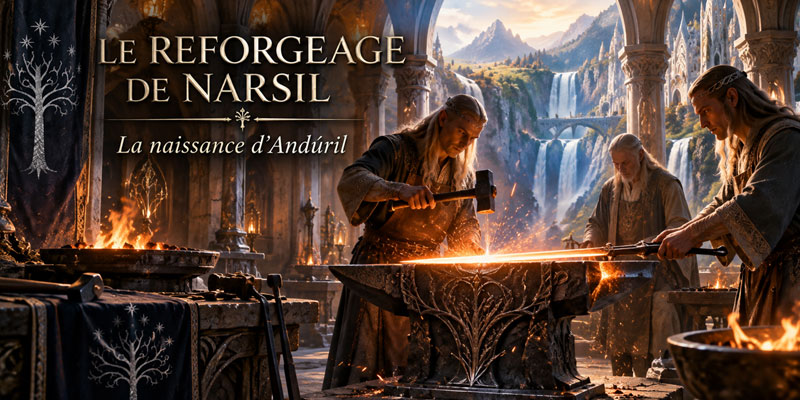
For more than three millennia, the fragments of Narsil have been passed down through the generations among Isildur’s heirs. This long history, however, belongs to another era in the blade’s life. With its reforging in Rivendell, a new chapter begins.
In the year 3018 of the Third Age, the Elven smiths of Rivendell reforged the fragments of Narsil. The blade was restored to its former state, but it did not simply regain its old identity. Aragorn gave it a new name: Andúril.
This change marks a true rebirth. Narsil still represented the memory of Elendil, the downfall of Sauron, and a legacy passed down through generations. Andúril now accompanies the one who must carry on that legacy.
In fact, Tolkien sets this transformation very early in the story. When the Fellowship leaves Rivendell, Aragorn is already carrying the reforged blade.
This is precisely where our two stories pick up where the other left off: *Narsil* tells the story of the shattered legacy; *Andúril* begins when that legacy is brought back to life.
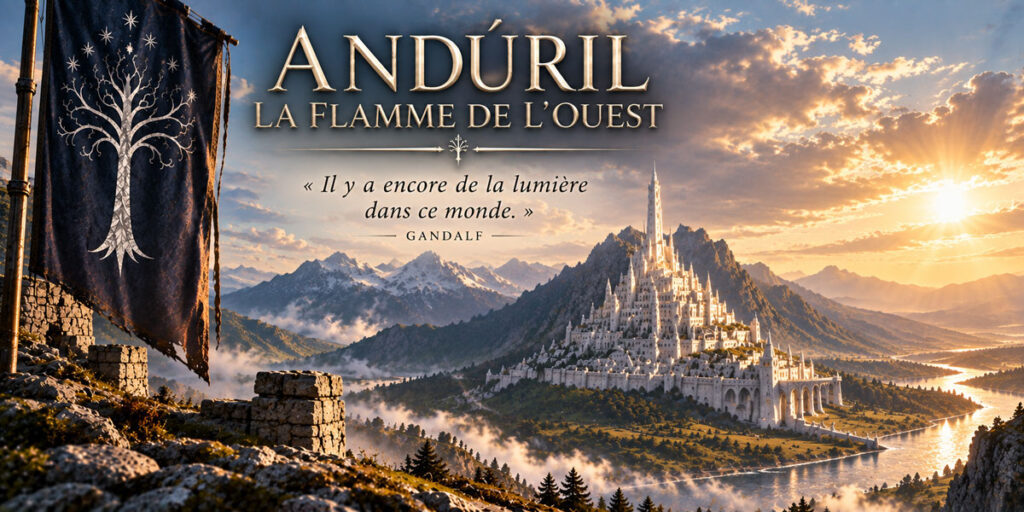
After it was reforged, Aragorn named the new blade Andúril. Tolkien derived this name from Quenya, one of the main Elvish languages in his universe. He translates it as «Flame of the West,» which is generally rendered in French as «Flamme de l’Ouest.».
This name is by no means insignificant. The West holds a central place in the history of Middle-earth. It evokes Valinor in particular, but also the legacy of the Númenóreans, from whom Aragorn is descended. Andúril thus connects its bearer to a past far older than the kingdom of Gondor.
The image of the flame reinforces this symbolic dimension. After centuries during which Narsil lay broken, the blade is reborn just as Isildur’s heir prepares to play a decisive role in the battle against Sauron. The Flame of the West thus becomes as much a sign of hope as it is a weapon.
Aragorn also uses another name to refer to it: the Reforged Flame of the West. Through Andúril, Tolkien is not simply bringing a sword back to life. He is bringing back to life everything it represents.
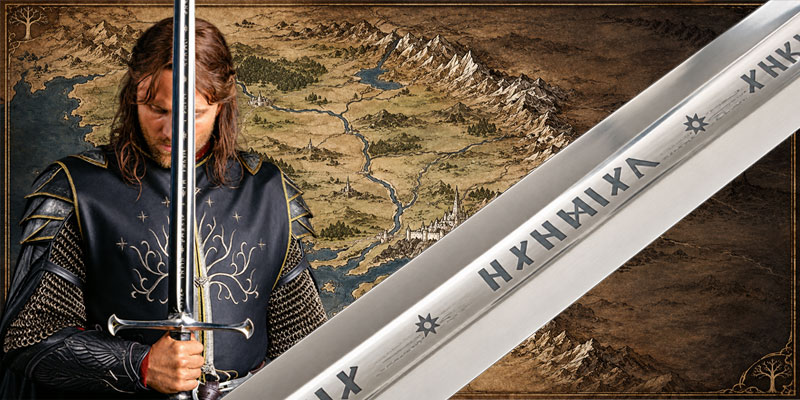
When the Elven smiths reforged Andúril, they did not merely restore the ancient blade of Narsil to its former integrity. Tolkien notes that several symbols now appear on the sword. Seven stars are arranged between a radiant Sun and a crescent Moon, accompanied by numerous runes, or cirth.
These emblems are a direct reference to the lineage of which Aragorn is the heir. The Seven Stars, in particular, are a symbol of Elendil. They echo the seven ships of the Faithful, each of which carried one of the Palantíri during the flight from Númenor.
The Sun and the Moon complete this dynastic representation. They represent Anárion and Isildur, respectively, the two sons of Elendil. The blade thus symbolically unites the father and his two heirs.
Tolkien also emphasizes its radiance. In the sunlight, Andúril glows with a fiery light. In the moonlight, its radiance turns cold. Thus, even before Aragorn wears a crown, his sword already symbolizes the history and legitimacy of his lineage.
💡 Did you know?
In Lothlórien, Galadriel gives Aragorn a scabbard specially designed for Andúril. Tolkien describes it as covered with an interlacing pattern of silver and gold flowers and leaves. Elvish runes, made of gems, also indicate the sword’s name and lineage. Galadriel even points out that a blade drawn from this sheath will neither be stained nor broken, even in the face of defeat. A sheath truly worthy of the Flame of the West!
When Aragorn leaves Rivendell with the Fellowship of the Ring, he takes Andúril with him. For the first time in millennia, Elendil’s ancient sword is thus restored to its full form in the hands of his descendant.
However, Aragorn does not carry Andúril merely as a weapon. On several occasions, he uses its name and history to assert his identity. In front of the Rohirrim, in particular, he introduces himself as Aragorn, son of Arathorn, heir to Isildur, and points to the reforged blade as one of the signs of his heritage.
Andúril also plays a particularly significant role when Aragorn travels along the Paths of the Dead. His authority over the Dead does not stem solely from the sword, but the presence of Elendil’s reforged blade reinforces the image of the heir who has returned to claim the fulfillment of an ancient oath.
Thus, Tolkien gradually links Andúril to Aragorn’s legitimacy. The sword does not make him a king; rather, it reveals to the world the legacy he has chosen to embrace.
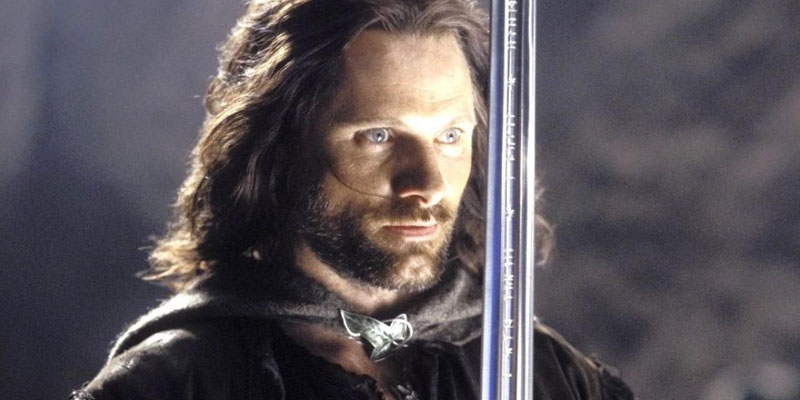
In Tolkien's books, Andúril appears much earlier than in the movies. The Elven smiths reforge Narsil in Rivendell before the Fellowship of the Ring sets out. Aragorn therefore begins his journey south with Andúril by his side.
Peter Jackson chooses a different timeline. In his trilogy, the fragments of Narsil remain in Rivendell for much of the story. Elrond eventually asks for the sword to be reforged, then brings it to Aragorn himself before his journey through the Paths of the Dead.
This change reinforces the character’s dramatic arc. The viewer sees Aragorn struggle for a long time with his legacy before fully accepting what it represents. The arrival of Andúril then marks this turning point.
In Tolkien's work, Aragorn accepts his identity and his rights much earlier. Andúril accompanies him on his path to kingship; in the movies, it becomes more of a visual symbol of the moment when he accepts his destiny.
💡 Did you know?
In The Lord of the Rings In Tolkien's work, Aragorn already possesses Andúril when he encounters the Rohirrim. He even brandishes the blade as he introduces himself as Isildur’s heir. In Peter Jackson’s films, this scene obviously cannot play out in the same way: at this point in the story, Andúril has not yet been reforged.
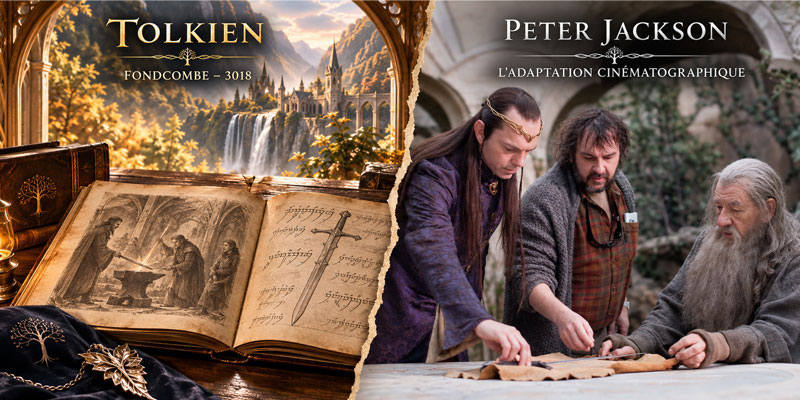
Tolkien describes Andúril through several symbolic elements, but he does not provide a detailed drawing of the sword. After it was reforged, the blade bears the Seven Stars, a radiant Sun, a crescent Moon, and cirth. Its brilliance also plays an important role in the author’s descriptions.
The appearance now associated with Andúril comes primarily from Peter Jackson’s trilogy. For the films, the artists at Weta Workshop designed a long, elegant sword with a straight guard, an ornate pommel, and a dark hilt. This design gives the weapon a regal appearance while remaining relatively understated.
The film version primarily features Elvish inscriptions visible on the blade. These should not be confused with a precise description provided by Tolkien. They are part of the adaptation process undertaken to give Andúril an identity that is immediately recognizable on screen.
It is precisely this cinematic appearance that inspires most of today’s reproductions of Andúril. For a collector, the engravings, the shape of the guard, and the pommel are therefore particularly important details to look for.
On the Andúril created for Peter Jackson’s films, a long inscription accompanies the symbols of the Sun, the Moon, and the Seven Stars. The text is in Quenya, but it is not an inscription given word for word by Tolkien in *The Lord of the Rings*. It is part of the work done for the film adaptation.
Its meaning can be translated as follows: «I am Andúril, once Narsil, the sword of Elendil. May the servants of Mordor flee before me.» The Sun and the Moon also frame this inscription.
This detail is particularly interesting for collectors. The engravings visible on the film-inspired reproductions are therefore not merely decorative. They directly reveal the blade’s identity: its former name, its connection to Elendil, and its rebirth as Andúril.
Tolkien, for his part, clearly states that runes surround the emblems on the reforged blade, but he does not provide their text. It is this difference that distinguishes the literary description from the design that has become famous in film.
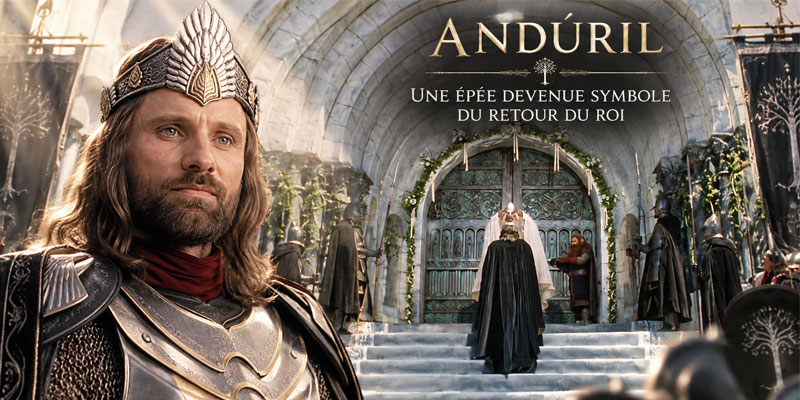
Andúril represents much more than the rebirth of a sword. When Narsil is restored to a complete blade and given a new name, the legacy of Elendil and Isildur also enters a new phase.
For generations, these fragments bore witness to a vanished kingdom and a lineage awaiting its time. With Aragorn, that wait comes to an end. The heir is no longer content merely to preserve the memory of his ancestors; he now moves forward to fulfill their legacy.
That is why Andúril so naturally accompanies the return of the monarchy. Its symbols evoke Elendil and his sons, while its new name affirms a rebirth. Yet the sword does not transform Aragorn into a king. It makes visible a legitimacy that already belongs to him by virtue of his birth, his choices, and his journey.
The difference between it and Narsil then becomes crucial. One carries the memory of a legacy cut short. The other embodies its fulfillment. Andúril thus becomes the symbol of a past finally reunited with the present and of a kingdom ready to be reborn.
Among the swords from *The Lord of the Rings*, Andúril holds a special place in the hearts of collectors. In fact, at Réplique Manga Ciné, it has been one of our best-sellers for many years. Its success stems as much from its connection to Aragorn as from its instantly recognizable appearance.
Some enthusiasts prefer to display the sword on its own to highlight its long blade and engravings. Others prefer a more complete presentation that includes the scabbard. Recent versions take this even further. A deluxe case, enhanced by a large engraved metal plate, adds further detail to the overall design.
Finally, one version pairs this sheath with an imposing wall plaque topped with a royal crown. This presentation immediately brings to mind Aragorn's destiny and reinforces the majestic nature of the line.
So, the choice doesn't depend solely on the sword itself. The way Andúril is displayed is now an integral part of the joy of collecting this legendary blade.
⭐ Réplique Manga Ciné's Tip
Before choosing your Andúril, consider the overall look you want to create in your display space. This sword has a particularly imposing silhouette. Be sure to allow enough space around it to fully appreciate its proportions and details. Displaying it with its scabbard helps create a more complete ensemble. Conversely, displaying the blade on its own draws more attention to its engravings and finish. Finally, if Andúril is to become the centerpiece of your collection, a regal display with a crown will naturally reinforce its connection to Aragorn and the Return of the King.
To compare Andúril to other iconic weapons from the saga, check out our collection of’Lord of the Rings swords, which features the great swords inspired by Middle-earth.
Yes, but under two different names. The Elven smiths reforged Andúril from the fragments of Narsil. Aragorn then gave the blade a new name. Narsil represents Elendil’s shattered legacy, while Andúril symbolizes his rebirth.
Andúril is a Quenya name that Tolkien translates as «Flame of the West,» or «Flamme de l’Ouest» in French. This new name marks the rebirth of Elendil’s ancient sword.
In the book, the Elven smiths of Rivendell reforge the fragments of Narsil before the Fellowship of the Ring sets out. Peter Jackson’s films move this event much later in the story.
Aragorn is a descendant of Isildur and belongs to the line of Elendil, the former owner of Narsil. The reforged blade thus becomes one of the visible symbols of his heritage and accompanies him on his path to kingship.
In Tolkien's work, the reforged blade bears the Seven Stars, a Sun, a crescent Moon, and cirth. The sword created for the films also features a long Elvish inscription that recalls its identity, its former name, Narsil, and its connection to Elendil.
In Tolkien’s work, Aragorn possesses Andúril from the moment he leaves Rivendell with the Fellowship. In the movies, Elrond brings him the sword much later, before Aragorn sets out on the Paths of the Dead.
Yes. In the book, Galadriel gives Aragorn a magnificent scabbard for Andúril in Lothlórien. Tolkien describes, among other things, silver and gold ornaments in the shape of flowers and leaves, as well as Elvish runes formed from gems.
Andúril possesses a symbolic power rarely found among the weapons of Middle-earth. Forged from the fragments of a broken sword, it accompanies Aragorn as Isildur’s heir fully embraces his legacy and moves toward his destiny.
Its symbols, its name, and its history connect several generations. Yet Tolkien and Peter Jackson each give it a different role in Aragorn’s journey. This difference also adds to the richness of its legend.
Today, its cinematic design has made its silhouette instantly recognizable. For fans and collectors alike, Andúril remains inextricably linked to Aragorn, the return of the king, and the rebirth of a long-awaited legacy.