

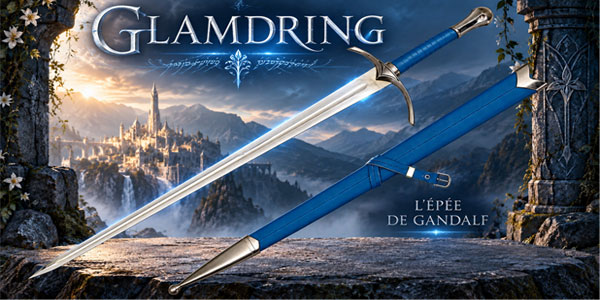
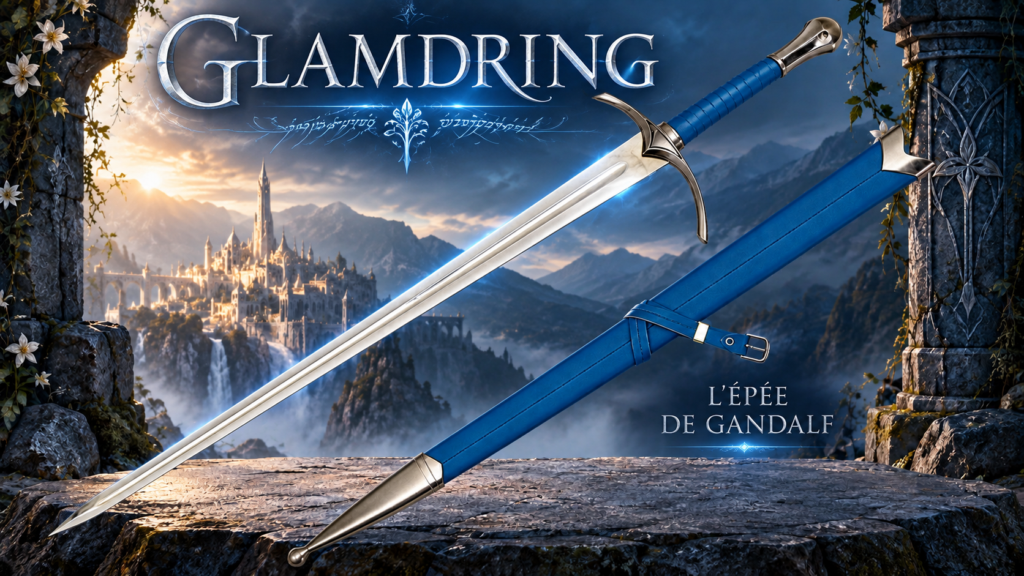
Forged in Gondolin during the First Age, lost for millennia, and then found by Gandalf in the lair of three trolls, Glamdring has a history that spans the Ages of Middle-earth.
Glamdring is much more than just the sword carried by Gandalf. Its story begins several thousand years before the events of *The Hobbit* and *The Lord of the Rings*, in one of the most famous Elven cities of the First Age: Gondolin.
Once wielded by Turgon, king of the hidden city, the blade disappeared after the fall of his kingdom. Tolkien does not specify what became of it during the centuries that followed. However, it reappears in the Third Age in a place that is, to say the least, unexpected: the lair of three trolls.
Gandalf discovers it alongside Orcrist, while Bilbo finds a third blade that will become Dard. In Rivendell, Elrond recognizes the ancient swords of Gondolin and reveals their origin. Glamdring then begins a new chapter in the life of the Gray Wizard.
Feared by the Goblins, used in the depths of Moria, and associated with one of Gandalf’s most famous battles, it thus features in two of Tolkien’s great adventures.
But what is Glamdring’s true origin? How did Turgon’s sword end up in Gandalf’s hands? And why does its appearance in the movies differ from what Tolkien tells us?
We are now going to recount the entire story of Glamdring, Gandalf’s sword.
A sword forged in the city of Gondolin
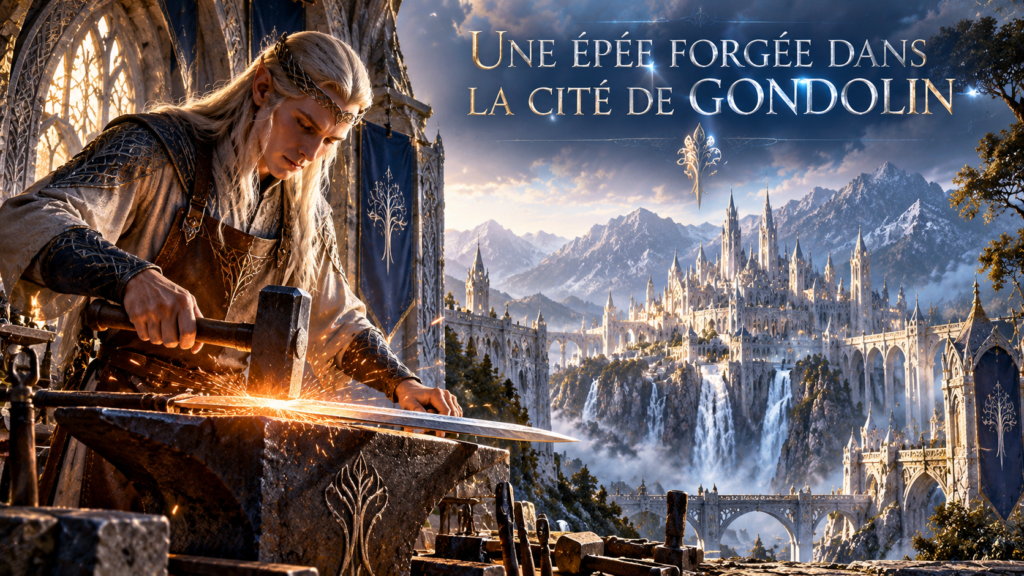
Long before it became Gandalf's sword, Glamdring belonged to a world that had already vanished millennia ago. Its story begins in Gondolin, one of the great Elven cities of the First Age.
Founded by Turgon in the secret valley of Tumladen, Gondolin remained hidden for a long time behind the Encircling Mountains. There, the Noldor built their city, safe from the forces of Morgoth. Its white walls, fountains, and the great Tower of the King made it one of the last great Elven refuges in Beleriand.
It was in this city that Glamdring was forged. Tolkien, however, does not specify either the exact date of its creation or the name of its blacksmith. It would therefore be risky to attribute it to any particular craftsman.
We do know, however, that this exceptional blade was wielded by Turgon, King of Gondolin. The texts also associate his sword with white and gold colors, as well as an ivory scabbard, even though the descriptions of Glamdring remain far less detailed than its appearance, which has become famous through film.
When Gondolin fell in the year 510 of the First Age, the city disappeared. Glamdring, however, mysteriously survived the catastrophe. It then began a journey spanning several millennia, of which Tolkien reveals only a part.
And it is precisely this mystery that makes his story so fascinating.
Gondolin remained hidden for nearly four centuries. Sheltered deep within the mountains, Turgon’s city was one of the last great Elven kingdoms to resist Morgoth. When it fell during the First Age, Glamdring nevertheless survived its destruction. It would be more than six millennia before the sword reappeared in history, in the hands of Gandalf.
Turgon, the sword's first owner
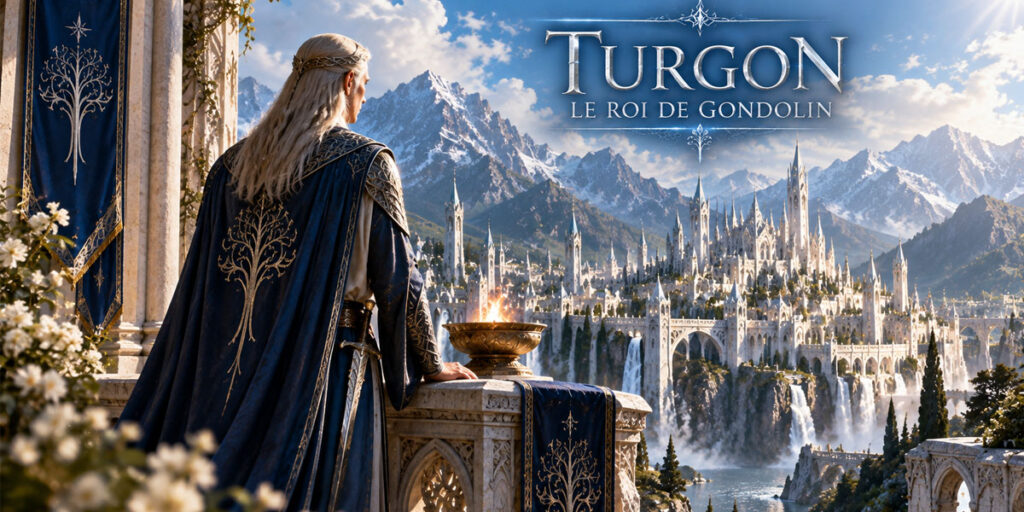
Before Gandalf, Glamdring belonged to Turgon, King of Gondolin and one of the most important Elven rulers of the First Age. The son of Fingolfin, he reigned over the hidden city until its destruction in 510. After the death of his brother Fingon, he also became High King of the Noldor.
Tolkien describes Turgon carrying a white and golden sword in an ivory scabbard. In *The Hobbit*, Elrond then clearly establishes the connection to Glamdring when he explains to Gandalf that this blade was once wielded by the King of Gondolin.
Its history also explains the sword’s extraordinary reputation. The Orcs know it as «Beater,» which can be translated as «The Beater» or “The One Who Strikes.” Thousands of years after the fall of Gondolin, its memory still strikes fear into the hearts of the Goblins of the Misty Mountains. Tolkien does not, however, specify exactly which battles forged this reputation. The connection to Turgon’s great battles is therefore partly inferred from its history.
Turgon died during the fall of Gondolin. His tower collapsed on top of him as the city was destroyed. However, Glamdring survived.
How could the sword of an elven king who disappeared in the First Age have reappeared, millennia later, in a troll cave?
That is where one of the greatest mysteries in its history begins.
What became of the sword after the fall of Gondolin?
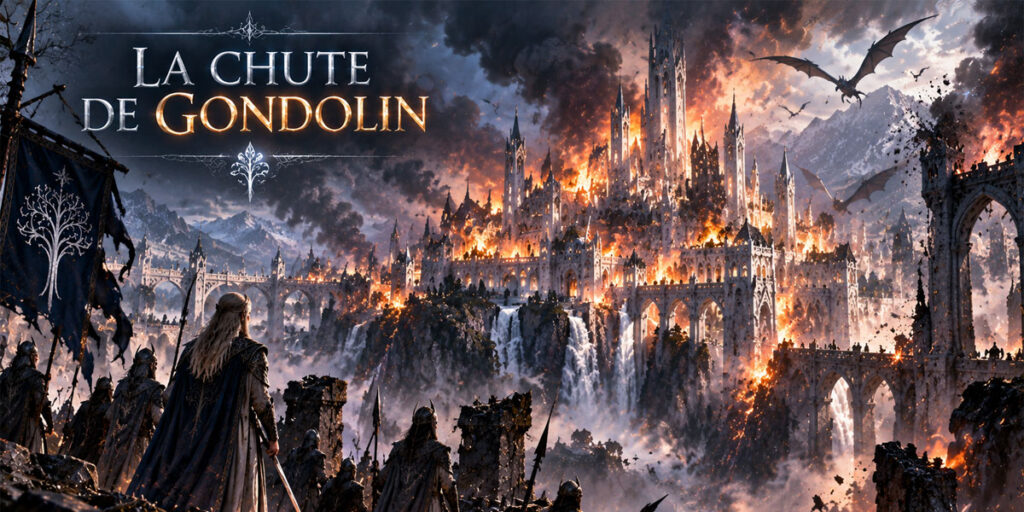
When Gondolin fell in the year 510 of the First Age, Glamdring disappears from the stories for several millennia. Turgon dies in the destruction of his city, but his sword evidently escapes the same fate. Tolkien, however, does not explain how it was saved, nor who possessed it afterward.
This silence leaves a vast unknown period between the fall of Gondolin and the reappearance of the blade in the Third Age. There is therefore no text that allows us to establish with certainty its whereabouts during all those years.
When Gandalf, Bilbo, and the Dwarves discover the Trolls’ treasure in 2941, Glamdring is found alongside Orcrist. Later, in Rivendell, Elrond recognizes the two weapons by their runes. He identifies Glamdring as the sword once wielded by the King of Gondolin.
Elrond himself wonders how these blades came into the Trolls’ possession. He speculates that they might have come from ancient plunder, which was then passed down from one owner to another. Tolkien, however, offers no definitive answer.
So this is one of the great mysteries surrounding Glamdring: we know who its first owner was and who would wield it millennia later, but almost nothing about its history in between.
And this mystery comes to an end in a place that is, to say the least, unexpected: a troll cave.
How does Gandalf find Glamdring in *The Hobbit*?
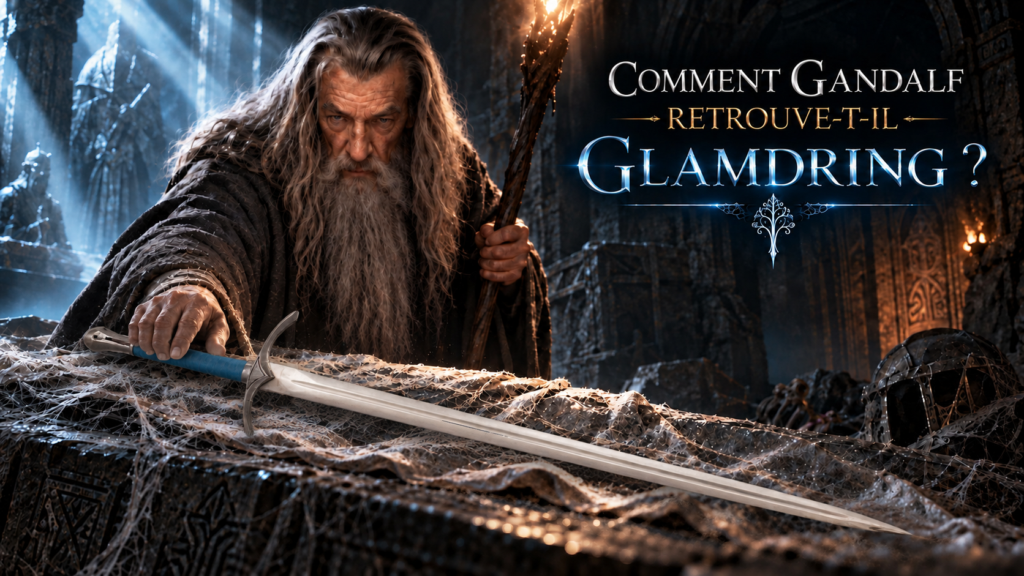
In the year 2941 of the Third Age, Gandalf accompanied Bilbo and Thorin’s company on their journey to the Lonely Mountain. Along the way, the group encountered three trolls. After their misadventure, the travelers discovered the trolls’ lair and, most importantly, the treasure they had amassed.
Among the gold, provisions, and looted items are several ancient weapons. Glamdring and Orcrist stand out in particular for the quality of their blades, their ornate hilts, and their magnificent scabbards. A third, smaller weapon is also recovered by Bilbo. It would later become famous under the name of Sting.
At that moment, Gandalf still does not know the true story behind the sword he has just taken.
It is in Rivendell that the mystery begins to unravel. Elrond examines the runes engraved on the two great blades. He identifies Orcrist and reveals that the other is Glamdring, the ancient sword once wielded by the King of Gondolin. Gandalf has thus, almost by chance, rediscovered a weapon that had been lost since the First Age.
But it doesn't take long for Glamdring to remind everyone why his name is still feared.
When the company is captured in the Misty Mountains, the Goblins recognize Orcrist, which they call Biter. Gandalf then intervenes with Glamdring. The blade glows in the darkness, and he uses it to kill the Great Goblin before freeing the prisoners. The Goblins, too, are familiar with this sword: to them, Glamdring is Beater, a weapon they hate even more than Orcrist.
More than six millennia after Gondolin, Turgon's sword has just found a new bearer: Gandalf.
Why are the Goblins afraid of Glamdring?
When Gandalf draws Glamdring in the Misty Mountains, the goblins don't just see an ancient Elven sword. They recognize a weapon whose reputation dates back to a time long, long ago.
Its name means «Foe-hammer,» generally translated as «Hammer of Enemies.» In Sindarin, the second element, *dring*, refers to the idea of striking or hammering. The first element is related to the terms used to refer to Orcs. The sword’s name thus already reflects its role as a weapon feared by their peoples.
The Goblins, however, give her their own nickname: Beater, «She Who Strikes.» They also know Orcrist as Biter. When these two blades reappear in the Misty Mountains, the mere sight of them strikes fear into their hearts.
Glamdring also has a remarkable feature. Like Orcrist and Dard, it can glow with a blue light when Orcs are nearby. This property of the ancient blades of Gondolin thus turns the sword into a true warning when danger approaches.
Glamdring's reputation thus seems to have endured through the millennia. Tolkien does not describe in detail the battles in which Turgon is said to have earned this fame with his sword. Yet, in the Third Age, the Goblins still remember Beater.
And now, this weapon they fear is in Gandalf's hands.
Glamdring, Orcrist, and Dard: three blades linked by the same discovery
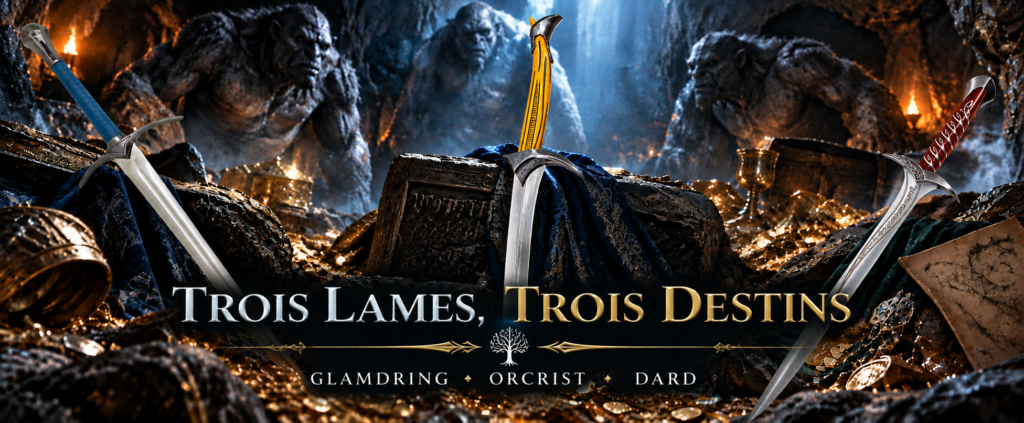
Glamdring, Orcrist, and Dard are often mentioned together when discussing the elven weapons in *The Hobbit*. Yet their fates take very different turns as soon as they enter the adventure.
Gandalf keeps Glamdring and carries it far beyond the journey to Erebor. Orcrist, meanwhile, becomes Thorin Oakenshield’s sword. After his death in the Battle of the Five Armies, it is placed on his grave. Tolkien notes that it then warns the Dwarves of their enemies’ approach by glowing in the darkness.
The smallest of the three meets yet another fate. Bilbo keeps Dard and names it after his battle with the spiders of Mirkwood. Years later, he gives it to Frodo before he leaves Rivendell.
Thus, these three weapons share a common starting point in the adventure, but Tolkien then develops them three separate stories : Gandalf's, Thorin's, Bilbo's, and then Frodo's.
Glamdring alongside Gandalf in *The Lord of the Rings*
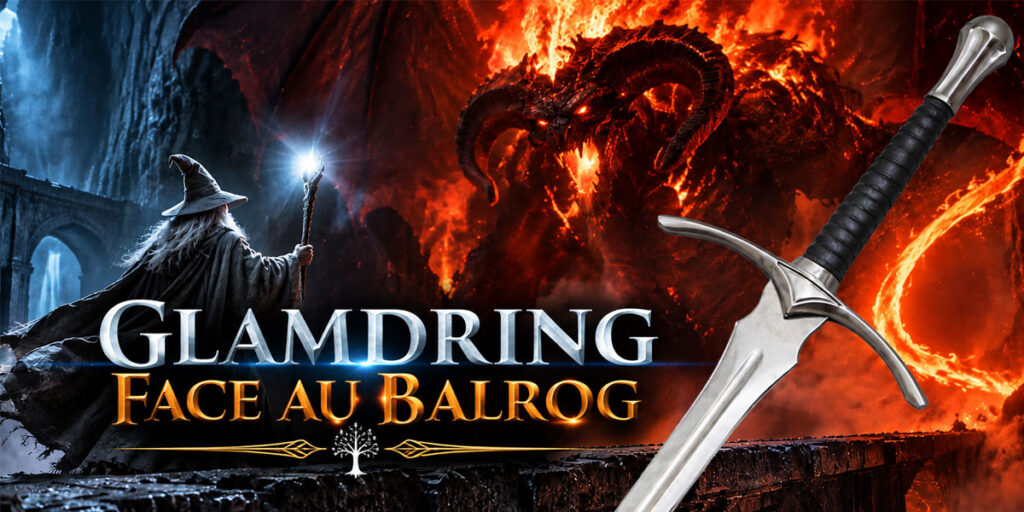
Decades after the expedition to Erebor, Glamdring still accompanies Gandalf. When the Fellowship of the Ring left Rivendell in 3018 of the Third Age, the Gray Wizard still carried Turgon’s ancient sword at his side. It then entered a new chapter in its history.
Deep within Moria, Gandalf uses the blade during the battle in the Hall of Mazarbul, among other instances. But his most famous battle takes place shortly afterward, on the bridge of Khazad-dûm.
Facing the Balrog known as the Bane of Durin, Gandalf stays behind alone to allow the Fellowship to escape. When the creature attacks with its flaming sword, he wields Glamdring against it. The elven blade withstands the blow, and the Balrog’s weapon shatters. Gandalf then destroys the bridge, but his opponent’s whip drags him into the abyss.
Their battle, however, does not end with this fall. Gandalf pursues the Balrog from the depths of the mountain to the summit of Celebdil. After a clash that ends at the summit, the Balrog is finally defeated. Gandalf, in turn, succumbs to his wounds before being sent back to Middle-earth in the form of Gandalf the White.
And Glamdring returns with him.
When he reunites with Aragorn, Legolas, and Gimli, Gandalf still has the sword. He continues to carry it throughout the War of the Ring. The blade, which had belonged to an Elven king of the First Age, thus accompanies Gandalf until the final events of the Third Age.
Tolkien never specifies what becomes of Glamdring after the end of the Third Age. When Gandalf leaves Middle-earth for good in 3021 to set sail for the West, the story does not tell us whether he takes the sword with him or leaves it behind. Having endured millennia of history, Glamdring’s ultimate fate therefore remains unknown.
From Tolkien to the Big Screen: How Peter Jackson Envisioned Glamdring
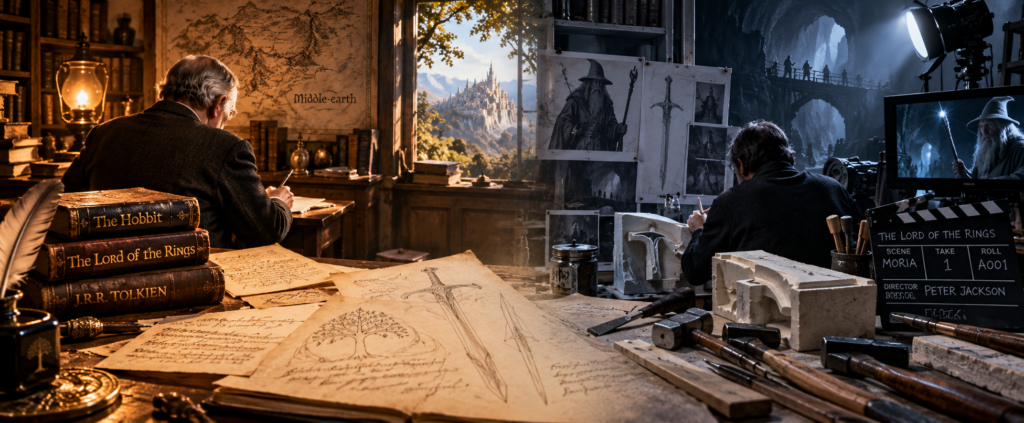
In Tolkien’s writings, Glamdring has a distinct identity, but its appearance is not described with enough precision to reconstruct every detail of the weapon. We know of its Elvish origin, its runes, and certain characteristics, but Tolkien does not provide the detailed design of the sword that has now become familiar to viewers.
For Peter Jackson's trilogy, the artists tasked with bringing Middle-earth to life therefore had to transform these literary descriptions into a powerful cinematic tool. Wētā Workshop was involved in the design and manufacture of the weapons used in the three films.
On screen, Glamdring takes the form of a long, double-edged sword. Its curved metal guard, ornate pommel, and dark hilt give it an instantly recognizable appearance. This design accompanies Ian McKellen in his portrayal of Gandalf and plays a major role in shaping the image that collectors associate with the sword today.
There is, however, one significant difference between Tolkien and Peter Jackson. In the books, Glamdring can emit a blue glow when Orcs are nearby. In the movies, this effect is not applied to Gandalf’s sword, unlike Dard.
The movie thus gave Glamdring a look that has become iconic, while making some choices that differed from the original story
In Tolkien’s books, Glamdring glows blue when Orcs are nearby. However, this effect is absent from Peter Jackson’s films, while Dard retains its famous glow. When asked about this difference, Peter Jackson and Philippa Boyens even joked that there wasn’t «enough blue left.» This joke has become famous among fans of the saga.
What do the inscriptions on Glamdring mean?
The inscriptions are one of the most fascinating details of Glamdring. In *The Hobbit*, Gandalf immediately notices the runes on the weapon, but he is unable to read them. It is Elrond, in Rivendell, who manages to interpret them and identifies the ancient sword of Gondolin. In particular, the runes reveal its name and its connection to the king who once wielded it.
Tolkien, however, does not provide us with any lengthy, complete inscription comparable to the one seen in the film version. This is an important distinction, as Peter Jackson’s films greatly enrich this aspect of the weapon.
On the Glamdring created for the movie, runes are inscribed along the hilt. The inscription refers to Turgon, King of Gondolin, identifies Glamdring as his sword, and highlights its role as an enemy of Morgoth’s forces and the Orcs. This inscription is therefore part of the film adaptation’s design and does not appear in Tolkien’s original text.
This choice, however, allows for the visual integration of several authentic elements from the history of Glamdring: Turgon, Gondolin, and the sword’s reputation in battle against the Orcs.
Why does Glamdring continue to fascinate collectors?
Having appeared throughout Tolkien’s stories for several millennia, Glamdring has become one of the most recognizable swords in Middle-earth. Its association with Gandalf obviously plays a major role. However, its origins in Gondolin, its connection to Turgon, and its role in both *The Hobbit* and *The Lord of the Rings* give it a particularly rich history.
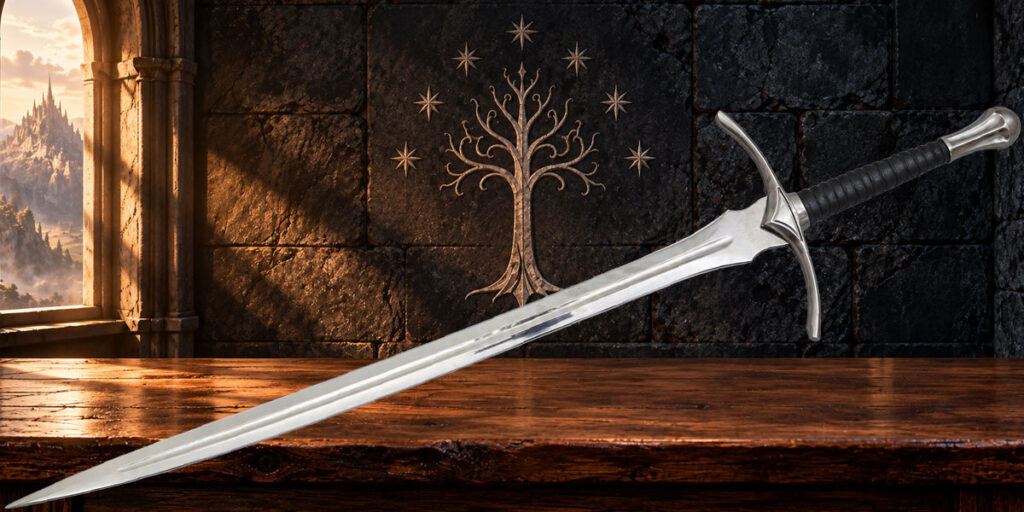
For collectors, its cinematic design also gives it a very different look from Andúril or Narsil. Its long, grooved blade, its guard with its distinctive curves, and its dark hilt make the Wizard’s sword instantly recognizable.
At Réplique Manga Ciné, we offer, among other things, a Glamdring with sheath. Its 440 stainless steel blade measures 89 cm, for a total length of 117 cm. Its wooden scabbard, covered in blue faux leather and decorated with metal accents, allows the sword to be displayed as a more complete set.
A second version of the’Gandalf's sword It also allows you to highlight the sword itself. Two different versions of the same legendary blade, depending on the place you want to give it in your collection.
If you’re adding Glamdring to your collection, be sure to choose your version based on the look you’re going for. The model with a scabbard creates a more complete ensemble and better highlights the sword’s historical character. In contrast, displaying just the blade immediately draws the eye to its silhouette, guard, and distinctive proportions. If you already own several swords from Middle-earth, consider displaying Glamdring alongside Orcrist or Dard: their shared history naturally creates a particularly cohesive ensemble.
Be sure to check out our collection of’Lord of the Rings swords to reunite Glamdring with the other great swords of Middle-earth.
FAQ About Glamdring
Who forged Glamdring? ?
Tolkien does not give the name of Glamdring’s smith. We do know, however, that the sword was forged in Gondolin during the First Age and that it belonged to Turgon, king of the city.
How Does Gandalf Find Glamdring? ?
Gandalf discovers Glamdring in 2941 of the Third Age in the lair of three trolls. In Rivendell, Elrond then identifies the sword by the runes on its blade.
What does the name Glamdring mean?
Glamdring is a Sindarin name that Tolkien translated as «Foe-hammer,» generally rendered in French as «Marteau des ennemis.» Goblins also know it by the nickname “Beater.”.
Why does Glamdring glow blue?
In Tolkien's writings, Glamdring can emit a blue light when Orcs are nearby. However, this characteristic of the ancient blades of Gondolin was not retained for Glamdring in Peter Jackson's films.
Did Glamdring belong to Gandalf from the moment it was forged?
No. Long before Gandalf, Glamdring belonged to Turgon, King of Gondolin. Several millennia, therefore, separate its two known owners.
Glamdring, Gandalf's legendary sword
Few weapons in Middle-earth have a history as long as Glamdring. Forged in Gondolin during the First Age, wielded by King Turgon, and then lost for millennia, it reappeared almost by chance on the path of Bilbo and Thorin's company.
In Gandalf’s hands, the ancient elven sword begins a new life. From the Misty Mountains to the depths of Moria, it accompanies the Gray Wizard through some of the most memorable moments of his journey.
Tolkien, however, leaves several questions unanswered regarding Glamdring. We do not know how it survived the fall of Gondolin, what path it took before reaching the trolls’ lair, or even what became of it after Gandalf set out for the West.
The movies would then give him a look that became instantly recognizable, adding a new dimension to his legend.
Once the sword of an elf king and later Gandalf’s weapon, Glamdring thus bridges two eras separated by millennia. An extraordinary destiny for a blade whose history remains, in part, shrouded in mystery.