




Summary: The Shodai Kitetsu is a blade from the Kitetsu lineage in One Piece, associated with the reputation of cursed swords. Its exact rank and bearer are among the most hotly debated points, as the main body of work remains patchy on this precise sword. In this article, you'll clearly distinguish what's confirmed from what's conjecture, situate the Shodai against the Nidai and Sandai, and learn what to look for to recognize a representation. As a bonus, you'll leave with a few simple pointers if you're looking for a decorative replica or a coherent cosplay accessory.

We're talking about a fictional object and, on the collecting side, decorative replicas and accessories inspired by the One Piece universe. The aim is to help you understand the lore without getting lost in the rumors, and then to use this information to avoid confusion when collecting.
Shodai Kitetsu: what's important?
In One Piece, the name Kitetsu refers to a line of swords known for their dangerous aura, often summed up by fans as a curse. The Shodai Kitetsu is generally presented as the oldest and most prestigious of the Kitetsu, but it's also the one that suffers the most from confusion, lacking the clearest exposition that the Zoro's Sandai Kitetsu for example. To move forward properly, the right reflex is to separate what the manga and anime explicitly show from what secondary media or the community infer.
- The Kitetsu lineage exists in the universe, and is associated with the idea of so-called cursed blades.
- Sandai Kitetsu is the easiest reference to anchor, as it is worn and named very clearly.
- Shodai Kitetsu remains a more mysterious blade, with its status and attribution often debated.
- For the collection, this vagueness increases the risk of misnamed plugs or hybrid replicas.
What is confirmed in the work?
What's solid is the general framework: One Piece introduces renowned swords, blade ranks, and the idea of yōtō, often translated as cursed blade. These elements appear in the story as published in manga and widely repeated in anime, notably via scenes that explain the rarity of certain blades and their reputation.
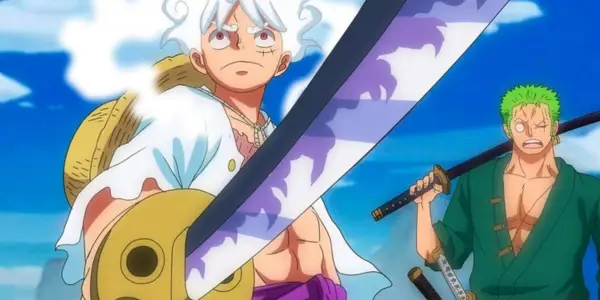
The Sandai Kitetsu, worn by Roronoa Zoro, serves as an obvious entry point to understanding what a Kitetsu is in the universe. For a canonical reading, the reference remains One Piece manga (VIZ edition), The anime serves mainly as a visual reminder for the general public.
- The term Kitetsu refers to a series of blades with ominous liabilities in the story.
- The concept of famous classified swords exists and influences the prestige of a weapon.
- The curse reputation is a lore motif, not a realistic datasheet.
What are fans still talking about?
Most of the debate surrounding the Shodai Kitetsu centers on three points: its identification, its exact rank, and its owner. Some swords in One Piece share similar visual characteristics. Thus, an ornate guard or a longer blade can lead to misidentification. Furthermore, images taken out of context often create confusion. Translations also vary depending on the source. Some merchandise also uses vague descriptions. To avoid mistakes, take a cautious approach. If the name Shodai Kitetsu isn’t clearly mentioned in the work, treat this information as a hypothesis. Do not present it as an established fact. This precaution is particularly useful for collectors. It prevents confusing the Shodai Kitetsu with a Nidai Kitetsu or a Sandai Kitetsu.
How can we understand the lineage of the Kitetsu and the rank of the Meitō?
To compare Shodai, Nidai, and Sandai Kitetsu, it is important to understand two key concepts: Meitō and rank. In One Piece, a Meitō refers to a famous or prestigious sword. This category is based on the blade’s reputation, history, and rarity. The rank, on the other hand, is used to classify swords. It establishes a hierarchy of their importance within the series. Thus, a higher-ranked blade attracts more attention. It also enhances the prestige of its wielder. This hierarchy plays an important role in the narrative. However, certain details may vary depending on the edition, translation, or anime adaptation. To remain accurate, it is best to focus on the logic behind the ranking. The exact labels are sometimes less important than the role assigned to each blade in the story.
- Meitō: famous sword, recognized throughout the universe for its quality and history.
- Grade: level in an internal classification, used as a marker of narrative prestige.
- Yōtō: blade with a bad reputation, often summed up as cursed in dialogue.
Sword grades in One Piece: how do they work?
Ranking is more about telling a story than defining numerical power. A high-grade blade is not magic by default, but it does signal exceptional quality and a special aura in the world of One Piece. In concrete terms, this system allows the author to create objectives for swordsmen, to distinguish iconic weapons from ordinary blades, and to give a symbolic charge to the transmission of a sword. Bear in mind, too, that the bearer counts as much as the object: a prestigious blade in the wrong hands doesn't automatically become decisive, while an expert can sublimate a simpler sword.
- Give status to weapons that are important to the plot.
- Structuring the progression and ambitions of sabreurs.
- Create clear benchmarks for fans and collectors.
Shodai, Nidai, Sandai: what are the differences?
Here's a deliberately practical comparison, designed to limit confusion. When a piece of information is not explicitly established in the main work, it is formulated as a common lead rather than an absolute fact. This approach also helps you to read the descriptions of decorative replicas with greater objectivity: a serious record specifies the reference, context and design, rather than just a prestigious name.
| Kitetsu | Grade | Sponsor / context | Visual clues | Available as a decorative replica |
|---|---|---|---|---|
| Shodai Kitetsu | Often presented as very high by secondary sources | Carrier frequently suspected by fans, but not always clearly attributed in the story | Clues discussed; focus on coherence between guard, handle and scabbard rather than isolated details | Rarer and sometimes confused with other models |
| Nidai Kitetsu in One Piece | Not specified here; mostly identified by its name in the Wano arc. | Combined with a collection and transmission context | Some codes are included in derived models, which can lead to confusion. | More affordable than the Shodai, depending on the range |
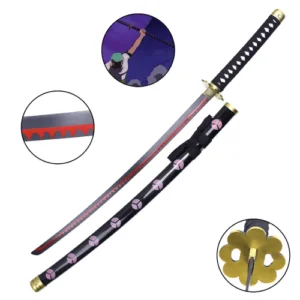
| Sandai Kitetsu | Not detailed here | Long-range, memorable introductory context | Frequently reproduced design, useful as a visual reference for the lineage | Very popular for collecting, decorating and cosplaying |
What does Shodai Kitetsu look like?
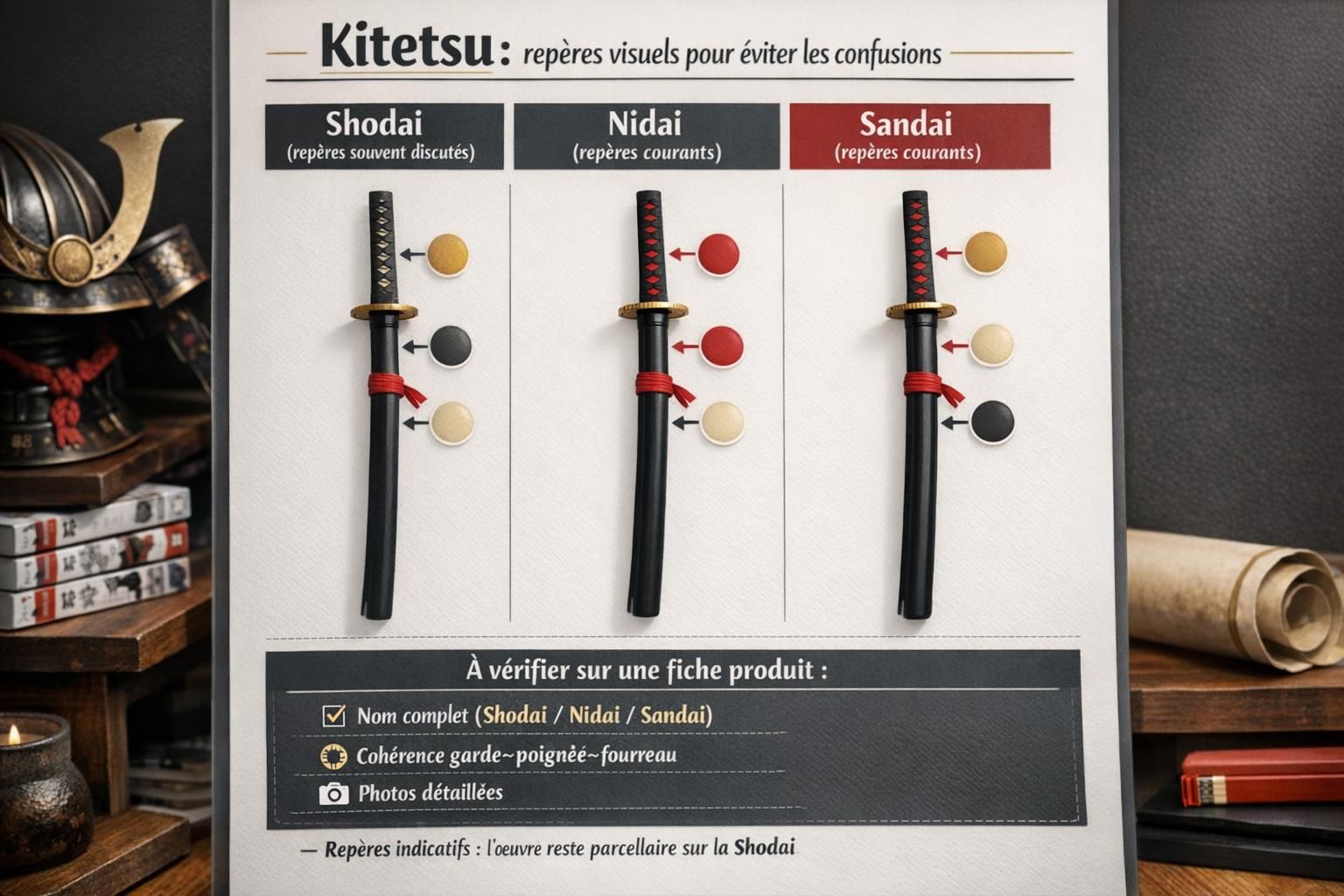
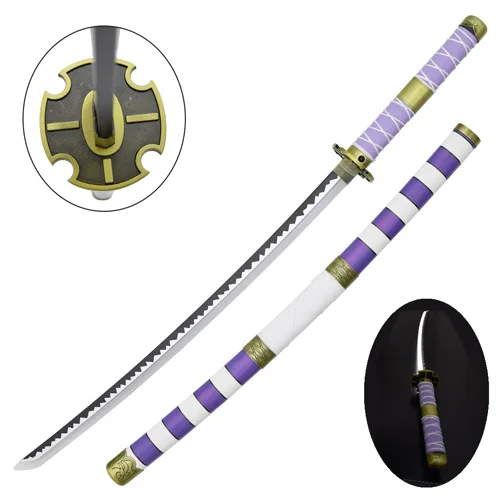
Recognizing Shodai Kitetsu is more difficult than recognizing a blade that has been staged for a long time, because the community often relies on partial visual elements. The aim, therefore, is not to obtain instant certainty, but to verify overall consistency. A simple rule of thumb: first look for hand-guard-furrow continuity before relying on the “name” of a file or an image out of context. In practice, you save time by always examining the same areas: hilt, grip, scabbard and color codes.
What details can you observe on a representation or decorative replica?
- The guard: its general shape, its visual thickness, and the presence or absence of regular patterns.
- The handle: dominant color, braiding, and aesthetic continuity with the guard.
- The scabbard: main color, ornamentation, presence of rings or distinctive decorative elements.
- Proportions: short or long silhouette, impression of a traditional sword or standard katana.
- The overall pattern: a coherent Kitetsu pattern avoids overly heterogeneous details.
- The advertised finish: a serious description distinguishes what is decorative from what is inspired by sword culture.
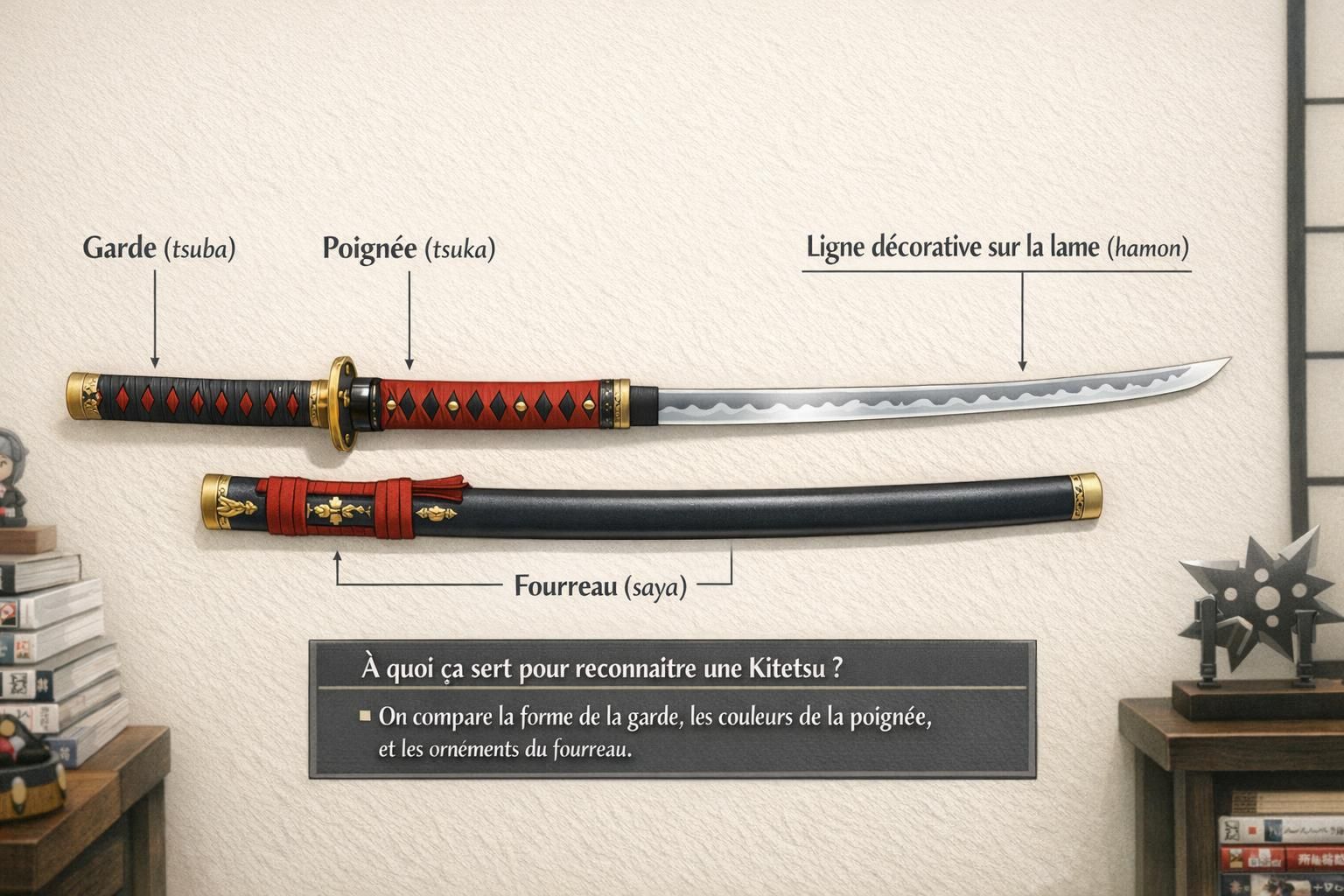
Express lexicon to help you read a file: the hilt is called tsuba, the handle tsuka, and the decorative temper line sometimes imitated on the blade is called hamon. For a more accurate vocabulary of Japanese swords, a pedagogical reference exists, such as the NBTHK Sword Journal for general Japanese sword terminology, without implying a precise historical model for One Piece.
Which confusions are most common?
- A replica labelled Kitetsu without specifying Shodai, Nidai or Sandai, which often masks a generic model.
- A mix of colors and patterns that recaptures the codes of the Sandai, while asserting the Shodai.
- Promotional visuals reused for several cards, without distinctive photos or descriptions.
- A grade assertion presented as certain when it comes from secondary sources.
Decorative replica: how to choose a Shodai Kitetsu without making a mistake?
If you're looking for Shodai Kitetsu replica (One Piece), If you're looking for a piece that's a little different from the rest, assume that scarcity and design vagueness create a market where names are sometimes generous. The safest method is to choose a piece whose visual coherence is clearly described, with a harmonized guard and scabbard handle set, rather than just a catchy name. For a collection, the aim is not to brandish, but to obtain a clean rendering on display and a readable reference in your One Piece universe, in the same way as One Piece katanas (replicas and sabers) or a decorative object.
An essential reminder: a decorative replica remains a collector's item and a showpiece. It is not intended for use, and your comfort depends on non-aggressive edges, careful transport and stable display conditions, especially if you're handling it for cosplay or events. Specialized stores such as Réplique Manga Ciné / RMC generally focus on these collector-deco uses rather than on weapon logic.
Checklist for quality and decorative use
- Check that the sheath is present and that the colors are consistent.
- Give preference to a clean finish on the hilt and closely visible ornaments.
- Make sure the description clearly mentions decorative and cosplay use.
- Anticipate exposure: presentation stand for katana furniture-mounted or wall-mounted.
- Avoid models with ambiguous names if you're looking for a specific lineage.
Decoration, cosplay, gifts: what level of finish should you aim for?
- For display: priority to overall rendering, visible finishes and stable presentation support.
- For cosplay: priority to lightness, safety and easy transport, without aggressive angles.
- For gifts: priority to a clearly identified reference and an aesthetic immediately recognizable by a One Piece fan, even if it means choosing a Nidai or Sandai if the Shodai is too confusing.
How to stage a Shodai Kitetsu at home?
A Shodai Kitetsu, even a decorative replica, works best when integrated into a scene rather than standing alone. The idea is to create an immediate read: your guest understands that it's a One Piece, but the presentation remains elegant. The more sober the setting, the greater the presence of the blade. Also consider eye level and lighting: too low or too dark an exposure erases the details of the hilt and scabbard, which are precisely your markers of recognition.
Three simple, immersive stagings
- Stand on a piece of furniture: place the replica on a horizontal stand, with a visual background related to the universe, and leave some empty space around it to reinforce the centerpiece effect.
- Sober wall presentation: discreet wall mounting and soft ambient lighting, to emphasize the silhouette without creating harsh reflections.
- Collection showcase corner: combine the blade with a maximum of two or three objects, such as a figurine, an atmospheric lighting element and a piece reminiscent of Wano, for a dense but legible effect.
In short, Shodai Kitetsu is a fascinating blade because it lies at the crossroads of canon, mystery and fan interpretation. By relying on a confirmed reading of the Kitetsu framework, comparing it with Nidai and Sandai, and applying a visual checklist, you can avoid most confusion. If your aim is collecting, a coherent, well-finished decorative replica will often make more sense than an uncertain appellation, and you can also consider more clearly identifiable Kitetsu alternatives.