


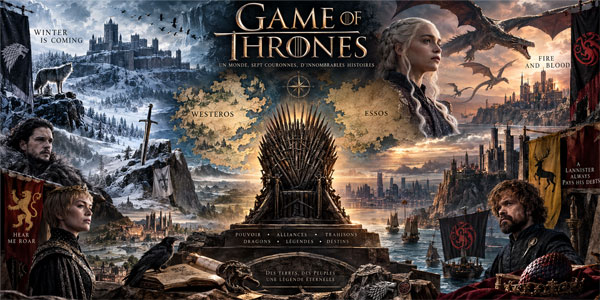
Dive into the’The Story of Game of Thrones, ...means entering a world where every crown comes at a high price. In Westeros, alliances are forged as quickly as they are broken. The great Houses vie for land, inheritance, and power, while the famous Iron Throne fuels everyone’s ambitions.
In the North, the Starks rule from Winterfell and face threats far older than political strife. In the West, the Lannisters possess wealth capable of turning the kingdom upside down. Yet, far from Westeros, a Targaryen heiress is preparing for the return of a dynasty that many thought was extinct.
However, to understand *Game of Thrones*, you have to go back well before the events of the series. Conquests, rebellions, and wars have shaped the Seven Kingdoms. In addition, each major House has its own traditions, symbols, and, in some cases, legendary weapons.
From Jon Snow to Daenerys Targaryen, from Arya Stark to Tyrion Lannister, this journey through Westeros allows readers to discover the history of its families, as well as the Wall, the White Walkers, the dragons, and the mysterious Valyrian steel.
Because in *Game of Thrones*, a sword is never just a weapon. It can carry a name, a history, and sometimes the fate of a House.
Westeros: Understanding the World of Game of Thrones
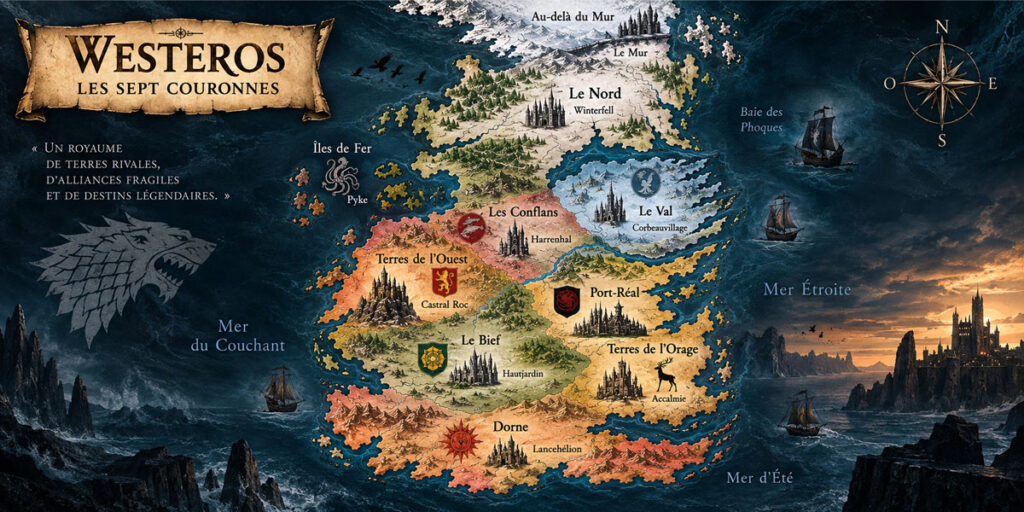
To understand the’The Story of Game of Thrones, you first need to know where it takes place. Westeros is a vast continent made up of very different regions. Each has its own climate, traditions, and, above all, its own ruling families.
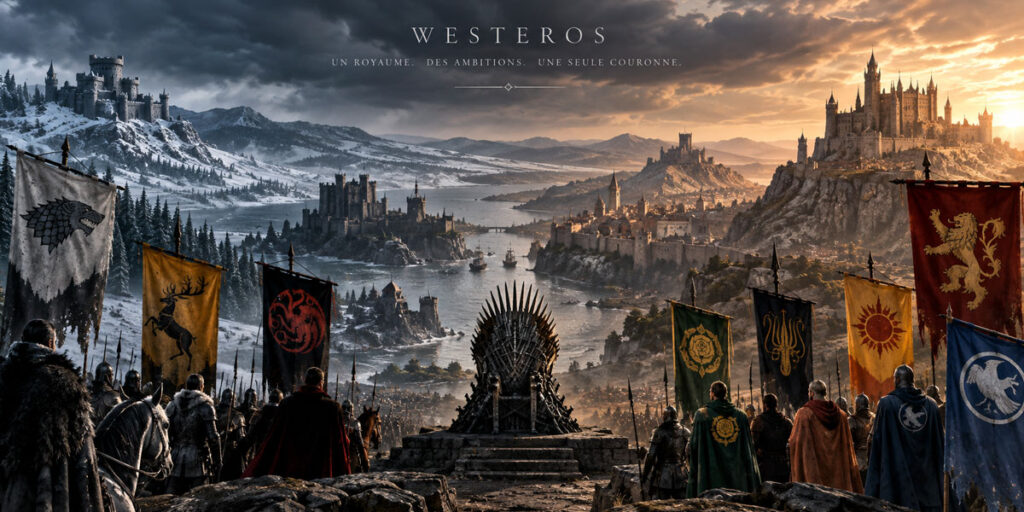
To the north lie the cold lands, which have been ruled for centuries by the Starks of Winterfell. Further south and east lie the Vale, the Westerlands, and the Riverlands, while Dorne occupies the far south of the continent. Finally, King’s Landing is the political center of the Seven Kingdoms and the seat of the Iron Throne.
However, Westeros is not a naturally united kingdom. Its history is built on conquests, alliances, and numerous wars. The ancient houses have retained a very strong sense of identity. As a result, their loyalty to the ruler can quickly fade when their interests are threatened.
This geography explains much of what happens in *Game of Thrones*. An army must travel considerable distances to reach its allies. Similarly, controlling a fortress, a port, or a strategic passage can determine the outcome of a war.
The Seven Kingdoms and Their Territories
The term «Seven Kingdoms» can be misleading. It refers to the kingdom unified by Aegon Targaryen and his descendants. However, Westeros comprises several major historical regions, whose borders and names have changed over time.
The North is the largest region and has Winterfell as its main center of power. The Vale is protected by its mountains, while the Westerlands owe much of their power to the Lannisters’ wealth. The Riverlands boast particularly fertile lands. Dorne, to the south, retains a very distinct cultural identity.
The Conflans occupy a central location that has been particularly vulnerable during times of war. The Iron Islands, for their part, are home to a culture centered on the sea. Finally, the Stormlands have historically been linked to the Baratheons.
At the heart of power lies King's Landing, the capital of the Seven Kingdoms. It is there that the Iron Throne stands and where countless alliances, plots, and betrayals unfold.
Thus, the map of Westeros is not merely a backdrop. It directly influences the ambitions and destinies of the great Houses.
Essos, the Other Key Continent in the History of *Game of Thrones*
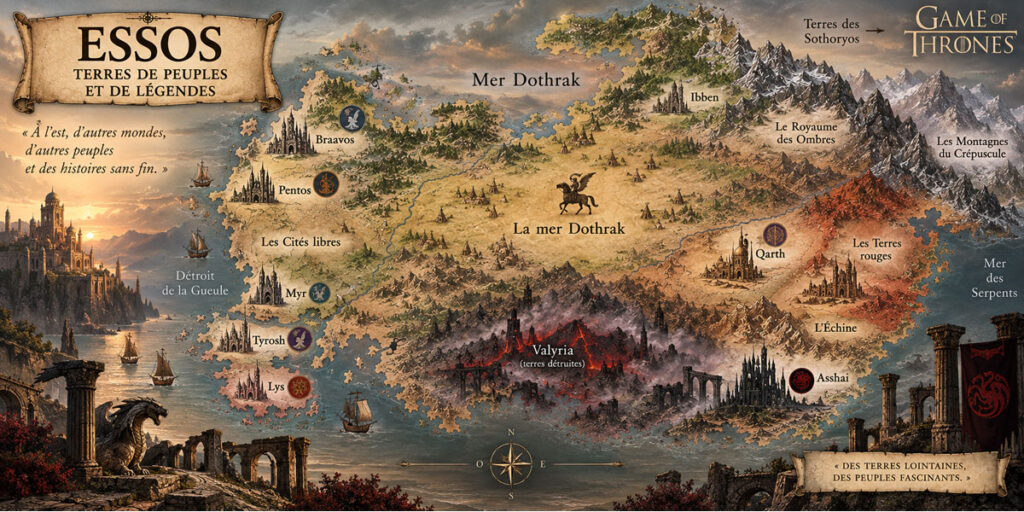
To the east of Westeros, across the strait, lies Essos. This vast continent plays a crucial role in *Game of Thrones*. In fact, much of Daenerys Targaryen’s journey begins far from the Iron Throne.
Essos is home to a wide variety of peoples, cultures, and territories. The Free Cities, such as Braavos and Pentos, play a particularly important role in trade and political intrigue. Further inland lies the Dothraki Sea, roamed by the fearsome Dothraki horsemen.
However, Essos above all helps us understand a much older legacy. Long ago, Valyria ruled over a considerable portion of the continent thanks to the power of its dragons. The Valyrians were also skilled in the production of an exceptional steel, the secret of which was lost after the Doom of Valyria.
The Targaryen family survived this catastrophe after settling at Dragonstone. Several generations later, their descendants conquered Westeros with their dragons.
Thus, Essos directly links the past to the present. It is not only the starting point of Daenerys’s journey, but also the homeland of two major elements of our story: dragons and Valyrian steel.
Seasons that can last several years
In Westeros, the seasons do not follow the pattern we are familiar with. A summer can last several years, just as a winter can last for a particularly long time. This unique feature profoundly influences the lives of the inhabitants and the organization of the kingdoms.
When the story of *Game of Thrones* begins, Westeros is experiencing an exceptionally long summer that is now coming to an end. In the North, the Starks know that change is coming. Their motto, «Winter is coming,» therefore means much more than just a reference to the weather.
She reminds us that no period of prosperity lasts forever. We must prepare for difficulties before they arise. This philosophy fits perfectly with a House accustomed to the harsh conditions of the North.
Furthermore, the arrival of winter is gradually bringing with it a far more alarming threat. Beyond the Wall, forces that many consider to be mere legends are beginning to reappear.
Thus, the climate plays a direct role in shaping the saga’s atmosphere. The more the rivalries for the Iron Throne intensify, the closer winter draws. Yet, while the great Houses vie for power, the real danger may already be coming from the North.
George R. R. Martin deliberately created irregular seasons for Westeros. Their duration remains unpredictable for the inhabitants. In the novels, maesters therefore observe various signs to predict the changing of the seasons. This uncertainty reinforces a central theme of the saga: even after a long summer, no one really knows how long winter will last.
The History of Game of Thrones: The Events That Shaped Westeros
When *Game of Thrones* begins, the rivalries between the great Houses sometimes seem to date back a very long time. Yet the kingdom as we come to know it is the result of conquests, marriages, rebellions, and changes in dynasties.
For centuries, Westeros was not ruled by a single sovereign. Several kings controlled their own territories and fiercely defended their independence. This situation changed with the arrival of a family from Dragonstone: the Targaryens.
Their conquest permanently altered the balance of power on the continent. It gave rise to a new dynasty and led to the rise of King’s Landing, which became the center of royal power. Above all, it created the kingdom over which the great Houses would later vie for control.
However, the Targaryen reign did not last forever. Nearly three centuries after the conquest, a new rebellion overthrew the dynasty. Robert Baratheon then ascended to the Iron Throne.
To understand the conflicts that erupt in *Game of Thrones*, we must therefore look back at those events. For when Ned Stark leaves Winterfell to travel to King’s Landing, the wounds of the past are still far from healed.
Aegon the Conqueror and the Birth of a Kingdom
Before Aegon Targaryen, Westeros was divided among several independent kingdoms. From Dragonstone, however, Aegon decided to bring these lands under a single authority.
He crossed the sea with his sisters and wives, Visenya and Rhaenys Targaryen. Accompanying them, above all, was the force that would upset the balance of power in Westeros: three dragons.
Aegon rides Balerion the Black Terror, while Visenya rides Vhagar and Rhaenys rides Meraxes. Before them, fortresses and great armies discover the destructive power of dragonfire.
Conquest, however, does not rely solely on force. Some houses choose to submit rather than confront the Targaryens. The Starks, in particular, thus retained their position in the North after Torrhen Stark’s submission.
Other dynasties disappear or lose their power. Harrenhal falls, while new Houses rise to positions of dominance. The Tullys establish their dominance in the Riverlands, and the Tyrells in the Reach.
Yet Dorne refuses to yield. Aegon thus manages to unite six kingdoms under his rule, without immediately subjugating the Martell lands.
This conquest marks a major turning point. A new dynasty now rules over much of Westeros: House Targaryen.
Three Centuries of Targaryen Rule in the History of *Game of Thrones*
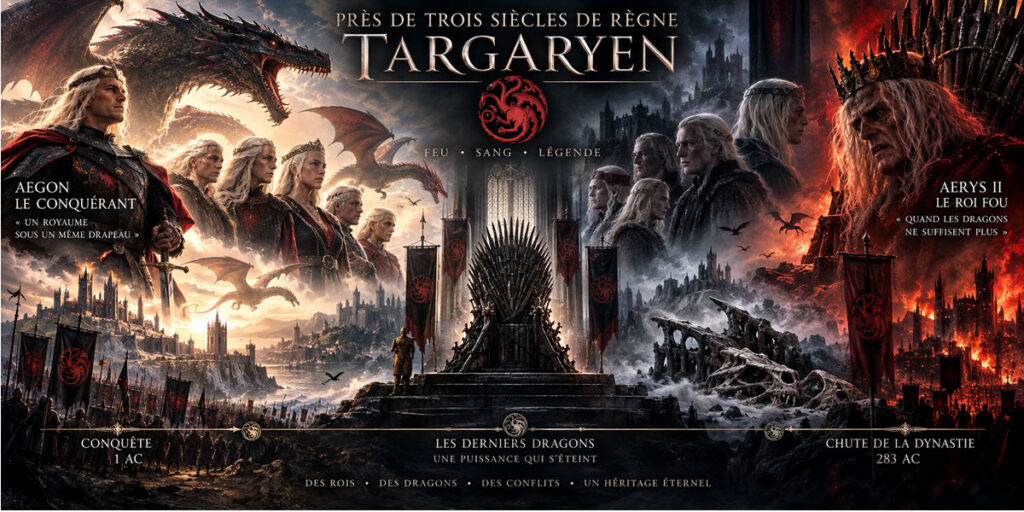
After Aegon's conquest, House Targaryen established itself permanently as the ruling house of Westeros. For nearly three centuries, its rulers succeeded one another on the Iron Throne.
However, this long period was far from peaceful. The dynasty experienced prosperous reigns, but also family conflicts and several wars. The Targaryens also had to contend with the great Houses, which retained considerable influence over their territories.
Dragons were initially one of the main symbols of their power. However, their numbers plummeted during the Dance of the Dragons. The last of them disappeared in the decades that followed. From then on, the Targaryens no longer had the military advantage that had allowed Aegon to transform Westeros.
Over the generations, certain crises further weakened the dynasty. One of the most significant pitted several family members directly against one another in a terrible war of succession. This period is primarily the subject of the story told in *House of the Dragon*; we will therefore return to it in our article dedicated to that era.
Much later, King Aerys II Targaryen ascended to the Iron Throne. The man history would remember as the Mad King became the last Targaryen ruler to reign before the events of *Game of Thrones*.
His reign eventually led to a rift with several major Houses. The Starks, Baratheons, Arryns, and Tullys found themselves at the center of a conflict that would once again change the fate of Westeros.
After nearly three hundred years of rule, the dynasty founded by Aegon the Conqueror is nearing its end.
Robert Baratheon's Rebellion
Nearly three centuries after Aegon’s conquest, the Targaryen dynasty is teetering. At the heart of the crisis are Rhaegar Targaryen, son of King Aerys II, and Lyanna Stark, sister of Ned Stark and betrothed to Robert Baratheon.
In Westeros, Lyanna’s disappearance is initially portrayed as a kidnapping by Rhaegar. Enraged, her brother Brandon travels to King’s Landing and demands that the prince come out to face him. Aerys II has him arrested, then summons their father, Rickard Stark. Both men are ultimately executed on the king’s orders. Aerys then demands that Jon Arryn hand over Robert Baratheon and Eddard Stark.
Jon Arryn refuses. The rebellion begins.
Several great Houses take up arms against the crown. Robert Baratheon, Ned Stark, and Jon Arryn become the leading figures of the uprising, while the Tullys also join their side.
The conflict reached a decisive turning point during the Battle of the Trident. There, Robert faced Rhaegar in single combat and killed him with his warhammer. Shortly thereafter, the rebel forces marched on King's Landing.
The capital finally fell when the Lannisters entered the city. Jaime Lannister killed Aerys II, even though he was a member of the Kingsguard. This act earned him the lasting nickname “the Kingslayer.”.
However, the series reveals much later that the story of Rhaegar and Lyanna was different from the version long accepted in Westeros. This revelation will prove essential to understanding Jon Snow’s true origins.
With the deaths of Aerys II and Rhaegar, nearly three hundred years of Targaryen rule came to an end. The line, however, survives: Viserys finds refuge at Dragonstone with his mother, Rhaella, who gives birth to Daenerys there. The two children are then taken into exile across the strait.
How Robert Baratheon Ascends to the Iron Throne
After the fall of King's Landing, the rebels must decide who will rule Westeros. Robert Baratheon then emerges as the new ruler.
His military victory obviously plays a major role. Robert is one of the rebellion’s main leaders, and he personally defeated Rhaegar Targaryen at the Battle of the Trident. However, he also has a family connection to the former dynasty.
His paternal grandmother, Rhaelle Targaryen, is a member of the royal family. This Targaryen lineage gives him the strongest dynastic claim among the principal rebel leaders, even though his rise to power depends above all on their military victory.
He then married Cersei Lannister. This union brought the new monarchy closer to one of the wealthiest and most powerful Houses in Westeros. Robert now ruled from King’s Landing, while Ned Stark returned to the North.
Yet peace remains fragile. Viserys and Daenerys Targaryen are still living in exile. Moreover, the rivalries among the great houses have not disappeared with the change in kings.
Years later, Robert's death would trigger another succession crisis. This time, several claimants would simultaneously lay claim to power.
It was precisely at that moment that the struggle for the Iron Throne escalated into a new war.
From Robert's Rebellion to the Fall of the Targaryens
| Event | Consequences for Westeros |
|---|---|
| Rhaegar and Lyanna disappear | Tensions between the Starks and the Targaryens come to a head. |
| Rickard and Brandon Stark are executed | Aerys II caused a rift with several major Houses. |
| Jon Arryn refuses to hand Ned and Robert over | The rebellion against the Iron Throne begins. |
| Robert kills Rhaegar at the Trident | The Targaryens lose their chief heir and commander. |
| King's Landing Falls | Jaime Lannister kills Aerys II and brings his reign to an end. |
| Robert Baratheon Becomes King | The Targaryen dynasty loses the Iron Throne. |
| Viserys and Daenerys are living in exile | The Targaryen line survives despite the defeat. |
The Great Houses in the History of *Game of Thrones*
In Westeros, power does not rest solely in the hands of the king. The great Houses of *Game of Thrones* control vast territories, maintain their own armies, and uphold alliances that have sometimes lasted for several generations.
Each family also has its own history. Their coat of arms, colors, and castle often serve as identifying features. Yet behind these symbols lie rivalries, political marriages, and ambitions that can upset the balance of the kingdom.
The Starks rule the North from Winterfell. The Lannisters wield immense influence from Casterly Rock. Robert Baratheon ascended to the Iron Throne after the fall of the Targaryens, while the heirs of the former dynasty live in exile.
However, these four houses do not alone determine the fate of Westeros. The Tyrells, Martells, Greyjoys, Arryns, and Tullys also play a crucial role as alliances begin to form.
Understanding these Houses therefore makes it easier to follow *Game of Thrones*. Because behind almost every war lies a fundamental question: to whom will a family choose to remain loyal?
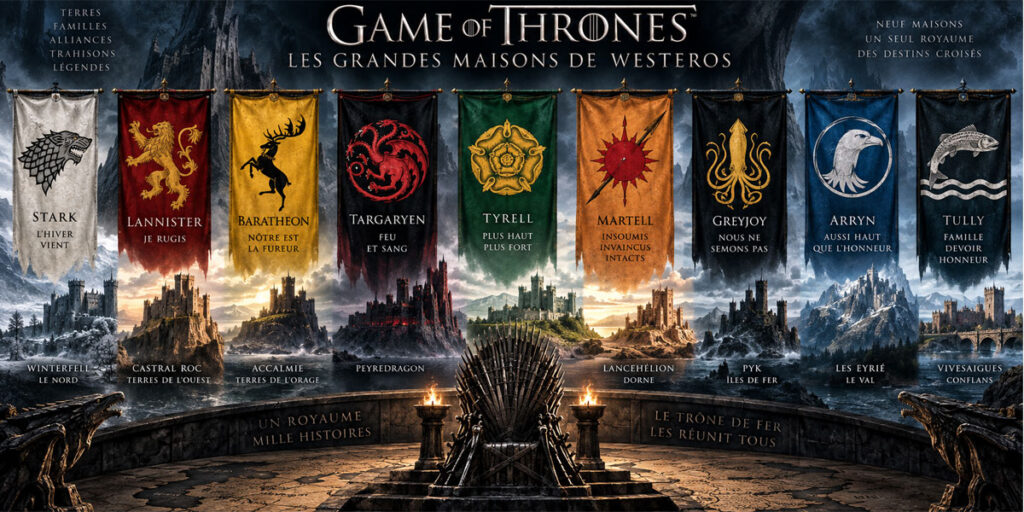
The Major Houses of Westeros
| House | Emblem | Currency | Headquarters | Territory | Major Characters |
|---|---|---|---|---|---|
| Stark | Werewolf | «Winter is coming» | Winterfell | The North | Ned, Catelyn, Robb, Sansa, Arya, Bran |
| Lannister | Lion | «I roar» | Castral Roc | Western Lands | Tywin, Cersei, Jaime, Tyrion |
| Baratheon | Red deer | «Ours is the fury» | Lull | Lands of the Storm | Robert, Stannis, Renly |
| Targaryen | Three-headed dragon | «Fire and Blood» | Peyredragon | Ancient Royal Dynasty | Aerys II, Rhaegar, Viserys, Daenerys |
| Tyrell | Golden Rose | «Higher, Stronger» | Hautjardin | Le Bief | Olenna, Mace, Margaery, Loras |
| Martell | Sun pierced by a spear | «Unsubmissive, undefeated, unscathed» | Lancehélion | Dorne | Doran, Oberyn, Trystane |
| Greyjoy | Golden Kraken | «We don't sow» | Pyk | Iron Islands | Balon, Theon, Yara, Euron |
| Arryn | Falcon and Moon | «As High as Honor» | The Eyrié | Le Val | Jon Arryn, Lysa Arryn, Robin Arryn |
| Tully | Silver trout | «Family, Duty, Honor» | Vivesaigues | Conflans | Hoster, Catelyn, Edmure, Brynden |
The seats and territories listed correspond primarily to the historical situation of the Houses at the beginning of *Game of Thrones*.
House Stark: Honor and the North
Among the great houses of Westeros, House Stark has one of the oldest histories. From Winterfell, its ancestors ruled for millennia as Kings of Winter, then Kings of the North, before submitting to Aegon the Conqueror. The direwolf is their emblem, while their motto, «Winter is coming,» perfectly sums up their approach to the world.
When *Game of Thrones* begins, Eddard «Ned» Stark rules Winterfell. Unlike the intrigues of King’s Landing, he places great importance on duty, keeping one’s word, and honor. These values have a profound influence on the upbringing of his children: Robb, Sansa, Arya, Bran, and Rickon.
However, the Starks’ story is quickly turned upside down when Robert Baratheon asks Ned to become his new Hand of the King. Upon leaving the North for King’s Landing, Ned enters a political world where honor isn’t always enough to survive.
Ned's downfall then changes the fate of his entire family. Robb Stark rallies the forces of the North and becomes King in the North. Sansa remains caught up in the power struggles, while’Arya takes a radically different path. Bran, meanwhile, discovers that his future extends far beyond the rivalries between the great Houses.
Despite wars, separations, and betrayals, Winterfell remains the family's anchor. More than just a castle, it represents the very identity of the Starks and their attachment to the North.
That’s also what makes this House so important in *Game of Thrones*: while many seek to claim the Iron Throne, the Starks fight above all to reclaim their home, protect their loved ones, and preserve the North.
House Lannister: Power, Wealth, and Ambition
Opposing the Starks is one of the most powerful families in Westeros: House Lannister. Its ancestral seat is Casterly Rock, in the Westerlands. Its sigil is a golden lion, and its official motto is «I Roar.».
Another phrase, however, has become much more famous: «A Lannister always pays his debts.» While it is not their official motto, it perfectly sums up the family’s reputation. A favor may be repaid. However, an offense may also be avenged.
At the head of the House stands Tywin Lannister, a figure feared for his authority and political acumen. For him, his family’s power must take precedence over the individual ambitions of its members. His three children—Cersei, Jaime, and Tyrion—hold very different positions in the kingdom, however.
Cersei Lannister's marriage to Robert Baratheon places the family at the heart of royal power. Jaime is a member of the Kingsguard, while Tyrion relies more on his intelligence and mastery of political maneuvering to find his place.
The Lannisters' wealth greatly enhances their influence. In addition to this financial power, they have the ability to form alliances and exploit their opponents' weaknesses.
After Robert Baratheon's death, their position becomes even more crucial. The legitimacy of his heirs is contested, and Westeros gradually descends into a new war.
From that point on, the Starks and the Lannisters are no longer just two great houses. Their conflict becomes one of the main driving forces behind the struggle for power.
House Baratheon: A Crown in Dispute
House Baratheon holds a special place in *Game of Thrones*. Unlike the Starks or the Lannisters, its importance is not based solely on its territory. Since Robert's Rebellion, it has become the new ruling dynasty of Westeros.
The three Baratheon brothers, however, have very different personalities. Robert is a warrior turned king, more drawn to the pleasures and memories of his battles than to the administration of the kingdom. Stannis, Lord of Dragonstone, is strict and deeply committed to what he considers his rightful claim. Finally, Renly, Lord of Storm’s End, has a more charismatic personality and knows how to rally powerful supporters.
As long as Robert sits on the Iron Throne, these differences remain relatively contained. His death, however, upsets the balance of the kingdom.
Officially, Joffrey Baratheon succeeds him. However, Ned Stark discovers that Joffrey, Myrcella, and Tommen are not Robert's biological children. Their father is Jaime Lannister, Cersei's twin brother.
This revelation turns a royal succession into a major political crisis. Stannis then lays claim to the throne: since Cersei’s children are not Robert’s, he considers himself his brother’s rightful heir. However, Renly refuses to recognize his claim and has himself proclaimed king as well.
House Baratheon thus found itself divided among several claimants. Its sigil, the crowned stag, now symbolized a dynasty unable to remain united around the power it had conquered some fifteen years earlier.
Ironically, Robert's death does not merely bring his reign to an end. It paves the way for a war in which the Baratheons themselves will fight one another for the Iron Throne.
House Targaryen: The Return of the Dragon
At the beginning of *Game of Thrones*, House Targaryen seems to be a thing of the past. After Robert’s Rebellion, the survivors of the former dynasty fled Westeros. Viserys and his younger sister Daenerys thus grew up in exile, across the strait.
Viserys remains obsessed with reclaiming the Iron Throne. Convinced that he is the rightful ruler, he seeks allies who can provide him with an army. To that end, he arranges for Daenerys to marry Khal Drogo, a powerful Dothraki chieftain.
However, the fate of House Targaryen takes an unexpected turn. Viserys disappears before he can return to Westeros. Daenerys then becomes her family’s primary heir.
Her journey gradually transforms the young exiled princess. She gathers followers, frees slaves, and leads a massive campaign against the slave cities of the Bay of Serfs, before settling in Meereen to rule there. Above all, an event that many thought impossible turns her fate upside down: dragons are reborn.
Drogon, Rhaegal, and Viserion are much more than just three extraordinary creatures. They bring back to life the very symbol of Targaryen power, which had been lost for generations.
However, Daenerys doesn't just want to survive in Essos. She believes the Iron Throne belongs to her family and is gradually preparing for her return to Westeros.
So, while the Starks, Lannisters, and Baratheons battle for control of the kingdom, another political threat is growing in the east. The dragon that Westeros believed to be extinct is returning.
Tyrell, Martell, Greyjoy, Arryn, and Tully
While the Starks, Lannisters, Baratheons, and Targaryens dominate much of the story, other Houses play a vital role. Their alliances, in particular, can shift the balance of power in the kingdom.
House Tyrell rules over the Bief, a fertile and prosperous region. It skillfully uses alliances and marriages to strengthen its influence, while Margaery and Olenna become two key figures in this political strategy. Her support thus becomes particularly valuable when Westeros becomes divided.
In the south, House Martell rules Dorne. The deaths of Elia Martell and her children during the fall of King’s Landing still fuel deep resentment. Later, Oberyn Martell serves as a reminder that old wounds remain very much alive.
House Greyjoy, based on the Iron Islands, has a culture centered on the sea. Balon dreams of independence, while Theon, Yara, and Euron follow very different paths.
In the Vale, House Arryn also plays an important role. Jon Arryn was the mentor to Ned Stark and Robert Baratheon. After becoming Hand of the King, his death set in motion the events that led Ned to King's Landing.
Finally, House Tully is closely tied to the Starks and the Arryns. Catelyn marries Ned Stark, while her sister Lysa marries Jon Arryn. These unions perfectly illustrate the importance of marriage in power dynamics.
All of these families illustrate a fundamental rule of *Game of Thrones*: no one rules Westeros alone. A political alliance can sometimes carry as much weight as an army.
The War of the Five Kings: When Westeros Was Torn Apart
This war was one of the major turning points in the’The Story of Game of Thrones, because it permanently disrupts the balance among the major fashion houses.
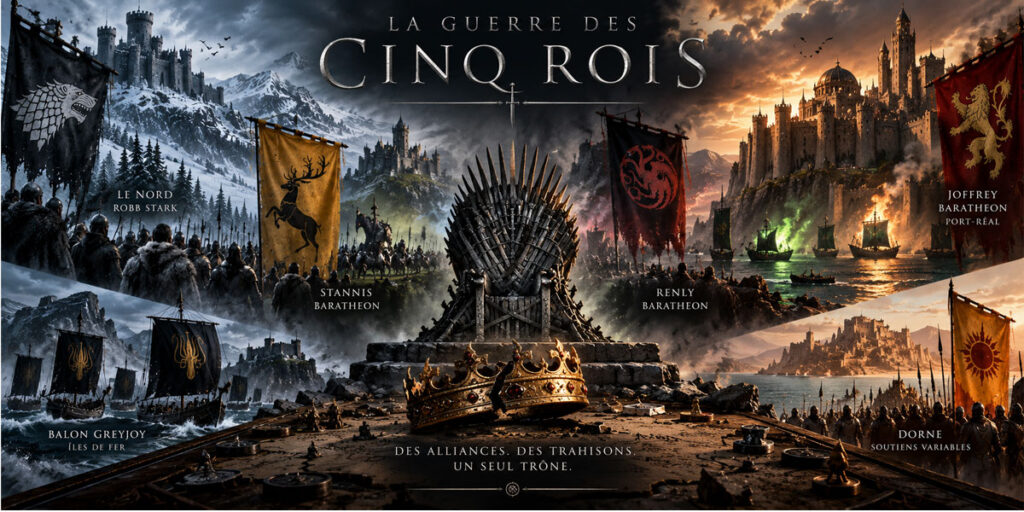
In King's Landing, Joffrey Baratheon sits on the Iron Throne with the support of the Lannisters. However, his claim to the throne is disputed. Stannis Baratheon claims to be Robert's rightful heir, while his brother Renly also lays claim to the crown.
In the North, the situation takes a different turn. Following Ned Stark’s execution, the lords of the North and the Riverlands proclaim Robb Stark King of the North. Also recognized as King of the Trident, he does not seek to seize the Iron Throne, but rather to wrest his territories from its control.
Meanwhile, Balon Greyjoy takes advantage of the chaos to lay claim to the crown and independence for the Iron Islands.
Five men now hold the title of king. Yet their ambitions differ. Some want to rule the Seven Kingdoms, while others are primarily interested in freeing their lands from the authority of the Iron Throne.
This period is thus known as the War of the Five Kings.
The Five Kings and Their Demands
| King | Claimed Title | Key Supporters | Objective |
|---|---|---|---|
| Joffrey Baratheon | King of the Seven Kingdoms | House Lannister and Allies | Defend the Iron Throne |
| Stannis Baratheon | King of the Seven Kingdoms | Supporters of Peyredragon | Establishing Your Right to an Inheritance |
| Renly Baratheon | King of the Seven Kingdoms | House Tyrell and numerous lords | Conquer the Iron Throne |
| Robb Stark | King of the North | Houses of the North and Allies of the Conflans | Defending the North and Its Independence |
| Greyjoy Balloon | King of the Iron Islands | Ironborn | Restore the Independence of the Iron Islands |
Not all five kings are claiming the Iron Throne, however: Robb Stark and Balon Greyjoy seek above all to rule independent territories.
Robert's Death and the Disputed Inheritance
When Robert Baratheon died after a hunt, the kingdom suddenly lost the ruler who had been maintaining a fragile balance among the great Houses. In King's Landing, Joffrey was quickly crowned with the support of Cersei and the Lannisters.
Ned Stark, however, refuses to recognize his legitimacy. Before his death, Robert had appointed him Lord Regent and Protector of the Realm until his heir came of age. Now, however, Ned knows that Joffrey is not the king’s biological son and considers Stannis Baratheon to be the rightful heir. Yet the situation turns in the Lannisters’ favor. Ned is arrested and charged with treason.
His execution in front of the Great Sept of Baelor forever changes the course of the conflict. Any possibility of reconciliation with the Starks then becomes nearly impossible.
Meanwhile, Stannis and Renly each refuse to recognize Joffrey. Alliances are forming, armies are gathering, and several regions are beginning to challenge King’s Landing’s authority.
The struggle is therefore no longer just about Robert's succession. Westeros is fracturing politically and militarily, effectively ushering in the War of the Five Kings.
Robb Stark, the King in the North
After Ned Stark’s arrest, Robb Stark leaves Winterfell at the head of the Northern forces. Although still very young, he must quickly establish himself as a military leader in the face of the Lannisters’ experienced armies.
His early campaigns revealed his strategic abilities. Robb won several victories and, notably, managed to capture Jaime Lannister. However, Ned’s execution profoundly altered the objectives of the conflict.
The lords of the North no longer wish simply to fight the Lannisters. They now refuse to be ruled from King’s Landing and proclaim Robb King in the North. This decision revives an independence that had been lost since Aegon Targaryen’s conquest.
From the very start of his campaign, Robb also has to navigate political alliances. To enable his army to cross the Twins, he strikes a deal with Walder Frey and, among other things, promises to marry one of his daughters. This alliance later becomes essential to maintaining unity within his camp.
In the series, he later breaks that promise by marrying Talisa Maegyr. This personal decision undermines a vital alliance and forces the Starks to seek reconciliation with Walder Frey.
Despite his successes on the battlefield, Robb comes to realize that a war cannot be won with an army alone. In Westeros, a broken promise can be just as dangerous as a military defeat.
Stannis and Renly Baratheon
After Robert's death, his two brothers each laid claim to the crown. However, Stannis and Renly Baratheon did not pursue their claims in the same way.
Stannis considers himself Robert’s rightful heir. Convinced that Joffrey is not his true son, he believes the Iron Throne rightfully belongs to him. From Dragonstone, he gathers his supporters and is also influenced by Melisandre, priestess of the god R’hllor.
Renly adopts a different strategy. Although he is the younger of the two brothers, he also proclaims himself king. His alliance with Margaery Tyrell secures him the support of the Bief and allows him to assemble a sizeable army.
The two brothers thus become rivals even as they are technically fighting the same enemy. Their confrontation leaves no room for reconciliation. Shortly afterward, Renly dies under supernatural circumstances linked to Melisandre.
Many of the lords who had been with Renly then joined Stannis, while the Tyrells refused to follow him. Stannis was now able to focus his efforts on King’s Landing and launched a major attack on the capital during the Battle of the Blackwater.
However, the defenses organized primarily by Tyrion Lannister, the use of Greek fire, and the arrival of Lannister-Tyrell reinforcements drove his army back.
The Baratheon split will thus have severely weakened their own side. Once again, internal rivalries are shaping the course of the war just as much as the battles themselves.
A Feast of Red and the Fall of the Starks
Despite his military victories, Robb Stark is gradually finding himself in a difficult situation. His army is growing weaker, the Greyjoys are attacking the North, and his alliance with the Freys has been weakened by his marriage to Talisa.
To mend this rift, the Starks agree to return to the Twins. A marriage is to unite Edmure Tully with Roslin Frey, the daughter of Walder Frey. On the surface, this union allows the two sides to reconcile.
However, the Freys have secretly formed an alliance with Tywin Lannister and Roose Bolton.
During the festivities, Robb, Catelyn, and several of their companions were murdered, despite the rules of hospitality that were meant to ensure their protection. This event became infamous as the Red Wedding.
Betrayal upsets the balance of the war. With Robb’s death, the Kingdom of the North loses its king. Roose Bolton is rewarded for his betrayal and becomes Warden of the North, while the Freys strengthen their influence in the Riverlands.
However, the Lannisters' political victory comes at a price. The Red Wedding becomes a symbol of betrayal that leaves a lasting mark on the families of the North.
Above all, they demonstrate once again a fundamental rule of *Game of Thrones*: the most decisive battles don't always take place on a battlefield.
Game of Thrones: The Ultimate Symbol of Power
As the’The Story of Game of Thrones, the Iron Throne thus becomes much more than just a royal seat: it embodies the ambitions, alliances, and conflicts that tear Westeros apart. Located in King’s Landing, it represents the sovereign’s authority over the Seven Kingdoms.
According to the history of Westeros, the throne was created following the conquest by Aegon I Targaryen. The swords taken from defeated enemies were gathered, heated in the fire of Balerion the Black Dread, then assembled and hammered into the Iron Throne. The result is deliberately imposing, uncomfortable, and dangerous.
The message is clear: ruling Westeros should never be comfortable.
However, the Iron Throne represents much more than just a royal seat. After the dragons disappeared, it became the primary visible symbol of the legacy left by the Targaryen conquest. Whoever sits upon it asserts their authority over a kingdom composed of territories and families with often conflicting interests.
That is precisely what drives much of *Game of Thrones*. Robert Baratheon seizes power, Joffrey succeeds him, Stannis and Renly lay claim to the crown, while Daenerys dreams of reclaiming what she considers her family’s legacy.
Yet while Westeros is torn apart by the question of who should sit on the Iron Throne, a far older threat is growing beyond the Wall.
This conflict is one of the central themes of the saga: men are fighting for power when they may soon have to fight simply to survive.
The North, the Wall, and the Night's Watch
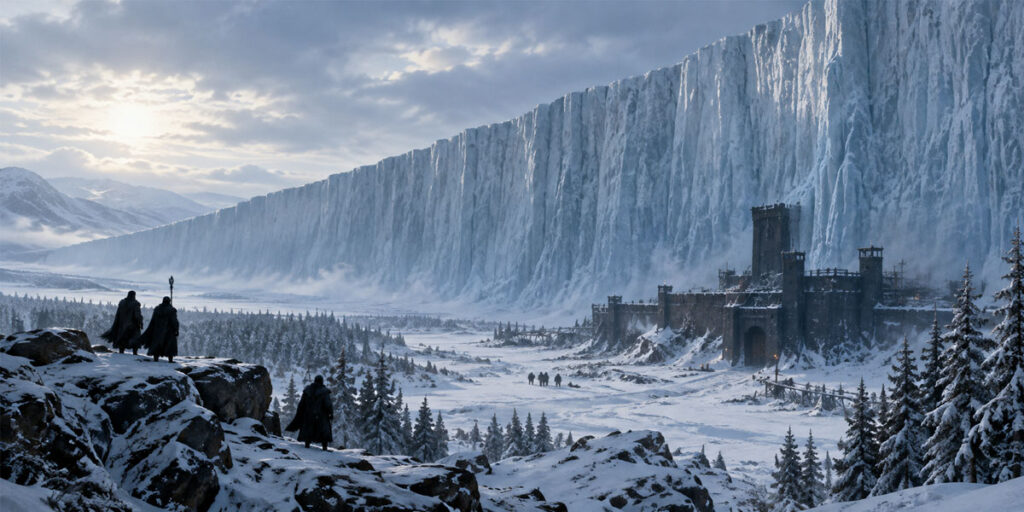
The North holds a special place in the’The Story of Game of Thrones, because the threat unfolding there is gradually transcending mere rivalries for power. Far from King's Landing stands the Wall, a gigantic ice fortress that has protected the kingdom for thousands of years.
At its feet stands the Night's Watch, a once-prestigious order charged with guarding the lands beyond the Wall. Yet, when *Game of Thrones* begins, many consider the ancient threats of the North to be mere legends.
This region, however, plays a crucial role in the story. It is here that Jon Snow discovers a world very different from that of the Great Houses. Beyond political rivalries, Westeros will soon have to face a danger that nearly the entire kingdom had forgotten.
Why is the Wall so important in the story of *Game of Thrones*?
The Wall stretches for several hundred kilometers across northern Westeros. According to ancient accounts, it was built several thousand years ago, following a period known as the Long Night.
Tradition credits its construction to Brandon the Builder, a legendary figure also associated with the origins of Winterfell. His mission was to protect the kingdoms of men from the dangers coming from the Far North.
However, over the centuries, the true reason for its existence has become shrouded in legend. For most of the people of Westeros, the Wall serves primarily to keep out the Wildlings, also known as the Free Folk.
As for the White Walkers, they belong in the stories told to children.
So when the first signs of their return appear, very few people are willing to believe them. The Wall then ceases to be merely a border: it gradually becomes once again Westeros’s last great defense against a threat from the past.
The Night's Watch and its sworn brothers
Stationed along the Wall, the Night’s Watch has only three occupied strongholds at the beginning of the story: Castle Black, Shadow Tower, and Fort Rising. Castle Black, however, serves as its main command center. Its members are recognizable by their black clothing, which has earned them the nickname “Black Brothers.”.
In the past, joining this order was a true honor. Knights and members of noble families voluntarily gave up their lands to defend the kingdom. However, by the beginning of *Game of Thrones*, the situation had changed significantly. The ranks have dwindled considerably, and the Guard now also accepts criminals, disgraced men, or those with no future—though some still choose to join voluntarily.
When a man takes his vows, he renounces his lands, his titles, and the chance to start a family. In theory, the Night’s Watch does not take part in wars between the great Houses. It protects the kingdom without serving any particular king.
Its organization is based primarily on three groups. The rangers explore the lands beyond the Wall and engage in combat when necessary. The builders maintain the fortifications. Finally, the stewards oversee the day-to-day operations of the order.
As the series progresses, this mission regains its full meaning. The Black Brothers gradually come to realize that the Savages are not their greatest threat.
For behind them looms a threat capable of endangering all the inhabitants of Westeros, regardless of their House.
Jon Snow: Part Stark, Part Targaryen
Raised at Winterfell alongside Ned Stark's children, Jon Snow grew up believing he was the Lord of the North's illegitimate son. This situation placed him both at the heart of the Stark family and slightly on the outside.
While still young, Jon decides to join the Night's Watch, where his uncle Benjen Stark is already serving. He quickly discovers that the Wall is not the glorious order he had imagined. Yet this new life will gradually shape him into a fighter, and then a leader.
Jon serves, among others, under Jeor Mormont, Lord Commander of the Night's Watch. After Jeor Mormont's death during the mutiny at Craster's and the events that shook the Wall, Jon himself is eventually elected Lord Commander of the Night's Watch.
His experience with the Free Folk also changes his perspective on the conflict. While many see only enemies, Jon understands that the Wildlings, too, are fleeing a far more dangerous threat from the Far North.
However, the series then reveals a secret that completely changes his story. Jon is not Ned Stark’s son: he is the son of Lyanna Stark and Rhaegar Targaryen. His existence thus links two of the most important houses in Westeros.
In George R. R. Martin's published novels, however, this family relationship has not yet been explicitly confirmed.
Thus, Jon finds himself symbolically caught between two worlds: the legacy of the Starks in the North and that of the Targaryens, while his true battle takes place far from the Iron Throne.
White Walkers and the Night King: The Real Threat
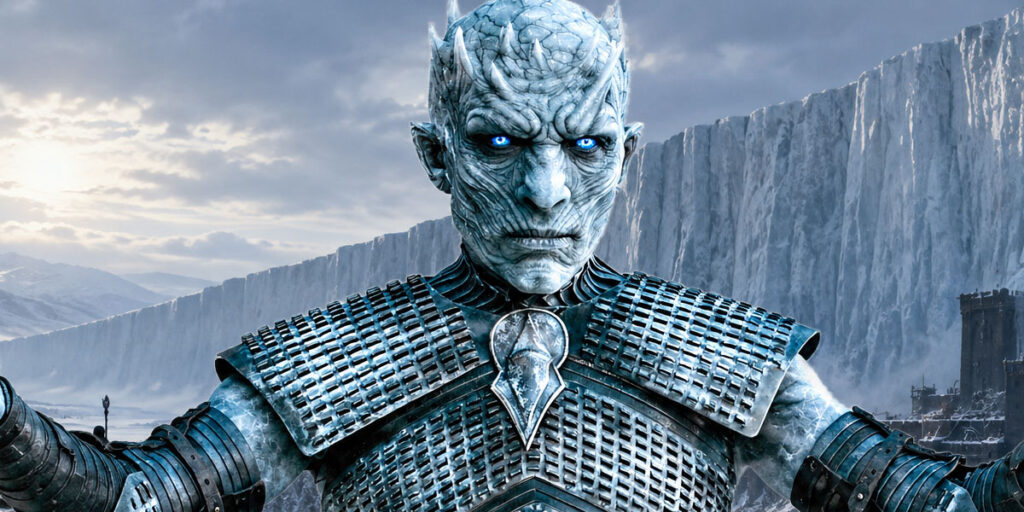
From the very first minutes of *Game of Thrones*, a long-forgotten threat emerges from beyond the Wall. Yet, for much of the story, the people of Westeros continue to fight over crowns and territories.
The White Walkers pose a very different kind of danger. Their threat goes beyond the political ambitions that are tearing Westeros apart: neither crown nor territory can explain it. Above all, their return serves as a reminder that the ancient legends of the North are rooted in a reality the realm had eventually forgotten.
This threat also gives full meaning to the Stark motto: «Winter is coming.».
Who are the White Walkers in the *Game of Thrones* storyline?
In the series, the White Walkers are supernatural beings who live in the frozen lands beyond the Wall. They are associated with the cold and have the ability to raise the dead, who then join their army.
Their origins date back to a very ancient time. Thousands of years before the events of *Game of Thrones*, a period known as the Long Night is said to have plunged Westeros into darkness and cold.
According to the stories, the men—with help in particular from the Children of the Forest—finally succeeded in repelling this threat during the Battle of Dawn. Over time, however, these events became legends.
That is why warnings from the North are initially met with skepticism.
In George R. R. Martin's novels, these creatures are mostly referred to as the Others. Their appearance and several aspects of their backstory also differ from how they are portrayed on television.
This distinction is important: the series has developed its own mythology surrounding the White Walkers, while the novels still leave much of their origins and true intentions shrouded in mystery.
The King of the Night in the series
In the series *Game of Thrones*, the White Walkers are led by a particularly menacing figure: the Night King. Unlike other creatures of the North, his origins are partially revealed through Bran Stark’s visions.
Thousands of years ago, the Children of the Forest were at war with the First Men. To defend themselves, they captured a man and drove a dragonglass dagger into his chest. This transformation gave rise to the Night King and helped create a threat that eventually spiraled out of their control.
As the leader of the White Walkers and their army of the dead, he becomes the main adversary of the living. His goal, however, remains poorly defined. Bran explains that he seeks to bring about an endless night and wipe out the world of men. It is largely for this reason that the Three-Eyed Raven, the guardian of their memories, becomes a key target.
However, it is important to note a key difference from the novels. The Night King from the series does not exist in this form in the published books.
George R. R. Martin does indeed mention a legendary character named the Night’s King. He is said to have been the thirteenth Lord Commander of the Night’s Watch. However, he belongs to a very distant past and should not be confused with the leader of the White Walkers created for the television series.
Why Dragon Glass and Valyrian Steel Are Essential
When facing the White Walkers, ordinary weapons quickly reveal their limitations. Two materials then take on considerable importance: dragon glass and Valyrian steel.
Dragon glass is actually obsidian, a black volcanic rock that is particularly sharp but fragile. In the past, the Children of the Forest already used it to make weapons. Most importantly, Samwell Tarly discovers that a dragonglass blade can kill a White Walker.
This discovery becomes crucial when Jon learns that Dragonstone has significant obsidian deposits.
However, the series reveals a second weapon capable of withstanding the White Walkers: Valyrian steel. During the Battle of Durlieu, Jon Snow faces off against one of them with Longclaw. Instead of shattering upon contact with his icy weapon, the sword holds firm and destroys his opponent.
This scene completely changes the strategic value of the ancient Valyrian blades.
For centuries, they were primarily regarded as treasures passed down through prominent families. Now, they are also becoming weapons capable of defending the living.
The novels, however, leave more to the imagination. Ancient texts mention a «dragon steel» capable of defeating the Others. Jon and Sam wonder if this could be Valyrian steel, but this theory has not yet been confirmed in the published books.
This raises a crucial question: Why is Valyrian steel so rare, and why has the secret of its production been lost?
Valyrian Steel: The Lost Legacy of Valyria
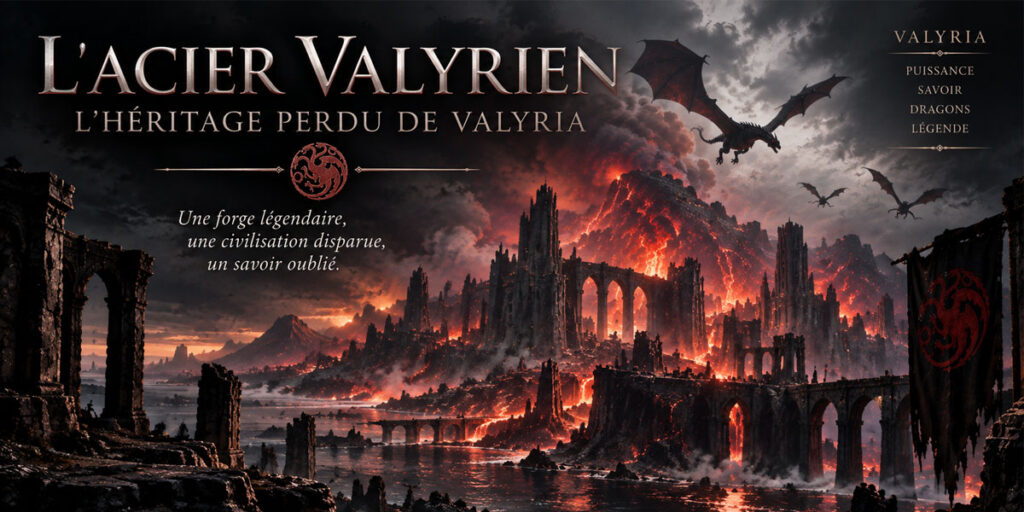
Of all the materials featured in *Game of Thrones*, none is shrouded in as much mystery as Valyrian steel. Extremely rare and recognizable by its distinctive appearance, it is used to forge blades renowned for being exceptionally light, strong, and sharp.
To understand its origins, we must go back to ancient Valyria. For centuries, the powerful Valyria ruled over much of Essos thanks to its dragons, but also to knowledge that has since been lost.
Valyrian blacksmiths at that time had mastered techniques capable of producing this exceptional steel. Magic is also said to have played a role in its production. However, the exact methods used at that time remain a mystery.
Everything changes with the Scourge of Valyria, a catastrophe that brutally destroyed the city and brought about the collapse of its empire. With it also vanished the secret to forging new blades of Valyrian steel.
The weapons that have survived thus become extremely valuable. Some have endured for centuries and are passed down through the great families of Westeros.
Thus, owning a Valyrian steel sword is not just an advantage in battle. It also means possessing a fragment of a vanished world, passed down from generation to generation.
And in *Game of Thrones*, some of these blades will face a particularly eventful fate.
What is Valyrian steel in the *Game of Thrones* storyline?
Valyrian steel is immediately distinguishable from ordinary metals. Blades made from this material are known to be lighter, stronger, and capable of retaining an exceptional edge.
They also have a distinctive appearance. Their surface features ripples and patterns visible in the metal, a legacy of the ancient techniques used by the blacksmiths of Valyria.
However, what truly sets them apart is how they are made. George R. R. Martin's writings suggest that Valyrian craftsmen did not merely work with metal. Spells are also said to have played a role in the process, though their exact nature is unknown.
This origin helps explain why these weapons have become so rare. In Westeros, a few hundred Valyrian steel blades are said to still exist, but some have disappeared over the centuries. Their actual number therefore remains uncertain.
Such a sword is therefore much more than just a weapon. It can become a family heirloom, a symbol of prestige, and sometimes one of a House’s most valuable possessions.
This is particularly true of Ice at the Starks' or Greatclaw at the Mormonts'.
Yet a paradox remains: some blacksmiths still know how to rework this steel, but no one seems capable of actually creating new steel from it.
Why doesn't anyone know how to make Valyrian steel anymore?
The secret of Valyrian steel was lost along with the Scourge of Valyria. This catastrophe wiped out a large portion of the Valyrian people, along with the knowledge needed to create this exceptional metal.
Since then, the blacksmiths of Westeros have been unable to produce new blades with the same properties. Each weapon that has survived has therefore become all the more valuable.
However, not all of that expertise has been lost.
A few artisans still master the extremely complex art of reforge and rework existing Valyrian steel. The blacksmiths of Qohor are particularly renowned for their mastery of some of these techniques.
This difference is crucial. They don't actually create new Valyrian steel; they can transform an existing blade and reshape it.
"Game of Thrones" provides a particularly striking example of this. After Ned Stark's death, his massive sword Ice falls into the hands of the Lannisters. Tywin then decides to have it remelted by the blacksmith Tobho Mott.
From this ancient Stark blade, two new Valyrian steel swords are forged: Féale and Pleurs-de-Veuve.
A highly symbolic transformation: the legacy of a defeated House thus becomes that of its enemies.
The Great Houses and Their Ancestral Blades
In Westeros, owning a Valyrian steel blade is a rare privilege. Some are passed down through generations and become an integral part of their House’s history.
Visit Stark They thus possess Ice, a mighty sword that had been passed down through their family before falling into the hands of the Lannisters. The Mormonts, for their part, had held Greatclaw for several centuries before Jeor Mormont entrusted it to Jon Snow.
Other prestigious families also have their own blades. The Tarly retain Corvenin, while the Hightower are associated with Vigilance. However, some weapons have disappeared. This is particularly true of Feunoyr, a sword once belonging to House Targaryen and wielded, among others, by Aegon the Conqueror; its current whereabouts remain unknown.
These swords, therefore, do not merely represent the power of Valyrian steel. They also convey the‘The history, prestige, and sometimes the political claims of a lineage.".
Losing such a weapon can be a real blow to a House. Conversely, receiving one of these blades is an exceptional honor.
That’s why the swords in *Game of Thrones* play such an important role in the world of Westeros. Behind each one lie owners, battles, and sometimes several centuries of history.
Iconic Weapons in the History of *Game of Thrones*
Certain weapons hold a special place in the’The Story of Game of Thrones, because they convey a House's legacy just as much as they shape the fate of those who wear them. They can symbolize a House, evoke a legacy, or mark a turning point in a character's fate.
Among them, Valyrian steel blades are obviously the most prestigious. However, *Game of Thrones* also shows that a weapon’s value does not depend solely on the metal used to make it.
Grand-Griffe, Glace, and Aiguille each have very different stories. Yet each becomes inseparable from the person who wears it.
Longclaw, the legacy passed down to Jon Snow

Greatclaw is the ancestral Valyrian steel sword of House Mormont, which has owned it for about five centuries. After Jon Snow saved his life during an attack by a wight at Castle Black, Jeor Mormont decided to entrust this exceptional weapon to him. Its former bear-headed pommel was then replaced with a white wolf’s head, symbolizing the new chapter beginning for the blade.
This passing on gives the blade a new story. Longclaw then accompanies Jon for much of his journey and gradually becomes one of his most recognizable symbols.
His Valyrian steel also takes on special significance in the face of the threat from the North. The sword thus demonstrates that certain weapons inherited from a vanished world can still play a decisive role in the future of Westeros.
Behind Grand-Griffe, however, lies a much longer history, closely tied to the Mormonts and Jon Snow's fate.
Ice, the ancestral sword of the Starks

Among the weapons associated with the great houses of Westeros, Ice holds a special place. This imposing Valyrian steel sword has belonged to House Stark for about four centuries, although the name «Ice» is much older.
At the beginning of *Game of Thrones*, it is carried by Eddard Stark, who uses it, in particular, when he must administer justice on behalf of the North. Its impressive size and age make it as much a symbol of authority as it is a genuine weapon.
After Ned Stark’s downfall, however, Ice leaves Winterfell and falls into the hands of the Lannisters. Its disappearance thus represents much more than the loss of a sword: the Starks are deprived of one of the symbols of their House.
Its steel will then take on a new purpose, as the blade will be transformed to give rise to Féale and Pleurs-de-Veuve.
Thus, the history of Glace symbolically parallels that of the Starks: a great House ravaged by war, whose legacy endures despite its dispersion.
Needle, Arya Stark's weapon

Unlike the large Valyrian steel swords, Needle It does not owe its fame to any exceptional metal. Small, lightweight, and well-suited to Arya Stark’s fighting style, it was given to her by Jon Snow before he left Winterfell.
Its significance is, above all, personal. As Arya navigates wars, separations, and hardships, Needle remains one of the objects that directly connects her to her family and her identity.
The young Stark also learns to wield this blade in a way that is very different from that of the knights of Westeros. Her training under Syrio Forel thus helps make Needle a weapon immediately associated with her journey.
Amid the immense ancestral swords and precious Valyrian blades, Needle reminds us of one essential thing: the value of a weapon also stems from the history of the person who wields it.
Féale and Pleurs-de-Veuve, the Heiresses of Ice
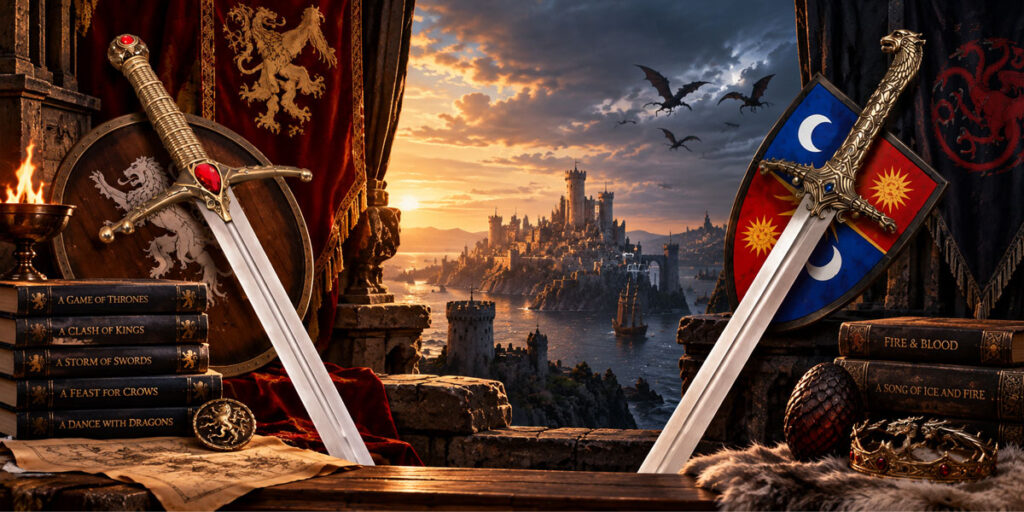
Born out of the redesign of Glace, Féale and Pleurs-de-Veuve have a common origin but have taken very different paths.
"Féale" was originally intended for Jaime Lannister. However, he chose to entrust it to Brienne of Tarth, with a particularly symbolic mission: to find and protect Sansa Stark. In this way, part of Ned’s old sword indirectly returns to serve his family.
"Widow's Tears" was given to Joffrey Baratheon by Tywin Lannister as a wedding gift. After his death, the sword remained in the royal family's possession before eventually being wielded by Jaime in the series.
These two swords perfectly illustrate how *Game of Thrones* uses weapons to tell the story of its characters’ development. Both stem from the same Stark legacy, yet they end up in the hands of characters associated with the Lannisters, while still carrying a part of Ice’s history.
They thus remind us that in Westeros, A blade can change hands without ever completely losing its history.
Corvenin and Other Notable Blades
The Starks, the Mormonts, and the Lannisters aren’t the only ones with weapons steeped in history. Other prestigious blades bear witness to the importance placed on family legacies in Westeros.
Corvenin thus belongs to House Tarly. This Valyrian steel sword has been in House Tarly’s possession for nearly five centuries and is one of its most precious heirlooms. In the series, Samwell Tarly eventually takes it with him before it is used by Jorah Mormont during the Battle of Winterfell.
Other famous weapons have met a far more mysterious fate. Feunoyr, for example, was wielded by several Targaryen rulers before passing into the hands of Daemon Feunoyr. Its current whereabouts remain unknown. Its history, however, is more closely tied to the past of the Targaryen dynasty than to the main events of *Game of Thrones*.
All of these blades demonstrate just how much a weapon can become a true witness to history. Some remain in the same family for centuries. Others change hands, are lost, or resurface at pivotal moments.
That’s also why they still hold such a fascination: behind every great sword in Westeros lies a story that goes far beyond combat.
Daenerys Targaryen and the Return of the Dragons
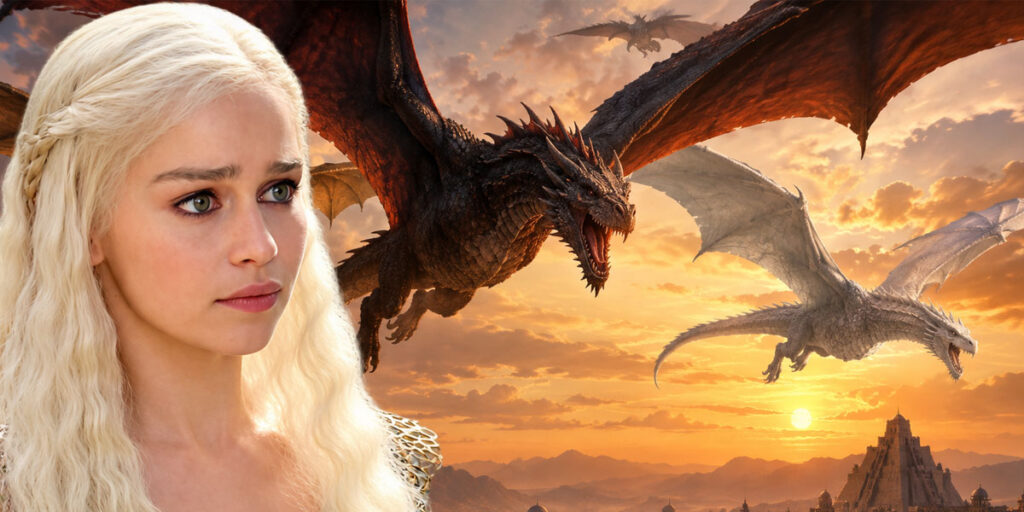
The return of the dragons is also a major event in the’The Story of Game of Thrones, even though these creatures had been extinct for several generations. Exiled to Essos with her brother Viserys, Daenerys Targaryen initially seems far removed from the power struggles rocking the kingdom.
Yet his fate will upset the balance of the world.
At her wedding to Khal Drogo, Daenerys receives, among other gifts, three petrified dragon eggs from Illyrio Mopatis. Considered precious relics of a bygone era, they serve as a reminder of a power the Targaryens lost long ago.
When Drogo died, Daenerys placed the eggs on his funeral pyre before stepping into the flames herself. When the fire died down, she emerged alive in the series, accompanied by three newborn dragons: Drogon, Rhaegal, and Viserion.
For the first time in about a century and a half, living dragons are reappearing in the world.
Their birth, therefore, goes far beyond Daenerys’s personal history. It marks the return of the creature that had once enabled the Targaryens to conquer Westeros.
As the dragons grow, Daenerys's ambitions evolve as well. The young exiled princess gradually becomes a ruler capable of raising armies and claiming her family's legacy.
From that point on, the Targaryens' return to Westeros was no longer just a dream.
From Exiled Princess to Mother of Dragons
At the beginning of *Game of Thrones*, Daenerys Targaryen lives in exile under the authority of her brother Viserys. He dreams of reclaiming the Iron Throne and arranges her marriage to Khal Drogo, hoping to secure the support of his Dothraki army in return.
At first vulnerable in a world she knows little about, Daenerys gradually learns the language and customs of the Dothraki. She earns their respect and, above all, begins to make her own decisions.
Viserys's death marks an important turning point. Daenerys then becomes the last known member of House Targaryen. Then Khal Drogo's death once again upends her fate.
The birth of her three dragons permanently changes her status. The woman whom many considered a princess without a kingdom becomes the Mother of Dragons, the bearer of a power that had been lost for several generations.
However, Daenerys soon finds that she is no longer content merely to reclaim the crown of her ancestors. Her journey through Essos also leads her to conquer cities, free slaves, and learn how to govern.
Each victory thus strengthens an ambition he has long inherited from his brother: to one day return to Westeros and reclaim the Iron Throne from the families who overthrew the Targaryens.
Drogon, Rhaegal, and Viserion
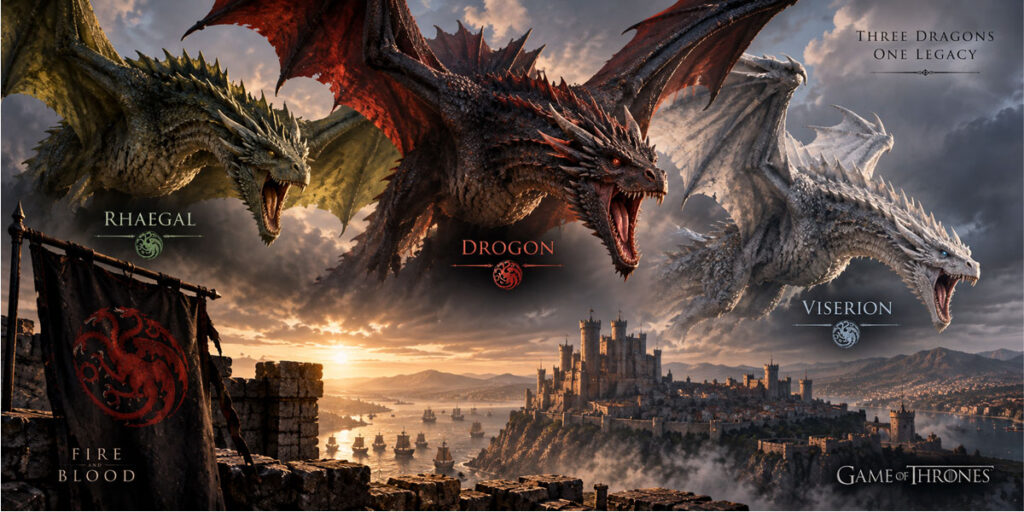
Daenerys's three dragons have names directly linked to the people who have shaped her life. Drogon is named in honor of Khal Drogo, while Rhaegal is named after her brother Rhaegar Targaryen. Finally, Viserion is named after her brother Viserys.
Drogon, recognizable by his dark scales, quickly becomes the most imposing and independent of the three. He also shares a special bond with Daenerys, who eventually rides him.
Rhaegal stands out for his greenish hues. In the series, his story takes on a symbolic meaning when Jon Snow manages to ride him, echoing his true origins.
Viserion has lighter colors. His fate, however, takes a dramatic turn beyond the Wall when the Night King kills him and then brings him back among the dead. Now a weapon in the Night King’s hands, Viserion goes on to play a decisive role in the destruction of part of the Wall.
Dragons, therefore, are not merely Daenerys's main military force. Their return directly links her story to that of her ancestors.
After more than a century without dragons, the power that had enabled the Targaryens to conquer Westeros has returned.
The Conquest of Westeros
After spending several years in Essos, Daenerys finally has the resources she needs to return to the land of her ancestors. She crosses the strait with her dragons, the Unsullied, a large Dothraki army, and several allies from Westeros.
Her arrival at Dragonstone, the former Targaryen stronghold, holds great symbolic significance. Daenerys returns to the place where her family had settled before Aegon I's conquest.
However, conquering Westeros proves to be much more difficult than expected. Cersei Lannister controls King’s Landing and, of course, refuses to give up the Iron Throne. Alliances shift, battles multiply, and Daenerys discovers that her dragons alone do not guarantee victory.
Her encounter with Jon Snow also changes her priorities. He is primarily seeking support against the Army of the Dead and tries to convince Daenerys that the real threat lies in the North.
The battle for the crown is thus confronted with a much broader issue.
For both Daenerys and Jon, one question becomes unavoidable: Should they continue to fight for power when the very existence of Westeros is threatened?
From the War for the Throne to the Battle for Westeros
For years, the great Houses have fought over who should rule the Seven Kingdoms. Yet the arrival of the Army of the Dead is forcing several former adversaries to look beyond their rivalries.
Jon Snow and Daenerys Targaryen arrive at Winterfell with their forces. The Starks, the Unsullied, the Dothraki, the men of the Vale, the Free Folk, and many fighters from various backgrounds then prepare to face a common enemy.
For once, the question is no longer who should rule.
You just have to survive.
The Battle of Winterfell thus becomes one of the series’ major clashes. Jon and Daenerys battle in the air with Rhaegal and Drogon, while the army of the dead gradually overwhelms the castle’s defenses.
In the heat of battle, the Night King seeks to reach Bran Stark. After Theon Greyjoy’s death, he seems on the verge of succeeding. However, Arya Stark intervenes and kills him with a Valyrian steel dagger, also causing the destruction of the White Walkers and the army of the dead.
The threat from the North then disappears, but human rivalries do not end with it.
Once the dead have been defeated, the struggle for the Iron Throne resumes. Daenerys once again turns her attention to King's Landing and Cersei Lannister.
Game of Thrones thus returns to the question that has run through its entire story: after so many wars, betrayals, and sacrifices, who will ultimately rule Westeros?
The Story of "Game of Thrones": From George R. R. Martin's Books to the HBO Series
Before becoming one of the most famous television series of its time, *Game of Thrones* was first and foremost an adaptation of an epic literary saga created by George R. R. Martin.
The series features many of the characters, settings, and events from the novels. However, as the seasons progress, the two versions begin to take different paths.
Some characters are omitted from the adaptation, several plotlines are simplified, and others are significantly altered. This distinction becomes particularly important when the television series goes beyond the events recounted in the published novels.
Understanding these differences therefore allows us to better distinguish the story told by George R. R. Martin from the one adapted for television.
A Song of Ice and Fire: The Origin of Game of Thrones
The world of Westeros appears in the literary series *A Song of Ice and Fire*, first published in 1996. The first book, *A Game of Thrones*, later lent its name to the television adaptation launched by HBO in 2011.
George R. R. Martin builds its narrative around numerous characters whose perspectives alternate throughout the chapters. This structure allows readers to explore Westeros from different angles and gives the novels a particularly expansive scope.
The HBO series initially follows the books’ general storyline fairly closely. However, adapting such a complex work quickly requires making choices. Some characters are cut, certain plotlines are combined, and several events take a different turn.
Above all, the series eventually surpasses the published novels.
From this point on, the two versions of *Game of Thrones* can no longer be considered two perfectly identical narratives. They share the same universe and many events, but their continuity must now be distinguished.
Novels and HBO Series: What Are the Differences?
| Element | Novels by George R. R. Martin | HBO Series |
|---|---|---|
| Jon Snow | His true parentage has not yet been explicitly confirmed in the published novels. | The series reveals that he is the son of Rhaegar Targaryen and Lyanna Stark. |
| King of the Night | The Others exist, but no leader equivalent to the Night King from the series has been introduced. | The Night King leads the White Walkers and the army of the dead. |
| Characters | Novels feature more characters and several significant subplots. | Some characters are removed, merged, or have their roles assigned to others. |
| Plots | Several story arcs take directions that do not appear in the adaptation. | Some storylines are shortened, altered, or created specifically for television. |
| The End | The main series has not yet been completed in the published novels. | The series ended in 2019 with its eighth season. |
Comparison based on the published novels and the Game of Thrones television series. Updated: September 2026.
How the Series Has Changed the Story of *Game of Thrones*
Adapting a saga as vast as *A Song of Ice and Fire* inevitably required certain changes. The *Game of Thrones* series stays true to the overall framework envisioned by George R. R. Martin, but it gradually simplifies several characters and storylines.
As a result, some characters from the novels disappear entirely from the adaptation. Others have parts of their backstories transferred to characters already familiar to viewers. The characters’ ages have also been altered: Jon Snow, Robb Stark, Daenerys, and the Stark children are significantly younger at the beginning of the books.
The differences also extend to the appearance of certain iconic elements of Westeros. Greatclaw is a good example: its interpretation, inspired by the novels, differs visually from the version made famous by the HBO series.
As the series progresses, the differences become even more pronounced. Some encounters are made up for television, while characters who are still present in the novels meet a different fate on screen.
Game of Thrones is thus gradually becoming an adaptation with its own continuity, rather than an exact reproduction of the novels.
Why the two stories are no longer the same
During its first few seasons, *Game of Thrones* was able to draw directly from George R. R. Martin’s already published novels. However, the TV series has gradually caught up with its source material. Starting in Season 6, it has gone well beyond the events of the five published volumes and continues the story based on details provided by George R. R. Martin, while developing its own continuity.
George R. R. Martin had shared some general outlines of how his story would continue with the show's creators. However, that did not mean that every event had already been written out in detail. HBO therefore continued the story by making its own choices regarding the characters, the battles, and the conclusion.
That is why the ending of *Game of Thrones* should not be viewed as an exact reflection of the ending envisioned for the novels. Some events may align, while their sequence, causes, or the fates of several characters may differ.
As of September 2026, *The Winds of Winter*, the sixth announced book in the series, has still not been published. The literary history of Westeros therefore remains unfinished and still holds some mystery.
Legacy in the History of Game of Thrones
When *Game of Thrones* ended in 2019 after eight seasons, the story told on screen came to a close, but the world of Westeros is far from having revealed all its secrets. The Great Houses, the dragons, the ancient lineages, and the conflicts explored throughout the series have their roots stretching back several centuries before the struggle for the Iron Throne.
This rich history helps us better understand the role the Targaryens have played in the history of Westeros. Long before Daenerys, Jon Snow, or Robert Baratheon, their ancestors were already ruling the Seven Kingdoms, while many dragons still roamed the continent.
It is precisely this earlier period that *House of the Dragon* explores. The series takes us back about two centuries before the events of *Game of Thrones*, to a time when the Targaryen dynasty was still at the height of its power. Yet a succession crisis would gradually divide the family and plunge Westeros into a civil war known as the Dance of the Dragons.
This story, however, deserves to be told in its own right. It constitutes another major chapter in the history of Westeros, with its own characters, alliances, dragons, and legendary weapons.
FAQ on the History of Game of Thrones
Where does the story of *Game of Thrones* take place?
The story of *Game of Thrones* takes place primarily on the fictional continent of Westeros, which is divided into several major regions ruled by powerful Houses. A significant portion of the story also takes place in Essos, where Daenerys Targaryen begins her rise to power before setting out to conquer Westeros.
Who created the Iron Throne?
The Iron Throne is associated with Aegon I Targaryen, known as Aegon the Conqueror. After subjugating much of Westeros with the help of his sisters and their dragons, he founded a new dynasty. According to tradition, the throne was forged from the swords of his defeated enemies, heated by the fire of Balerion, his dragon.
Why did the Targaryens lose the Iron Throne?
Nearly three centuries after Aegon’s conquest, the reign of Aerys II Targaryen—nicknamed the Mad King—plunged the dynasty into a deep crisis that ultimately sparked a rebellion. The rebellion, led notably by Robert Baratheon, Eddard Stark, and Jon Arryn, led to the dynasty’s downfall. After Aerys II’s death, Robert became King of Westeros.
Is Jon Snow really a Stark?
Jon Snow grew up at Winterfell as Eddard Stark’s illegitimate son. In the HBO series, his true heritage is finally revealed: he is the son of Lyanna Stark and Rhaegar Targaryen. He is therefore of both Stark and Targaryen descent. However, the published novels have not yet explicitly confirmed this revelation in the same way.
Why is Valyrian steel so valuable?
Valyrian steel is renowned for its lightness, strength, and exceptional sharpness. The original method of its manufacture was lost along with the ancient civilization of Valyria. As a result, the blades that still exist have become extremely rare and are often passed down within the great houses of Westeros.
Who kills the Night King in *Game of Thrones*?
In the HBO series, Arya Stark kills the Night King during the Battle of Winterfell. She uses the Valyrian steel dagger that was once used in the attempt to assassinate Bran Stark. The Night King, however, is a character unique to the series: no equivalent character is currently portrayed as the leader of the Others in the published novels.
What is the difference between *Game of Thrones* and *House of the Dragon*?
"Game of Thrones" primarily chronicles the great Houses' struggle for power following the death of Robert Baratheon, alongside the threat from the North. "House of the Dragon" takes place nearly two centuries earlier and focuses on the Targaryen dynasty and the civil war known as the Dance of the Dragons.
To start a collection centered on Game of Thrones, first choose an element from the universe that resonates with you the most: a House, a character, or a significant moment in the story. Grand-Griffe evokes Jon Snow and the North, Aiguille accompanies Arya’s journey, while the blades forged from Ice recall the Stark legacy and the upheavals that have befallen their family.
Beyond its aesthetic appeal, knowing the history of a weapon often allows you to appreciate its replica even more. It’s also what transforms a simple decorative object into a true evocation of Westeros.
From the ancient dynasties of Westeros to the War of the Five Kings, from the secrets of Valyrian steel to the return of the dragons, the story of *Game of Thrones* goes far beyond a simple struggle for the Iron Throne. Above all, it tells the story of a world shaped by legacies, oaths, rivalries between Houses, and the consequences of choices that sometimes date back several generations.
This also explains why Westeros continues to fascinate long after the series has ended. A sword, a coat of arms, or the name of a House never represents just one character: each one points to an older history and to events that intertwine throughout the saga.
And this story goes far beyond the events of *Game of Thrones*. Long before Jon Snow, Daenerys Targaryen, or the Starks we know, Westeros had already seen conquests, wars, and dragons. With *House of the Dragon*, another era of this vast universe unfolds before us—and a new chapter in the history of Westeros that we, in turn, will explore.