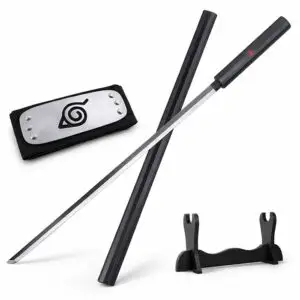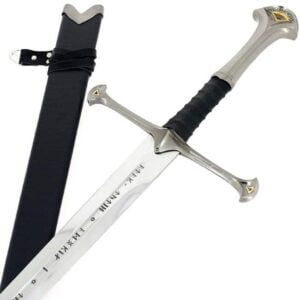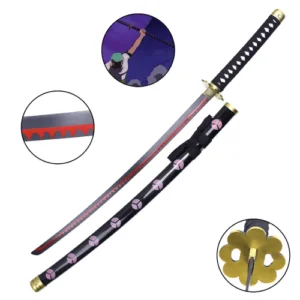





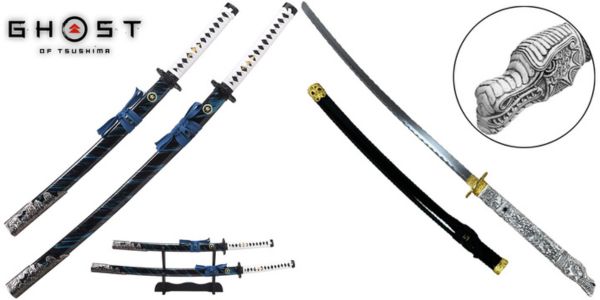
Objective: to help you choose a decorative katana that “collects”: beautiful rendering, legible details, a style consistent with your world, simple display and uncomplicated maintenance.
Choosing a decorative katana isn't just about hanging a sword on the wall. It's a piece that tells a story: a traditional Japanese ambiance, a movie-inspired replica, or the centerpiece of a geek collection corner. To avoid disappointment, keep these 4 criteria in mind before you decide:
- Visual rendering (scabbard, guard, handle, overall proportions)
- The material (for appearance, weight, safety and maintenance)
- Coherence with your collection (theme, colors, world)
- The exhibition (support, location, light, dust)
Before buying: define use and desired effect (decoration, collection, cosplay, gift)
Before comparing models, clarify what you want from your decorative katana. This changes everything, including the choice of material and the way it's displayed.
- Wall decor/shelving: priority to overall design (saya, tsuba, colors), and to the presence of details visible from a distance.
- Collection: look for a logic (an aesthetic “line”) rather than an accumulation: motifs, tones, universes (manga, film, fantasy, video games...).
- Cosplay: opt for a light, non-sharp option, more reassuring if you're moving around in a convention or if the object is being handled.
- Gift: aim for a model that is immediately visually “iconic”, easy to display, with a style that speaks to the recipient.
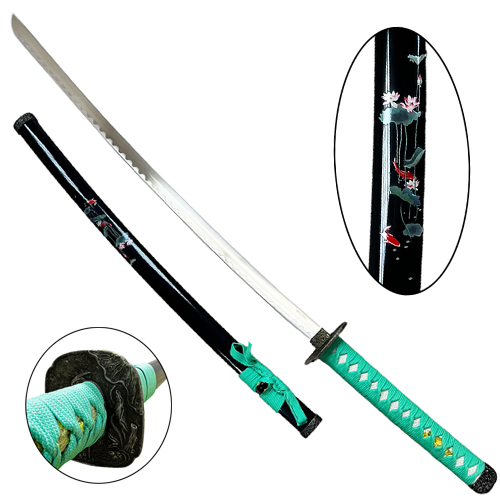
If you like elegant pieces that set the mood at a glance, you can also start with a strong theme. For example, for a refined, poetic touch, the Katana Deco Japanese flower stands out for its floral motifs, very effective in decoration and perfect for giving an immediate identity to a space.
Materials & finishes: what really changes the look of a decorative katana
On a decorative piece, “perceived quality” comes above all from what the eye catches first: the appearance of the blade (metal effect), the finish of the scabbard, the presence of details on the hilt, and the balance between blade and handle. Museums that exhibit Japanese swords point out that the frame (all the elements visible when the saber is dressed) plays a full part in the aesthetics of the object, as does the blade (useful reference points, particularly in the collections of the Metropolitan Museum of Art).
Stainless steel, wood: choosing the right context
- Stainless steel (decoration) : a frequent choice for a beautiful visual effect and easy maintenance. Stainless steel resists oxidation well on a daily basis, which is practical if the saber is left exposed.
- Wood : lighter, often more reassuring in a cosplay context or if the object can be handled (e.g. family environment). It's also a good option if you want a replica look without a metal blade.
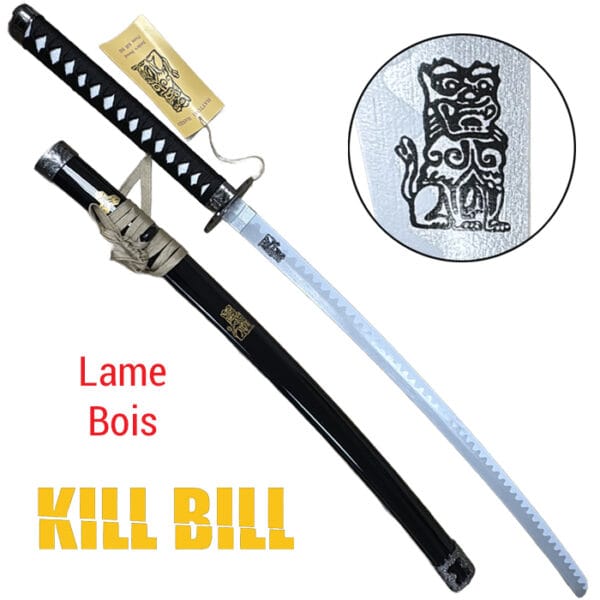
In a pop culture spirit, a wooden replica can be an excellent compromise: visual presence, homage to a work of art, and peace of mind. That's exactly the idea behind Beatrix Kiddo wooden katana, inspired by the film Kill Bill A decorative piece that immediately evokes the world of cinema, without trying to be a weapon, and which lends itself very well to display.
Visual mini-glossary (for easy comparison)
Without getting technical, knowing 3 words helps you enormously when comparing two decorative katanas in a photo:
- Tsuba The guard. It's often the most “signature” element in a design (shape, pattern, presence or sobriety).
- Saya the sheath. Color, lacquer, pattern... it has a huge decorative impact, especially when displayed on a stand.
- Tsuka The handle. Look at the texture and colors: this is what gives the feeling of a “neat” finish or not.
These terms (and other mounting elements) are commonly used in museum contexts, notably in the notices from the British Museum, This allows us to draw on a stable, recognized vocabulary when comparing parts.
Styles & coherence: building a unique collection without going off in all directions
A fine collection is rarely judged by the number of pieces... but by its coherence. The idea is not to mix everything up, but to create a “gallery” where each sword has its place: through a theme, a color palette, or a balance between sobriety and more striking pieces.
3 easy ways to give your collection an identity
- By universe : manga/anime, cinema, fantasy, video games... A line can serve as an immediate reminder of a work you love, and become a real narrative set piece.
- By aesthetic : minimalist, floral, dark, “ceremonial”, black/red contrast, etc. This is particularly effective if your pieces are displayed in the same room.
- By controlled contrast : integrate a piece of different inspiration (a straighter shape, a style from another part of Asia) to create a focal point, without breaking the whole.
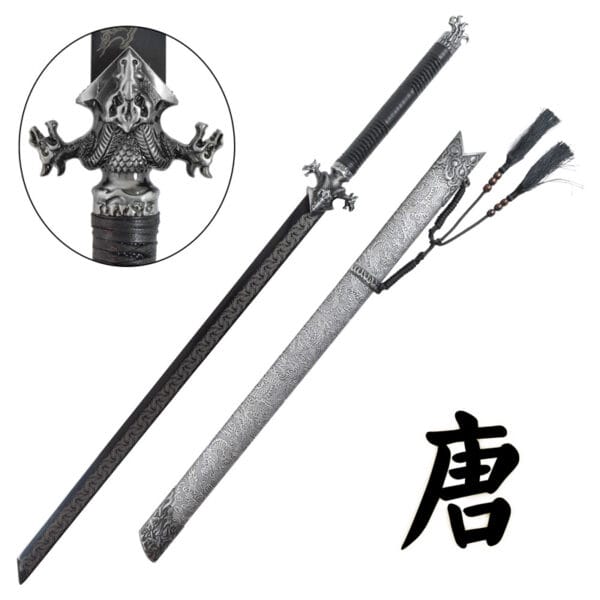
With this in mind, a piece like’Traditional Ming Dynasty sword can provide an interesting contrast in a predominantly “katana” collection: a more rectilinear silhouette, a different presence on a stand, and real visual variety. The important thing is not to see this as an “origin” of the katana, but as a way of enriching your collection corner with another Asian aesthetic inspiration.
Display & care: sublimate your decorative katana and keep it impeccable
A decorative katana really comes into its own when it's well staged. The support (often called kake) is more than just an accessory: it stabilizes the piece, prevents unnecessary rubbing on the scabbard and gives that “showcase” look that transforms a replica into a collector's item.
Support, orientation, location: the right reflexes
- Choose a suitable support: the ideal is a stable support that lets the design breathe (dark, unobtrusive wood often works very well for decorating).
- Wall or furniture? The wall creates an immediate impact (centerpiece). On a cabinet/shelf, you can more easily evolve the display as you acquire new items.
- Think “available space”: check the usable space (total length, depth with support, proximity to a passageway) to avoid a “cramped” look.
- Orientation: there are presentation codes inspired by the traditional port. When decorating, keep to one simple rule: a stable, legible orientation, consistent with your staging.
- Light & humidity: avoid direct sunlight and damp rooms: this is the best way to preserve the colors of the handle and the appearance of the scabbard.
If you're looking for ideas for styles to display (and, depending on the model, presentation options), you can browse our selection of Decorative katanas It's also a good way to identify what appeals to you most visually (guard, scabbard, colors, ambience).
Simple care (special deco)
Good news: a light maintenance is sufficient in most cases. The idea is above all to avoid marks and protect aesthetics over time.
- Microfiber: a soft cloth to remove dust and marks (especially on metal/stainless steel effect surfaces).
- Less hand contact: fingerprints can dull the appearance over time. If possible, handle through the sheath or with clean, dry hands.
- No excessive humidity: prefer a dry, well-ventilated location.
- Beware of UV: prolonged exposure to the sun can alter certain colors (handle braiding, scabbard finishes).
Conclusion: find the centerpiece of your collection
The perfect decorative katana is one that ticks off your priorities: a look that pleases you at first glance, legible finishes (tsuba, saya, tsuka), consistency with your world, and a simple display that enhances the piece. By taking a minute to define the desired effect and the intended location, you can turn a “coup de coeur” into a real collector's item.
And if you'd like to build an exhibition corner that tells the story of your passion (manga, film, fantasy or video games), our selection of decorative katanas can help you find your next signature piece.