It's already Christmas at RMC: 10% discount on non-promotional products With the code: NOEL25

How to maintain your katana : Complete guide

First of all, welcome to this article "How to care for your katana". Let's take a look at how to look after your katana.

The katana, a Japanese sword is an emblematic symbol of Japanese culture and history. Recognized by its curved blade and unique cutting edge, the katana is famous for its beauty, quality and combat effectiveness. Making a katana is an art in itself, requiring considerable skill and expertise.

That's why maintaining it is also a mark of respect, reflecting the traditions and values of the samurai who once wielded it.

1. Katana Maintenance Basics

How to care for your katana

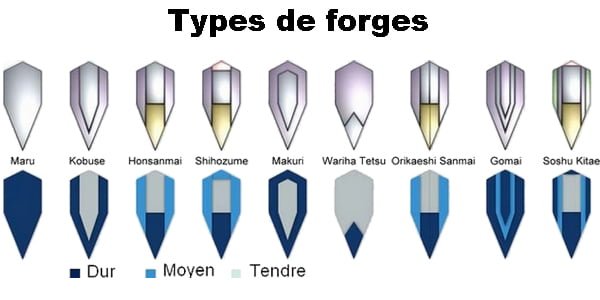
The care of a katana is crucial to preserving its quality and beauty. This process begins with understanding the different types of katana and their specific care needs. For example, traditionally forged katanas, available on our page dedicated to forged katanas, may require a slightly different approach to care than modern replicas. It's important to know the type of katana you have in order to apply the right care methods.
For decorative katanas, you don't need this style of care.Ballistol oil as soon as you touch the blade with your fingers. So, for sharp katanas, in addition to regular cleaning and polishing, proper care and storage are also essential to keep the blade in good condition.

2. Cleaning the Blade: Crucial Initial Step

How to care for your katana
Cleaning the blade

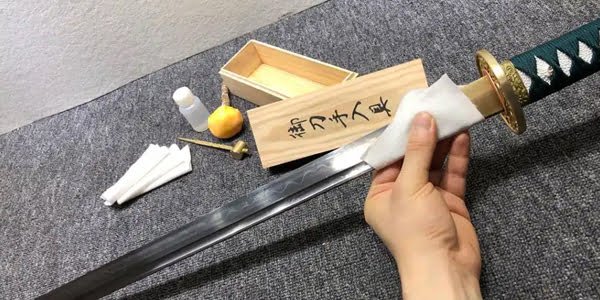
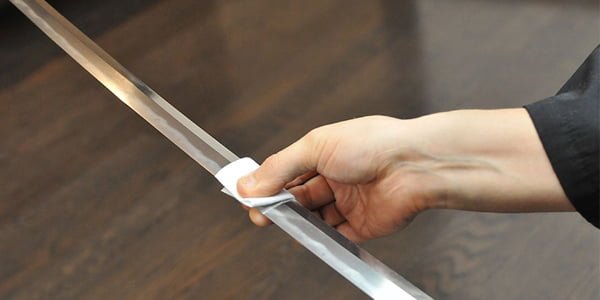
The first step in maintaining a katana involves cleaning the blade. This begins with the removal of old oil, a fundamental process to prepare the blade for more thorough cleaning. A dry cloth is ideal for this. Once the oil has been removed, the next step is to polish the blade.

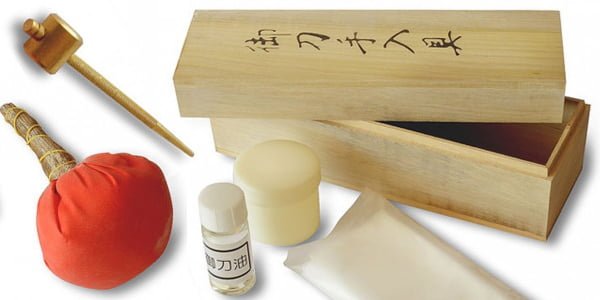
Our maintenance kit for katana, designed specifically for this task, contains all the tools needed for effective and safe cleaning. The quality of polishing is as important as the cleaning itself, as it helps protect the blade from corrosion and wear.

Next, take the cloth, put some vegetable oil on it and run the cloth over the entire length of the blade. Note that you don't need to dismantle the handle to maintain this blade.

3. Cleaning and Polishing: Essential Katana Care Techniques

Maintenance kit

After removing the oil, use another cloth or a sheet of nugui-gami to gently rub the powder onto the blade. An essential step in the process of cleaning a forged katana. If necessary, repeat this step for a perfect clean.
Then tap the Uchiko ball every 5 cm against both sides of the blade and on the back, releasing small quantities of powder.
Use a new sheet of rice paper to remove all remaining stone dust from both sides of the blade.
Inspect the blade closely for any signs of rust. Place a few drops of oil on each side of the blade, then wipe carefully and evenly on both sides.

Finally, check the blade carefully without touching it, to ensure that the oil layer is even and complete.

4. Storage and cleaning frequency

Forged katana
Forged Katana

Proper storage of the katana is just as important as cleaning it. Proper storage prevents damage and corrosion. The frequency of cleaning depends on several factors, including the environment and storage conditions. In dry regions, cleaning every three to four months is generally sufficient. However, in humid areas, more frequent cleaning may be necessary.

For ideal storage, place the sword on a wooden stand with the blade in its sheath. Make sure the sheath is clean and dry before storing the blade. Avoid damp locations and extreme temperature variations.

It's important to note that if your sword is not just for decoration, but also for cutting training, clean the blade after each use.

5. How to care for a katana : Tips RMC

Forge types
Forge types

If you don't want to damage your katana, you need to clean it carefully. First and foremost:

- Never use chemicals unsuitable for cleaning a sharp katana. These will damage the blade surface and may cause corrosion.
- Never hold the blade between your fingers for several reasons:

- 1 Of course, to be on the safe side, don't forget that your blade is very sharp.

- 2 The acidity of the fingers present in sweat can cause imperceptible condensation that favors the emergence of corrosion (rust).

- Your blade is getting dull! You don't have any water stones to sharpen it, or any experience, so don't do it yourself. Call in a professional for sharpening.

In conclusion, when you decide to maintain your sword, you handle it alone, and above all, without the presence of a child.

Notify me when the product is available We will inform you when the product is in stock. Please enter your e-mail address below.