





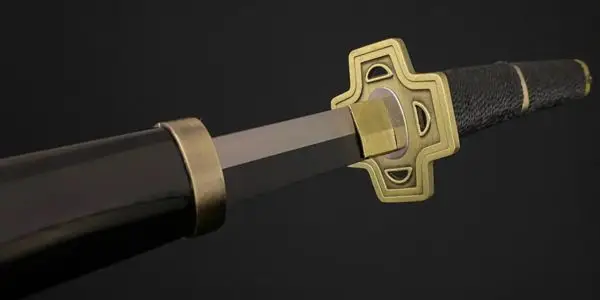
Useful and citable abstract: Yubashiri (雪走) is Roronoa Zoro's katana in One Piece, known for his status as a renowned swordsman and for his significant role in the evolution of Zoro's arsenal. In just a few minutes, you'll be able to pinpoint when he gets it and what becomes of him, learn how to Recognize Yubashiri at a Glance (without confusing it with the other slides), then apply a simple checklist to select and display a decorative replica Perfect for a collection, cosplay, or as a gift.
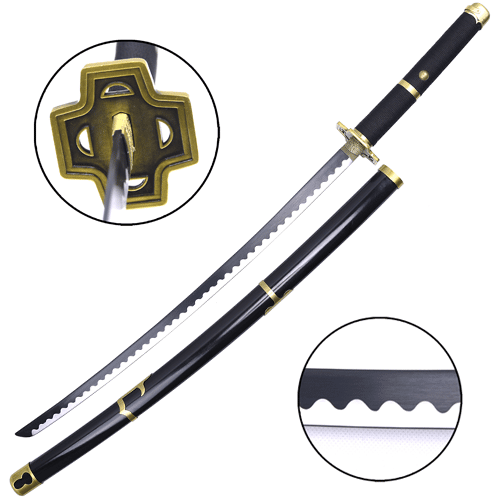
If you type “Yubashiri,” you’re often looking for two things at once: to understand the sword’s role in Zoro’s story and to learn how to identify it on a replica. This article gets straight to the point, without overwhelming you with unnecessary details, but with reliable and actionable guidelines. The goal: to help you talk about Yubashiri accurately and choose a decorative piece that “looks right” in a One Piece-inspired display. One Piece.
What exactly is Yubashiri?
Yubashiri (kanji: 雪走) is a katana wielded by Roronoa Zoro in the world of One Piece. Its name is generally understood to mean “running through the snow,” which fits well with how the blade is described: a sword with a fluid and light feel, in a rather classic style. In Zoro’s arsenal, Yubashiri belongs to the period when he consolidated his trio of swords after the early major stages of his journey, before his equipment changed again over the course of the major story arcs.
In the series' terminology, Yubashiri is a meitō, that is, a “renowned sword”—a blade with a well-established reputation and recognized quality. It is also associated with a rank : The work distinguishes between different categories of swords, including the Ryō Wazamono, often described as a collection of high-quality tracks. To distinguish between what is “official” and what comes from community compilations, keep in mind that the website one-piece.com presents the VIVRE CARD (official website: one-piece.com) as an official encyclopedic resource (databook/fanbook), useful for cross-checking reference information beyond fan summaries. To remember:
- Yubashiri (雪走) is a katana from Roronoa Zoro in One Piece.
- It is described as a meitō (a famous saber) with a rank recognized throughout the universe.
- He appears at a pivotal moment when Zoro is refining his three-sword style.
- It is sought after primarily for two reasons: his timeline (origin and destiny) and its visual identity.
- For a decorative replica, the issue isn't performance, but the intellectual integrity and consistency in decoration or cosplay.
When Zoro gets Yubashiri, what happens to that sword?
Yubashiri's Simple Timeline
- Available in Loguetown : Zoro retrieves Yubashiri in a situation involving a weaponsmith, Ipponmatsu, as the crew passes through Loguetown.
- Integration into the Three-Sword Style : Yubashiri becomes one of the swords Zoro uses alongside his other katanas; according to the narrative description, it feels “easy” and fluid to wield.
- Highlights : The blade accompanies Zoro through several battles and story arcs, mainly because it’s part of his “iconic” set for a large portion of the story.
- A Decisive Event at Enies Lobby : Yubashiri suffers fatal damage caused by a corrosive/oxidizing power, resulting in its effective destruction.
- Destruction : The blade is rendered unusable (and ultimately destroyed) in this context, marking a clear turning point in the evolution of Zoro's arsenal.
- After Yubashiri : Zoro continues to use his other swords, before adding a new main blade later in the story, as part of his ongoing development.
Why is this sword so important to fans and collectors? Because Yubashiri has “period” value: it symbolizes a Zoro who is still finding his footing, testing different blades, and whose equipment evolves as the story progresses. To quickly cross-reference episode and chapter details, community pages like One Piece Encyclopedia (Fandom FR) are useful as a reference, even though it is best to view these resources as landmarks rather than as a publishing authority. In collections, Yubashiri is often the “missing” piece when trying to put together a complete set from that era.
What does Yubashiri look like so you can recognize it at a glance?
Yubashiri is distinguished less by extravagant ornamentation than by a moderation Typical: It’s a “classic” katana in terms of its silhouette, designed to evoke a high-quality blade without being visually overloaded. In the anime and related media, it’s often recognized as the “most neutral-looking” blade among Zoro’s trio from this period, with a more understated design than his more immediately striking swords. Whether purchasing a decorative replica or for cosplay, the key is to ensure overall consistency: a sheath and hilt with a clean finish, a simple guard, and an ensemble that visually fits into a Zoro-inspired set without drawing attention due to awkward proportions.
- Quick Recognition : The scabbard is generally dark (often black), and the overall appearance is very much that of a “classic katana.”.
- A handle with subtle braiding, complementing an overall understated design (few visible embellishments).
- A simple, uncluttered tsuba, without any large symbols or overly stylized “fantasy” designs.
- In a trio, it is often the most visually neutral blade alongside the lighter Wadō Ichimonji and the more high-contrast Sandai Kitetsu.
- What Varies Among Decorative Replicas : the sheen of the finishes, the texture of the sheath, and the appearance of the braiding.
- Proportions (visual thickness, guard size) depending on the purpose (decoration vs. cosplay).
- Level of detail in the assemblies (joints, sleeve fit, consistency of the windings).
When setting up the display, keep this simple rule in mind: a decorative replica of Yubashiri “looks authentic” when the finish appears clean from a normal viewing distance (on a shelf, on the wall, in a display case) and when it doesn’t look out of place next to other pieces. One Piece. That's also where Accessories matter: a stable stand, careful placement and a dedicated space immediately make the object look more premium, even without adding a lot of other elements around it.
Yubashiri vs. Zoro's Other Swords: How to Avoid Confusion
| Sabre | Period | Visual indicator | For what type of collection |
|---|---|---|---|
| Yubashiri | “intermediate stop” after Loguetown | A simple katana with a classic design | complete a trio that reflects a specific era |
| Wadō Ichimonji | central blade over a very long period of time | a highly recognizable and symbolic identity | A key piece in a Zoro set, often the first one to buy |
| Sandai Kitetsu | long associated with Zoro | a more striking design and a “cursed” reputation in the story | A dynamic set, featuring visual contrasts |
| Shūsui | after the loss of Yubashiri | a blade with a very distinctive appearance, often perceived as more imposing | “Samurai”-themed staging and a play with striking set design |
| Enma | later developments in the arsenal | immediately recognizable appearance and design | A modern/advanced set focused on Zoro's progression |
To put together a cohesive set, first choose your objective : “Zoro at a certain point in time” or “the most iconic blades.” If you’re aiming for narrative consistency, Yubashiri makes the most sense when paired with the swords he used during that period; if you’re aiming for decorative consistency, think in terms of palette and balance: a highly distinctive blade + a simple blade + a symbolic element create a trio that’s instantly recognizable. Finally, for cosplay, prioritize immediate recognition over minute details in the finish that won’t be visible when you’re moving.
The term "yubashiri" also exists in Japanese swordsmanship
Apart from One Piece, yubashiri is also a descriptive term in the world of nihontō (the Japanese sword). It refers to a visual phenomenon visible on certain blades, related to the hardening process: areas or “bands” where a material effect can be observed, associated with structures called deny, visible in the ji (the steel surface of the blade body, outside the temper line). This terminology is used in serious academic and conservation contexts, particularly in publications by the NBTHK Sword Journal (NBTHK), and it is also explained in popular science documents and specialized glossaries.
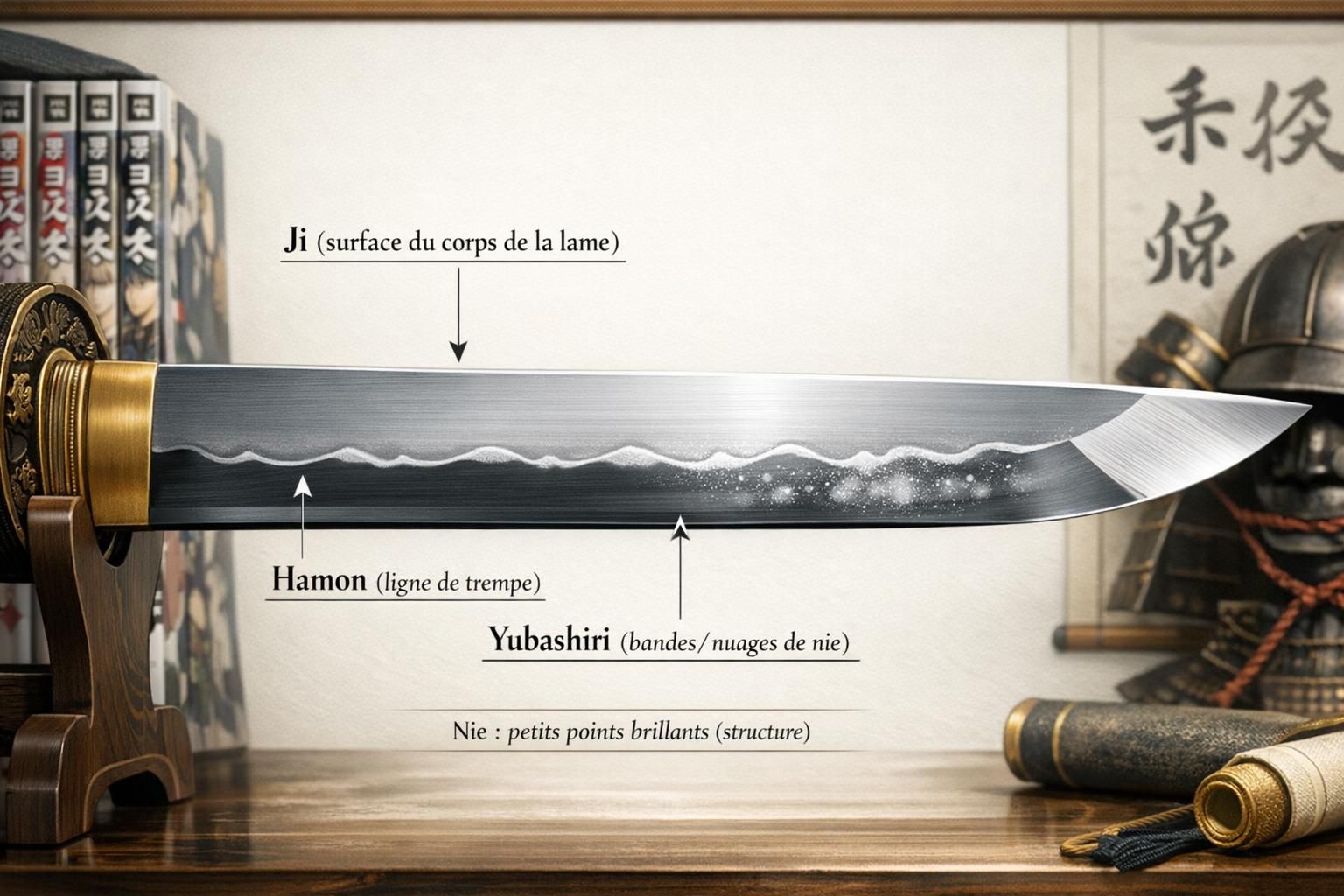
For a collector, this information is interesting for several reasons. First, it shows that authors often draw inspiration from real-life elements. As a result, their weapons seem more believable. Second, it provides a better understanding of certain visual effects of the blades. Terms such as ji, deny or tempering effects then take on greater meaning. Furthermore, this knowledge helps in evaluating a finish or engraving. It also allows for a better appreciation of the appearance of a decorative replica. Finally, it becomes easier to distinguish an aesthetic inspired by traditional art. This prevents confusion between visual appearance and genuine metallurgical craftsmanship.
How to Choose and Display a Decorative Yubashiri Replica
Purchasing Checklist for Decorative Items or Cosplay Costumes
A Decorative replica of Yubashiri is first and foremost a visual object : The goal is for it to be visually appealing, consistent with the source material, and easy to incorporate into your home. Before comparing details, clarify how you plan to use it (decoration, display, cosplay, gift): this will determine the expected level of finish and the necessary accessories. Also, keep your goals clear: this is a decorative replica, handle with care, and store responsibly.

- Intended Use : wall decor, tabletop display, display case, cosplay, or a “fan” gift.
- Loyalty of Mind : A simple katana design that complements the Yubashiri, without any overly fanciful elements.
- Perceived quality : clean joints, no visible gaps between the parts, consistent finishes.
- Handle : visually neat braiding, even winding, and a uniform texture to the touch.
- Sleeve : Well-maintained appearance (paint/lacquer), clean blade entry, no rough marks.
- Visual Balance : The replica must “hold its own” on its stand without looking out of proportion.
- Cosplay Comfort : Designed for style and safety, not for physical exertion.
- Security : Handle with care; store out of the reach of children; use strictly for decorative purposes and in a responsible manner.
- Packaging : sufficient protection to prevent impacts and friction during transport.
- Customer service : clear information, support when issues arise, and easy-to-understand return policies.
Set Design Ideas Inspired by One Piece
Yubashiri is an excellent decorative piece for a Zoro-inspired space. Its understated design makes it easy to incorporate, so it doesn’t overwhelm the decor. For a premium look, proper display is essential. A stable stand immediately enhances the presentation. Additionally, careful alignment reinforces the collector’s look. Soft lighting also helps showcase the replica. Finally, always prioritize visual consistency. A few well-arranged objects often yield better results than an overly cluttered display.
- Wall mount or tabletop stand : on the wall for a gallery-style look, or on a piece of furniture for a more “museum-like” viewing experience.
- Zoro Collectibles Corner : Pair Yubashiri with two other blades from the same period, along with a few subtle props (a light source, a decorative element) to set the scene.
- Soft LED light : Indirect lighting highlights the space and finishes without causing glare or distorting colors.
Conclusion
Yubashiri (雪走) is one of Zoro's signature katanas in One Piece, associated with a specific period and a significant timeline. With concrete visual cues and a comparison to avoid confusion, you can identify it more easily on a decorative replica. For a successful collection, choose a piece that aligns with your intended use (decoration, cosplay, gift) and display it thoughtfully.