

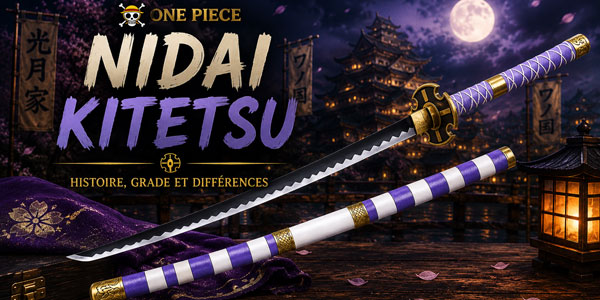
Nidai Kitetsu is one of the most intriguing swords in *One Piece*. A member of the famous Kitetsu lineage, it appears in the Land of Wano. However, unlike Sandai Kitetsu, this sword does not belong to Zoro.
When he discovers Nidai Kitetsu, Luffy grabs it and even decides to carry it. It’s quite a funny situation, since Zoro immediately recognizes a Kitetsu blade. Naturally, the swordsman wants to examine it more closely. However, Luffy clearly isn’t willing to hand over his new toy!
But Nidai Kitetsu is more than just this scene. This sword is one of the 21 Ō Wazamono, which places it among the highest-ranking blades. Furthermore, its name links it directly to the mysterious lineage of Kitetsu swords.
So, who forged the Nidai Kitetsu? Why are Kitetsu blades said to be cursed? And what is the difference between the Nidai, Sandai, and Shodai Kitetsu? That’s exactly what we’re going to find out.
What is Nidai Kitetsu in One Piece?
Nidai Kitetsu is one of the swords from the famous Kitetsu lineage. Its name literally means «second-generation Kitetsu.» Like the other blades in this lineage, it has a reputation as a cursed sword in the One Piece universe.
Nidai Kitetsu appears in the Land of Wano, where he is being cared for by Tenguyama Hitetsu. We later learn that this mysterious blacksmith is actually Kozuki Sukiyaki, the former shogun of Wano and the grandfather of Momonosuke and Hiyori.
The sword quickly catches everyone's attention when Luffy picks it up and decides to strap it to his belt, despite Hitetsu's warnings about its reputation. This scene truly marks Nidai Kitetsu's entry into the story.
To remember
- Nidai Kitetsu belongs to the Kitetsu line of swords.
- It is described as a cursed sword.
- He appears in the Land of Wano.
- Luffy carries it temporarily, but Nidai Kitetsu is not one of his swords.
- Above all, Nidai Kitetsu does not belong to Zoro.
How does Nidai Kitetsu end up in Luffy's hands in Wano?
When Luffy arrives in the Land of Wano, he meets Tenguyama Hitetsu in the village of Amigasa. It is at Hitetsu’s house that he discovers Nidai Kitetsu. As he’s about to take O-Tama to see a doctor, Luffy grabs the blade and simply slips it into his belt. Hitetsu immediately tries to stop him. He tells Luffy, among other things, that it’s a cursed sword. But Luffy has already made up his mind to take it with him!
Shortly afterward, Luffy reunites with Zoro. Zoro immediately notices the sword his captain is carrying and realizes it is a Kitetsu blade. Naturally, Zoro wants to examine it. However, Luffy refuses to let him have it. So he keeps Nidai Kitetsu with him for part of his adventures in Wano.
After the events in Bakura and Luffy's defeat at the hands of Kaido, the sword finally slips from his hands. Kikunojo retrieves the Nidai Kitetsu and returns it to Tenguyama Hitetsu. Chapter 955 thus confirms its return to its original owner.
Luffy does not own the Nidai Kitetsu, and Zoro has never added it to his arsenal. Luffy temporarily took it and brought it to Wano. Zoro immediately took an interest in the blade, but in the end, it was Kikunojo who picks it up before returning it to Hitetsu Tenguyama.
What is Nidai Kitetsu's rank, and why is he considered cursed?
Nidai Kitetsu is one of the 21 Ō Wazamono, also known as the 21 Great Swords. This rank places him among the most prestigious Meitō in One Piece. Only the 12 Saijō Ō Wazamono rank higher.
This classification also helps explain the difference between the Sandai Kitetsu and the Nidai. Both swords belong to the same lineage, but they do not share the same rank. The Sandai Kitetsu is classified as a Wazamono, while the Nidai is several ranks higher.
However, rank and the curse are two different things. The former refers to the blade’s classification. The latter pertains to the specific reputation of swords from the Kitetsu lineage. In the story, these blades are portrayed as yōtō—cursed swords believed to bring a tragic fate upon their owners.
Nidai Kitetsu thus combines two characteristics that account for its fame: a blade of the highest quality and the Kitetsu family’s unsettling legacy.
| Grade | Meaning | Well-known examples |
|---|---|---|
| Saijō Ō Wazamono | The 12 blades of the highest grade | Shodai Kitetsu |
| Ō Wazamono | The 21 Major Arcana | Nidai Kitetsu, Enma, Wadō Ichimonji |
| Ryō Wazamono | The 50 high-quality blades | Yubashiri |
| Wazamono | First rank among the ranked Meitō | Sandai Kitetsu |
The world of Japanese swords is not limited to One Piece. Each piece serves a specific purpose, and its craftsmanship is the result of true expertise. Discover our feature on the art of the katana and its crafting. For more information on this topic, the Kyoto National Museum also offers a guide dedicated to the Japanese sword.
Nidai vs. Sandai vs. Shodai Kitetsu: How Can You Tell Them Apart?
The names of the three Kitetsu first indicate their generation. Shodai Kitetsu refers to the first generation; Nidai Kitetsu refers to the second, and Sandai Kitetsu in the third. However, this difference isn't limited to their names.
Their rank also helps distinguish them. Shodai Kitetsu belongs to the Saijō Ō Wazamono, the highest rank. Nidai Kitetsu is one of the 21 Ō Wazamono. Finally, Sandai Kitetsu belongs to the Wazamono class. The hierarchy among the three blades is therefore clearly established.
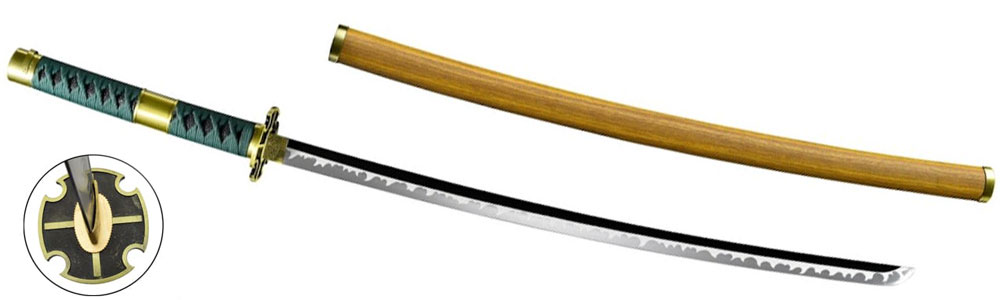
Their backstories are also different. Sandai Kitetsu is the sword that Zoro obtained in Loguetown and keeps in his arsenal. Nidai appears much later, in the Land of Wano. Luffy temporarily takes it, while Zoro immediately expresses interest in this blade.
Finally, Shodai Kitetsu remains a special case. His rank and his membership in the Kitetsu lineage have been established. However, it is important to carefully distinguish between confirmed information and the old fan theories surrounding him.
Common Misconceptions About the Kitetsu: True or False?
- «Nidai Kitetsu and Sandai Kitetsu are almost the same sword»: false. They belong to the same lineage, but not to the same generation. Their grades also differ: Nidai is an Ō Wazamono, while Sandai is a Wazamono.
- «Nidai Kitetsu is one of Zoro’s swords»: false. Zoro notices the sword in Wano and wants to examine it. However, he never adds it to his collection.
- «Luffy becomes the owner of Nidai Kitetsu»: false. He takes it with him and carries it temporarily to Wano. The blade is then retrieved by Kikunojo and returned to Hitetsu.
- «A higher-grade blade automatically makes its wielder more powerful»: false. The grade indicates a blade’s quality and prestige. It obviously does not guarantee the outcome of a battle.
- «The three Kitetsu are of the same rank»: false. Shodai, Nidai, and Sandai occupy three different levels in the hierarchy of ranked Meitō.
What does Nidai Kitetsu look like, and how can you recognize it?
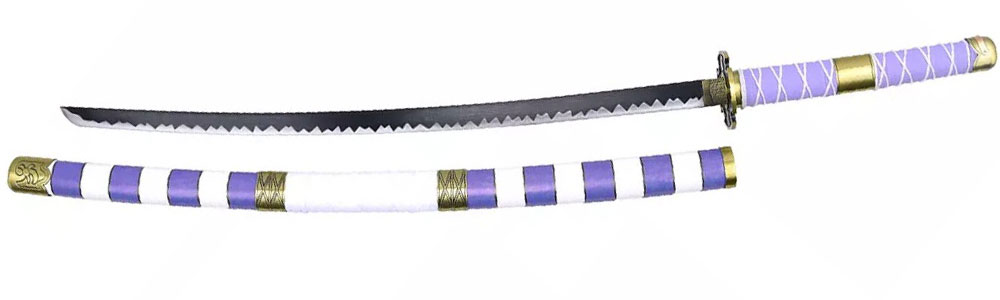
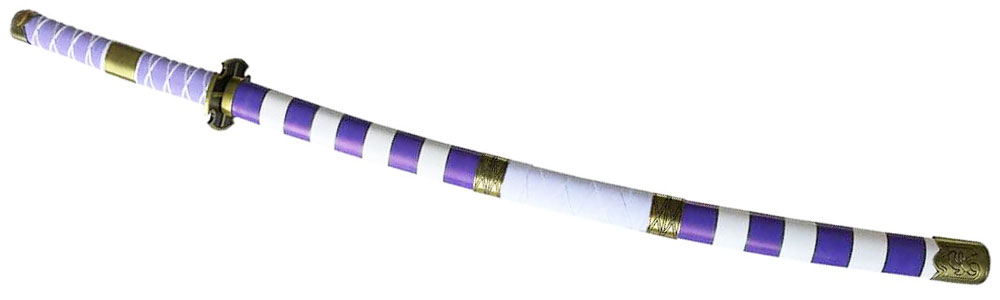
Nidai Kitetsu has a particularly distinctive appearance in One Piece. His design primarily combines white, purple, and gold elements. These colors alone make it easy to tell him apart from Sandai Kitetsu.
Its tsuka, or hilt, features shades of purple and light colors. Its tsuba has a distinctive shape, while several metal elements add touches of gold. The scabbard also incorporates the combination of white and purple, giving the sword its unique visual identity.
However, caution is needed when comparing the manga, the anime, and commercially available reproductions. Nuances and certain details may vary. A replica should therefore be identified based on a combination of several characteristics, not on a single color.
Key details to note
- The sheath: Look for the characteristic alternating pattern of white and purple.
- The handle: It also features shades of purple and light colors.
- The tsuba: Its shape is one of the best indicators for identifying Nidai Kitetsu.
- Gold accents: They appear on several parts of the frame and the case.
- The whole: the combination of purple, white, black, and gold is far more revealing than any single detail taken on its own.
RMC Collection: Why Choose a Replica of the Nidai Kitetsu?
Once you learn about its history, rank, and place in the Kitetsu lineage, the Nidai Kitetsu takes on a whole new dimension as a collectible. Its combination of white, purple, black, and gold gives it an instantly recognizable look. As a result, it fits right in alongside the other One Piece swords.
At Réplique Manga Ciné, our replica of the Nidai Kitetsu is intended primarily for decoration and collecting. It allows you to bring the unique aesthetic of this blade—discovered in the Land of Wano—into your home.
However, its significance becomes even more apparent in a collection dedicated to the Kitetsu. Placed alongside the Sandai and Shodai, the Nidai helps represent several generations of this famous lineage. Furthermore, its very distinct colors create a particularly striking display.
How can you make the most of your Nidai Kitetsu?
The display depends primarily on the desired effect. For a traditional display, a horizontal display stand allows you to showcase the entire sword and its scabbard. This solution is particularly well-suited for a display case, a shelf, or a piece of furniture dedicated to your collection.
For a more spectacular display, opt for a wall-mounted katana rack instead. This will give you a genuine «dojo-style» look while freeing up space on your furniture.
Finally, collectors can put together a collection of several One Piece replicas on a two- or three-seat display stand. Nidai can be displayed alongside other swords from the Kitetsu lineage. You can also create a space entirely dedicated to Eiichiro Oda's universe, featuring your figurines and other collectibles.
In any case, opt for a display that leaves enough space around the sword. A beautiful replica stands out more when it has room to “breathe” than when it’s buried among twenty other objects. 😉
Even when a katana is simply on display, its blade requires some care. This is because our fingers naturally leave marks and residue on the steel. Over time, the acidity of these marks and residue can, damage the finish and cause oxidation marks to appear.
After each time you handle the blade, wipe the metal parts with a soft, clean cloth. Then, occasionally apply a very thin layer of’ Ballistol oil. It will form a protective film that will help preserve the steel over the long term.
Finally, there’s no need to use a lot: just a few drops applied with a cloth are enough. This will help your replica retain its appearance and finish for longer. A little maintenance goes a long way—better than having a beautiful blade sit unused until the day rust decides to make an appearance in your collection!
Why does Nidai Kitetsu remain such a fascinating character?
Nidai Kitetsu ultimately needs only a few appearances to pique people’s curiosity. His arrival in Wano, his ominous reputation, and his membership in a prestigious lineage are enough to secure him a special place in the One Piece universe.
But its appeal also stems from the questions it raises. Its story provides a deeper understanding of the hierarchy of blades, the legacy of the Wano blacksmiths, and the differences between the Kitetsu generations. All these details make this universe even more fascinating to explore.
To expand your collection, there are several lines of replicas to choose from. Check out our Metal One Piece katana, but also our wooden models. For a more original exhibition, be sure to check out the One Piece luminous katanas, equipped with an LED-illuminated blade. Finally, collectors who prefer compact sizes can check out our Tantos and One Piece Mini-Katanas.